Washington Agriculture Is Key to Climate Solutions
By Margaret Griset, Heleene Tambet, and Georgine Yorgey, CSANR
This story is part of the 2024–2025 CSANR Biennial Report.
A new report to the Washington State Legislature highlights how the state’s farmers and ranchers can play a powerful role in tackling climate change—if they have the right support.
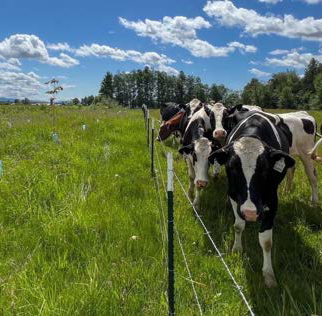
The Organic and Climate-Smart Agriculture Report, released in May 2025, was developed by WSU’s Center for Sustaining Agriculture & Natural Resources, the Washington State Conservation Commission, and KR Creative Strategies. It finds that climate-smart and organic practices, ranging from cover crops to manure management technologies, can help Washington cut greenhouse gas emissions, build resilience across the state’s diverse agricultural landscapes, and provide benefits to the public.
The report’s clearest message comes from the producers themselves: climate solutions must start with the needs of farmers and ranchers. If policies and programs don’t work for producers, they won’t work at all.
What is climate-smart agriculture?
Climate-smart agriculture (CSA) refers to practices that reduce emissions while helping farms adapt to climate change. These include practices like cover cropping, reduced tillage, precision fertilizer use, soil amendments such as compost and biochar, and technologies like anaerobic digesters.
Many CSA practices overlap with organic practices, which are often associated with a smaller climate footprint per acre. However, organic farming prohibits synthetic inputs while CSA can include synthetic fertilizers or herbicides. Both approaches can be part of the solution.
Producers’ perspectives
In addition to reviewing the scientific literature, the project team conducted interviews, listening sessions, and outreach across the state. Four consistent themes emerged from farmers, ranchers, and industry partners:
- Flexible, ongoing funding. Producers need continual financial and technical support to identify the right programs, adopt new practices, and keep the practices going.
- Research and baseline data. Research tailored to Washington’s diverse production systems, and stronger baseline tracking, is essential.
- Support for agriculture’s broader value. Keeping farmland and rangelands in production avoids emissions caused by conversion to housing or infrastructure, and protects an industry vital to the region.
- Producer-centered approaches. Climate programs must work with producers by aligning grant-based funding with agricultural calendars, involving farmers in the design process, and using familiar language.
Agriculture’s unique role in climate mitigation
According to the state greenhouse gas inventory, agriculture contributes about 7% of Washington’s emissions. Potent greenhouse gases, methane and nitrous oxide, are largely associated with three sources:
- Livestock digestion
- Soil management, including fertilizer use
- Manure storage (primarily by dairies)
But the inventory doesn’t capture the whole picture. Some aspects—fuel use by farms, emissions from fertilizer production, food waste—are accounted for under other sectors or not included in the inventory.
At the same time, agriculture can actively remove carbon from the atmosphere. Certain practices not only reduce emissions, but also improve soil water retention, reduce erosion, and result in more consistent yields for farmers while delivering benefits like cleaner air and water.
Rangelands, livestock, and dairy
Washington’s rangelands hold substantial carbon stocks, and their preservation is critical. Grazing management can deliver modest carbon gains, while preventing rangeland degradation avoids massive carbon losses.
Livestock systems, especially dairies, also offer powerful mitigation tools based on emerging technologies:
- Anaerobic digesters and methane-capturing lagoon covers
- Manure solids separation systems
- Feed additives that reduce enteric methane
These technologies face barriers of cost, scale, and infrastructure. For example, digesters are currently only viable for large dairies, and feed additives are difficult to deliver on extensive rangelands. Still, given the scale of livestock systems in Washington, they can make an important contribution to any serious climate strategy.
Supporting soil carbon sequestration and organic systems
Well-managed croplands can draw down carbon and improve soil health. The potential gains are usually modest but accumulate over time, with the greatest opportunities in high-yielding, irrigated systems. Key practices can help sequester carbon in soils:
- Intensifying production through cover cropping, double cropping, and elimination of fallow periods
- Reducing or eliminating tillage
- Planting perennial crops
- Using soil amendments like compost, manure, and crop residues
Some of these practices are central to organic farming, including cover cropping and organic amendments. Organic systems can build better soil structure, support long-term resilience, and emit less per unit area than conventional systems, primarily due to reduced use of synthetic inputs. Per-unit output emissions can be higher or lower, depending on yields.
Organic certification provides a well-established, trackable framework. Barriers to adoption, such as high certification costs and market access, can be addressed with policy support and incentive programs.
Protecting land from unintended climate tradeoffs
Land preservation is climate mitigation. When farmland is converted to housing or infrastructure, stored carbon is released and future sequestration is lost. Urban and low-density residential areas are also associated with significantly higher emissions than farmland. Policies that protect farmland and rangelands from conversion can help avoid these emissions.
Similarly, ensuring agriculture’s viability in the state is a climate solution; pushing food production elsewhere is often associated with higher overall emissions.
The role of innovation, long-term data, and carbon markets
Washington is well positioned to continue to lead in climate innovation thanks to several emerging technologies and strategies:
- Biochar made from forest waste
- Enhanced rock weathering using ground basalt
- Electrification of irrigation pumps and farm equipment
- Agrivoltaics, or solar integrated with crops or grazing
However, scientific data gaps remain, particularly in measuring emissions reductions across Washington’s varied farming and ranching systems. These gaps mean uncertainty, and therefore hesitancy, for producers.
Don’t ignore the rest of the food system
Agriculture’s climate impact doesn’t stop with agricultural practices, so effective climate action requires systems-level thinking. Fertilizer production and dietary choices, along with food waste, processing, and transportation, all contribute significantly to emissions but are often overlooked in inventories and policies. Better accounting and policy alignment could help ensure that climate efforts reflect the whole food system.
Moving forward: climate action must work for producers first
Washington’s agricultural sector is positioned to lead on climate action if policies support producers. Achieving these outcomes requires several key approaches:
- Investing in evidence-based, feasible practices
- Ensuring timely and sustained financial and technical support
- Recognizing the climate and other benefits of land stewardship and various production systems
- Valuing producers’ expertise
- Developing policies that strengthen farm viability rather than compromise it
Ultimately, the success of Washington’s climate-smart agriculture depends on ongoing collaboration among farmers, researchers, and policymakers. By supporting innovative solutions, improving local data, and maintaining flexible, farmer-centered programs, the state can lead the way in supporting resilient farming communities and low-emissions production systems.
Read the full report by visiting the Washington State Conservation Commission website.

This work is supported with funding from Washington’s Climate Commitment Act. The CCA puts cap-and-invest dollars to work reducing climate pollution, creating jobs, and improving public health. Information about the CCA is available at climate.wa.gov.