A Conversation on Enabling Community Engaged Research at WSU
October 2025 | Sonia A. Hall, Sasha McLarty, Julie Padowski, Jan Boll
PDF is provided for offline use. Some features may not be digitally accessible.
Executive Summary
On March 4, 2025, Washington State University’s (WSU) Center for Environmental Research, Education, and Outreach (CEREO) hosted the one-day summit titled “Engaged! A Conversation on Enabling Community Engaged Research at WSU.” The purpose of the Engaged! summit was to convene WSU faculty, administrators, staff, postdocs, and graduate students discuss challenges, existing University resources, and opportunities for further action to support community engaged research at WSU. Comments from two panels set the stage for this conversation: the first panel shared their experiences and challenges carrying out community engaged research. The second panel shared specific programs, initiatives, resources or approaches that are currently being deployed at WSU to foster community engaged research. Participants then collaboratively developed recommendations for actions to better foster community engaged research at WSU. This report synthesizes and organizes these findings to benefit the larger, University-wide conversation that is occurring through multiple venues.
As described by WSU’s Office of Research, “community engaged research is defined by a set of practices, values, and objectives that center respectful, responsible, and reciprocal research relationships.” Importantly, community engaged research requires some degree of involvement in the co-production of knowledge with community partners. Through the course of the day, it became clear that community engaged research at WSU occurs across many units, is diverse in the relationships we cultivate, and has significant benefits for the partners we work with. The summit was attended by 40 faculty, administrators, staff, postdocs and graduate students, representing 22 units, including 10 centers or offices. Engaged! panelists sharing examples of partnerships they have with agencies and task forces, utilities, collaborative groups, sovereign Tribal Nations, the State Legislature, farmers, rural adolescents, and local county partners.
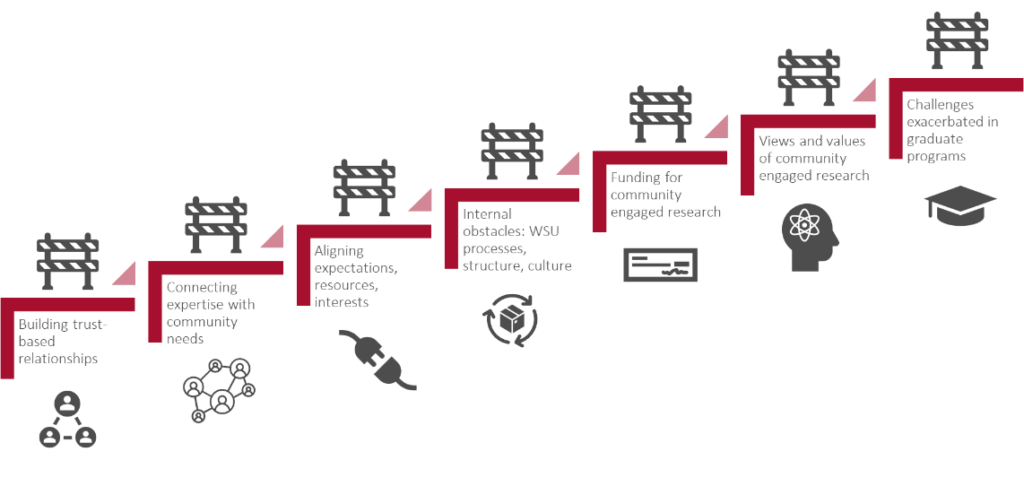
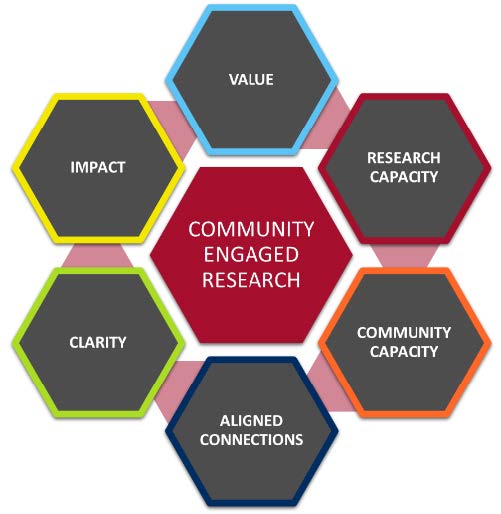
However, such work also faces substantial barriers within an academic system. The challenges specific to community engaged research at WSU ranged from the basic need to have the time and resources to develop trust-based relationships and understand community needs, to how challenges are exacerbated when graduate students carry out community engaged research as part of their programs (Figure ES1). Considering these challenges, participants developed actionable recommendations on how WSU could better foster and support community engaged research. Six key elements emerged that, together, enable such research (Figure ES2).
Impact and Value
Identify research that could lead to meaningful societal impacts and document and quantify those impacts. Improve the visibility and support for community engaged research as a tenet of advancing our land grant mission, including from researchers who do not themselves carry it out, yet understand its contribution.
Recommendations for enhancing the impact of community engaged research at WSU and how it is valued by all included calls to articulate, quantify, document, and enhance the visibility of the benefits and the impact past and ongoing community engaged research has had on society. Participants recommended WSU establish a Provost-level position with the responsibility to elevate community engaged research as a priority at WSU, including coordinating with and leveraging the strengths of relevant units, such as the Center for Civic Engagement, other relevant Centers, and, particularly, WSU Extension.
Research Capacity
Provide and institutionalize development opportunities for researchers interested in (1) investing time, (2) pursuing funding, (3) learning methodologies and skillsets and (4) building trusted relationships to enable them to carry out effective and impactful community engaged research.
Many participants discussed the desire to strengthen community engaged research capacity at WSU through university-wide training opportunities to build skills and learn approaches that support community engaged research, and service and consulting options to help faculty effectively conduct such research. Ideas proposed include creating and funding Extension Assistantships (analogous to Teaching and Research Assistantships), offering support services to hone or identify appropriate methodologies or skillsets for doing different types of community engaged research, and providing programs that give junior researchers opportunities to “shadow” upper-level community engaged researchers. Participants also suggested that WSU consider mechanisms that could better support faculty, staff, and students who are building relationships with communities, including supporting researchers investing time and funding to maintain relationships with “alumni” communities.
Other recommendations focused on maintaining and updating a repository of what work has or is being conducted with community partners to avoid partner fatigue and improve coordination across the research domain, identifying better ways for faculty to tap into existing networks, and creating clearer pathways by which communities can reach researchers at WSU with their needs. In addition, many participants said they would greatly appreciate help in securing funding, particularly from foundations and private donors, who are considered more likely to value engagement and community impact, but fall outside of the typical “grant writing” focused on federal and state sources. Participants explicitly spoke about the need to improve visibility and awareness of community engaged research to increase research capacity.
Community Capacity
Invest in building potential community partners’ capacity to engage in research.
Participants also discussed the need to support communities’ capacity to engage. Suggestions ranged from placing more emphasis on researchers valuing local expertise, helping communities come to the table and building from their strengths, to actively pursuing funding for community partners to engage. Discussions also recognized the need for commitment to ongoing engagement with “alumni” communities once projects are complete, as well as the opportunities to leverage undergraduate students’ community engagement as training towards becoming future community partners themselves. They also called for providing processes and capacity to engage with (geographically local) communities in ways that allow for scaling up solutions to significant challenges, which could enhance impact.
Aligned Connections
Expand ongoing and evolving spaces and mechanisms through which researchers’ interests and capacity can connect and align with communities’ needs and capacity, to enable impactful community engaged research.
Participants developed the most recommendations for this key element, emphasizing the role that WSU could play in fostering aligned connections with communities. With such a diversity of research occurring across the system, there is value to having some centralization at the University level to ensure partnerships are well-matched, well-managed, and considerate of partner needs. Recommendations included calls to identify successful community engagement mechanisms (such as those led by the Ruckelshaus Center), and to leverage existing University-community networks to learn from and connect through, such as restructuring Extension to serve a University-wide role, and/or providing meaningful incentives and support for Extension faculty and staff to connect their community engagement efforts to a broader network of researchers across WSU.
Other proposals centered on identifying mechanisms to help faculty and staff more easily learn about and connect with community needs. Examples included organizing an annual “Partner Fair” where Extension faculty and staff can connect with researchers and students around the community needs they have assessed; creating a University-wide platform for match-making, similar to the Center for Civic Engagement’s Givepulse, through which community engaged researchers could find out about community or societal needs; and supporting faculty, staff, and students’ participation in community activities and events without any “agenda.” Other ideas focused on a more systematic approach, such as developing and implementing a process through which faculty and students interested in community engaged research could collaboratively identify and connect with potential community partners with scientific needs.
Clarity
Ensure there is a common understanding of what community engaged research is and how it is different from community engagement, service, or other related work. Further develop and normalize mechanisms to identify, document, and appropriately and equitably evaluate and reward those investing in community engaged research.
Multiple recommendations targeted the need for clarity around community engaged research, including ensuring a common understanding of what community engaged research is via symposia like Engaged!, developing a common language that resonates with researchers, and agreeing upon a rubric assessment that articulates what aspects of community engaged research are important to evaluate (as a precursor to developing metrics for quantifying impact). One proposal that would tie all these ideas together and enable progress on the other five key elements, was to develop and encourage the use of a designation for faculty and others actively carrying out community engaged research.
Conclusion
An overarching message from the Engaged! summit was that participants value ongoing efforts to foster and support community engaged research at WSU, while acknowledging that needs remain and that there are opportunities to go further (Figure ES3). Considering the challenges faced when embarking on community engaged research, the deeply held commitment to research that makes a real-world difference, the diversity of actions—top down and bottom up—that WSU is already investing in to support community engaged research, and the variety and depth of recommendations across all key elements of successful community engaged research, we offer the following two priorities that we believe can, in the near-term, best leverage and amplify WSU’s strengths for fostering community engaged research that can tackle current wicked environmental problems:
- Establish a University-wide leader or unit empowered to foster community engaged research, whose responsibility it is to connect, coordinate and leverage all existing efforts, and strategically work with relevant units (e.g. Extension, Centers, Development team) to expand and enhance their ability to serve community engaged research across the University. The need to develop diverse mechanisms to facilitate aligned connections between WSU researchers and community partners is an element that urgently needs focus and attention.
- Design a mechanism to designate community engaged researchers across the University and actively recruit and engage researchers to pursue such a designation. The clarity and visibility such a program would provide would streamline, connect, and accelerate progress across all key elements of community engaged research—especially aligning connections—as well as better serving researchers and, in addition, graduate students interested in community engaged research.
In addition to these two near-term priorities which will require action from WSU leadership, we hope that all participants in Engaged! will take these recommendations, consider them, refine them, and work out how to institutionalize and further foster community engaged research across WSU, advancing our land grant mission together. If you are interested in exploring how to work together to implement one or more of these recommendations, please contact us. Thank you to everyone who joined Engaged! and generously shared their perspectives and ideas. We look forward to continuing the conversation.
The Engaged! Summit
On March 4, 2025, Washington State University’s (WSU) Center for Environmental Research, Education, and Outreach (CEREO) hosted a one-day summit on the Pullman Campus, with support from WSU’s Office of Research, the Center for Sustaining Agriculture and Natural Resources (CSANR), the National Science Foundation (NSF)-funded Intermountain West Transformation Network, and the Rivers, Watersheds, and Communities NSF Research Traineeship Program. The purpose of the summit, titled “Engaged! A Conversation on Enabling Community Engaged Research at WSU,” was to convene WSU faculty, staff, and graduate students to discuss challenges related to community engaged research, existing University resources, initiatives, and programs that support community engaged research at WSU, and opportunities for further action. Comments from two panels set the stage for this conversation: the first panel consisted of research faculty, Extension faculty and graduate students sharing their experiences—including the challenges involved—carrying out community engaged research. The second panel consisted of administrators, staff and faculty sharing specific programs, initiatives, resources or approaches that are currently being deployed at WSU to foster community engaged research. The main task for all participants, following the panels, was to collaboratively identify remaining challenges and gaps in support, and develop recommendations for actions that can address them.
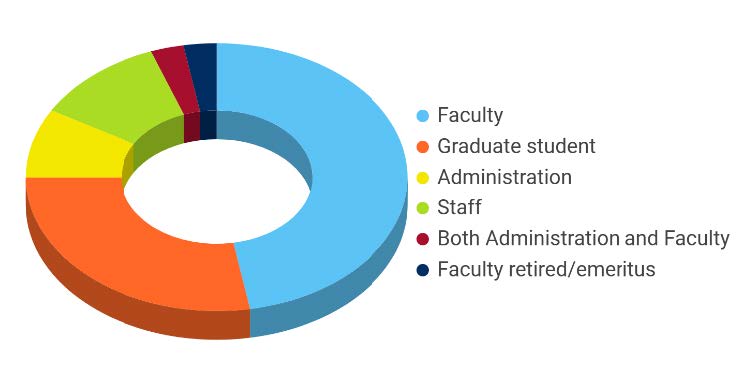
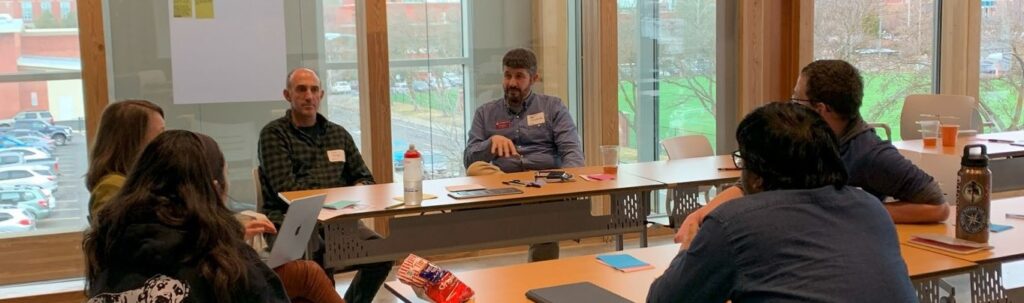
This report seeks to synthesize and organize the recommendations developed by the 20 faculty, five administrators, five staff, and 10 graduate students and postdocs that participated in Engaged! (Figure 1) representing 22 units, including 10 centers or offices (Table 1). We do not view these recommendations as comprehensive or exhaustive, but rather as the highlights that emerged from the shared experiences of these 40 interested participants, intended as contributions to the larger, University-wide conversation that is occurring across multiple venues at WSU. In the interest of keeping this report brief and focused, we draw particularly from the outcomes of the discussion sessions during the summit, including challenges faced by those interested in carrying out community engaged research at WSU, and recommendations for how WSU could better support and enable community engaged researchers in their endeavors.
| School of Biological Sciences |
| School of Design and Instruction |
| School of the Environment |
| Antrhopology |
| Biological Systems Engineering |
| Civil and Environmental Engineering |
| Crop and Soil Science |
| Human Development |
| Prevention Science |
| Office of Research Advancement and Partnerships |
| Provost’s Office |
| Center for Environmental Research, Education, and Outreach |
| Center for Tribal Research and Collaboration |
| Center for Civic Engagement |
| Center for Sustaining Agriculture and Natural Resources |
| Composites Material and Engineering Center |
| Institute Northwest Energy Futures |
| WSU Extension |
| Community and Economic Development |
| Youth and Families |
| Metro Center |
Where to Find the Rich Details
Participants reflected on the challenges faced when doing community engaged research after hearing from the two sets of panelists. Panelists are listed in Appendix A. The full list of challenges identified by participants individually is available in Appendix B; their highlights of what initiatives, programs, or approaches they thought were doing the most—or had the potential to do the most—to foster and enable community engaged research at WSU are in Appendix C; and what they felt was missing from the panelists’ presentations is captured in Appendix D. Participants also had a chance to highlight their top recommendations for further fostering community engaged research at WSU, listed in Appendix E, following afternoon breakout groups that developed the recommendations for how to address the challenges and foster community engaged research at WSU.
Our Focus: Community Engaged Research
Community engaged research is defined differently within different disciplines, and this has value in many ways. At the outset of Engaged! we presented the definition we use, with the intent of being clear rather than proposing one universal definition. Such clarity is important, as it not only articulates how we are thinking of community engaged research, but also frames how we think about community engagement and who we are including as potential communities.
As described by WSU’s Office of Research, “community engaged research is defined by a set of practices, values, and objectives that center respectful, responsible, and reciprocal research relationships.” Importantly, community engaged research requires some degree of involvement in the co-production of knowledge with community partners. This deeper level of engagement is what distinguishes community engaged research from outreach and dissemination activities to communities, such as presenting research findings to a community group in a one-directional exchange of knowledge.
Underlying this kind of research is community engagement, which the Carnegie Foundation for the Advancement of Teaching describes as “the collaboration between higher education institutions and their larger communities (local, regional/state, national, global) for the mutually beneficial exchange of knowledge and resources in a context of partnership and reciprocity” (Driscoll 2009). This definition also highlights how we think of the communities that engage in research: these may be place-based communities, but they may also have other unifying characteristics that lead to being considered a community of interest, such as broader geographic location (e.g., watershed, region), identity (e.g., gender, race, social class), group membership (e.g., political party, occupation, industry, organization), or common interest (e.g., a group of people who share a common goal, passion, or circumstance) (Freeman and Hall 2024, citing Hacker 2013). It is important to be clear about who the communities are that are engaging in research, as there is no “one community.” The breadth of possible communities was clearly conveyed by panelists, who shared examples of engaging with agencies and task forces, utilities, collaborative groups, sovereign Tribal Nations, the State Legislature, farmers, rural adolescents, and local county partners.
Challenges in Doing Community Engaged Research
Community engaged research faces a variety of challenges in addition to those faced—and overcome—when carrying out any type of academic research. The discussions at Engaged! focused on those challenges that are specific to community engaged research at WSU and ranged from the basic need to have the time and resources to build relationships and understand community needs, through characteristics of how the university is structured that can pose obstacles to effective community engaged research, to how challenges are exacerbated when graduate students carry out community engaged research as part of their programs (Figure 2).
Challenges inherent in building trust-based relationships.
Participants expressed, explicitly and implicitly, that effective community engaged research requires a foundation of trust-based relationships between researchers and their community partners. It is challenging and requires time, resources, long-term commitment and flexibility to build and maintain these kinds of relationships. In addition, the interactions that communities have had with other researchers—from WSU or not—can impact current and future relationships.
Challenges in connecting the researchers’ expertise and capacity with community needs.
The challenges articulated included how researchers find out about, and understand, communities’ needs. They also included questions about whether communities see WSU researchers as resources they can seek out when they need support in addressing their community’s needs and whether they have ways to reach those researchers when needed. Even in cases where researchers are aware of the needs and communities are aware of the researchers as resources, there may still be a disconnect between researchers’ focus on questions or hypotheses and communities’ focus on addressing needs, and by navigating the process of iteration and compromise needed to converge on shared goals.
Challenges in aligning expectations, resources, and interests between researchers and community partners.
Many of the alignment challenges discussed focused on navigating different norms, cultures, language, disciplines, epistemologies and approaches to communication. Others were more practical in nature, including understanding the type of research results that are valued and rewarded (e.g., applied, consulting type results vs publishable novel science), timing of when outputs are expected (grant cycles vs. decision-making timelines), and timing (of research results vs decisions made and action taken by community partners). Underlying these alignment challenges was the intent and need to respect community partners’ time and resources, compensate their contributions, and honor their values, all while responding to the strictures of academic expectations.
Challenges due to the internal structure, processes and culture at WSU, that can create obstacles to community engaged research: WSU internal challenges include organizational silos, such as Extension being solely within the College of Agricultural, Human, and Natural Resources Sciences (CAHNRS); University bureaucracy, such as IRB review times and delays in financial processing of honoraria and other types of compensation (e.g. daycare, meals); as well as institutional policies, timelines, competing responsibilities for faculty, and the structure of funding and projects, which can be confusing and lead to frustration on the part of community partners and researchers alike.
Challenges with funding community engaged research.
In addition to the funding challenges relevant to all research, participants identified additional challenges specific to funding community engaged research. Two dimensions of this challenge that were highlighted were (1) the minimal and continually reduced operational funding for Centers and Extension that house and support much of the community engaged research underway, and (2) funding to support relationship building and exploratory efforts or to maintain networks and connections.
Challenges still arise from how community engaged research is viewed and valued within WSU.
Though focused primarily on how community engaged research is considered in tenure and promotion processes and employee evaluation, these challenges also include how such research was perceived more broadly by all faculty and across all units. Some participants were aware of the current efforts to recognize community engaged research activities, yet the general perception was of a lack of adequate recognition and credit for community engaged research and scholarship. WSU Extension was seen as the exception. Included in this set of challenges was the valuing of non-tangible outcomes, quantifying impact in meaningful ways, and recognition of the time required to engage communities.
Challenges are exacerbated by the requirements and bounds of graduate programs.
Many of the challenges described so far are especially restrictive for graduate students interested in carrying out community engaged research. The mismatch in timing and milestones, the time and funding for engagement, and how graduate students are trusted (or not) to lead the engagement process are all challenges faced by established researchers. However, these challenges are often exacerbated when graduate students carry out community engaged research, sometimes putting at risk graduate students’ ability to carry out community engaged research as part of their program.
Other challenges.
A variety of other challenges were identified, that are hard to categorize neatly. These include challenges like research fatigue or resistance to accepting change, the difficulties in ensuring the research is not extractive, or the challenges inherent in becoming proficient in rigorous methodologies for community engaged research.
Key Elements for Fostering Community Engaged Research
An overarching message from participants at the Engaged! summit was the deeply held value and commitment to research that makes a difference in the real world. Six key elements emerged that, together, enable such research (Figure 3).
Impact: A key benefit of effective community engaged research is the potential for achieving positive changes on the issues faced by the communities the research serves. There is a need to identify research that could lead to such impacts on community issues and a need to document and quantify those impacts.
Value: Investing across the University system in enabling community engaged research starts with valuing this kind of research as integral to the University’s land grant mission. While WSU has many strengths in this area, there is still a need—and opportunities—to improve the visibility and support for community engaged research as a tenet of advancing our land grant mission, including from researchers who do not themselves carry it out, yet understand its contribution.
Research Capacity: The capacity to carry out effective community engaged research has multiple dimensions, including funding and time, methodological knowledge and skillsets, and experience in building trust-based relationships. There is a need to provide and institutionalize development opportunities across these multiple dimensions for researchers interested in building one or more of these capacities.
Community Capacity: Some communities are themselves limited in capacity and may not be able to invest in partnering in community engaged research, even when they are interested in doing so. There is a need for WSU to help build potential partners’ capacity to engage in research.
Aligned Connections: The magic of community engaged research occurs when researchers’ interests and capacity are connected and well aligned with a community’s needs and capacity. There is an urgent need for ongoing and evolving spaces and mechanisms to create and foster those aligned connections to enable impactful community engaged research.
Clarity: To address the challenges we face we must start with a shared understanding of what community engaged research is and what elements help it be successful. That shared understanding will help us effectively identify needs, document impacts, improve visibility and support, build research and community capacities, and better connect research expertise and interests with community needs to achieve impact. There is a need to build on ongoing efforts to ensure a common understanding of what community engaged research is, and to further develop and normalize mechanisms to identify, document, and appropriately and equitably evaluate and credit those investing in community engaged research.
During the Engaged! summit participants developed specific and actionable recommendations for all six elements. The panelists we convened to present on current efforts to foster community engaged research at WSU also shared efforts that target these elements as well. We believe all six elements are necessary, and that there is room and opportunities for further work to fully meet the need for support articulated under each element, even though recommendations for some were more comprehensive than for others. We hope framing the outcomes and recommendations in this light will help us collectively make progress towards WSU being a University that stands out as a national leader in how it supports and enables community engaged research.
Recommendations for Fostering Community Engaged Research
Impact and Value
Identify research that could lead to meaningful societal impacts and a need to document and quantify those impacts. Improve the visibility and support for community engaged research as a tenet of advancing our land grant mission, including from researchers who do not themselves carry it out, yet understand its contribution. Only a few specific recommendations for enhancing impact and value emerged during the Engaged! conversations; however, there were threads of these elements throughout the other recommendations.
- Articulate, quantify, and document the benefits of community engaged research and the impact past and ongoing community engaged research has had on society, both in Washington and beyond (regionally, nationally, internationally, globally).
- Enhance the visibility of community engaged research and its impacts on society. If we can elevate stories of success and impact achieved through community engaged research then more researchers might value and want to pursue this work, and community engaged research at WSU may gather further momentum.
- Establish a Provost-level position with responsibility to pursue community engaged research as a priority at WSU, including coordinating with and leveraging the strengths of relevant units (Center for Civic Engagement, Extension, other relevant Centers such as CEREO, CSANR, the Ruckelshaus Center, Center for Native American Research and Collaboration, etc.).
- Educate or train faculty and staff on collective impact, and on how their community engaged research fits into and contributes to meaningful impact on environmental (or other) problems. Clarity on how community engaged research intersects with the work and efforts of communities and other decision making entities can contribute to understanding the investments needed to achieve impact.
Research Capacity
Provide and institutionalize development opportunities across the multiple dimensions of capacity for researchers interested in (1) investing time, (2) pursuing funding, (3) learning methodologies and skillsets and (4) building trust-based relationships to enable them to carry out effective and impactful community engaged research. These are the specific recommendations for building research capacity that emerged during the Engaged! conversations.
- Offer ongoing trainings in community engaged research, as a research approach, to help ensure those doing community engaged research are immersed in this field, and that relationships are built on principles of respect, reciprocity, trust, and integrity. Such trainings should connect with the requirements to be designated as someone doing community engaged research, and the tenure and promotion guidance associated with community engaged research and scholarship (see under Clarity, below).
- Offer ongoing trainings in specific skillsets needed to carry out community engaged research, as well as supporting the development of these skills in other ways. Examples include communication and active listening, and community engaged research or participatory research methodologies. Such trainings should be accessible to graduate students, and accompanied by efforts to ensure students know about them.
- Offer support services and consulting options in key skillsets needed for community engaged research. For example, have a mechanism to obtain support from an Extension professional skilled in quantifying impact via Community Capitals, or Ripple Effect Mapping, or other specific methodology. (1)
- Enable and facilitate mechanisms for junior researchers to have the opportunity to “shadow” experienced community engaged researchers and be mentored by them in their own community engaged research endeavors.
- Support faculty, staff, and students spending time getting to know and engaging with communities. Mechanisms for doing so could include teaching buy-outs or buying summer or other time to travel and spend time with community partners. (2)
- Help graduate students enter and participate in ongoing or emerging community engaged research processes, with relationships and partnerships already in place or being built. (3) This would open opportunities for graduate students to engage effectively in a relevant time frame, be mentored in how to conduct community engaged research, and foster clear and transparent conversations on whether they can carry out effective community engaged research on their timeline.
- Create Extension Assistantships, analogous to Teaching and Research Assistantships, for students. Extension Assistantships would be led or co-led by faculty or staff in County Extension, Extension Specialists, or Center-based positions actively engaging with communities. (4)
- Develop, centralize, disseminate, and update a repository of resources on how to reach out to communities and tap into existing networks. This should include a mechanism that identifies the expertise available on campus for different skills needed to effectively carry out community engaged research, as well as mechanisms for support in quantifying impact (e.g., calculating return on investment, using Ripple Effect Mapping as a tool).
- Develop, centralize, disseminate, and update resources or mechanisms for communities to reach researchers at WSU when they have needs that could be addressed through community engaged research.
- Pursue funding from foundations expected to be more likely to identify engagement and community impact as a value, and therefore support community engaged research. Many community engaged researchers may not have experience with private fundraising, so it will be important to help them connect with Office of Foundation Relations (OFR) staff, which may require new processes or mechanisms for internal collaboration.
- Engage community engaged researchers in fundraising from philanthropical sources and private donors more broadly. The impacts and benefits to communities and society—the stories of successful community engaged research—could help garner support and funding. Again, partnering researchers with OFR staff may be critical to the success of such efforts.
- Prioritize funding for County Extension, such that Extension has the capacity to act as a boundary-spanning organization to support community engaged researchers across the University. Extension faculty and staff already build and maintain relationships with community partners and identify needs; additional funding and capacity are likely needed to allow them to then connect with relevant researchers and facilitate community engaged research.
- Improve visibility and awareness of community engaged research capacity within relevant Legislative Committees to foster opportunities for legislative proviso funding to support relevant community engaged research. The Ruckelshaus Center, the Center for Sustaining Agriculture and Natural Resources and the Metropolitan Center for Applied Research and Extension are examples of units represented at Engaged! that receive legislative provisos. Fostering additional connections with faculty and staff in those Centers—or others that have also received proviso funding—may be an effective way to enhance this funding source.
- Establish a mechanism to support researchers investing time and funding to maintain relationships with “alumni” communities—communities with whom they have completed research projects with—to continue to support their use of the resulting research, and to maintain open channels of communication to identify potential future community engaged research opportunities.
Aligned Connections
Expand ongoing and evolving spaces and mechanisms through which researchers’ interests and capacity can connect and align with communities’ needs and capacity, to enable impactful community engaged research. These are the specific recommendations for fostering aligned connections that emerged during the Engaged! conversations.
Learn from and leverage engagement mechanisms that have led to successful partnerships with communities, and leverage existing networks to connect through. The focus should be on sharing and scaling up mechanisms that have worked, likely at smaller scales or in other places. A specific example offered was the Ruckelshaus Center’s success in connecting researchers and partners in response to state provisos or requests, which could be leveraged by developing analogous mechanisms for community partners with specific research needs to connect with community engaged researchers across WSU. Another example suggested building off the strengths of Extension to enable community engaged research more broadly across WSU, without overburdening Extension faculty and staff who are already stretched thin due to declining resources and capacity at the County level.
- Help faculty and staff learn about and connect with opportunities around community needs; this would extend to faculty being able to connect graduate students to those partners. One specific idea centered on organizing a Partner Fair where Extension faculty and staff can connect with researchers and students and identify potential connections around the community needs they have assessed.
- Provide meaningful incentives and support for Extension faculty and staff to connect their community engagement efforts and their understanding of community needs to a broader network of community engaged researchers across WSU (and not just in CAHNRS, where Extension is currently housed).
- Create a University-wide platform for match-making, through which community engaged researchers could find out about community or societal needs that their community engaged research could help address and connect with potential partners. The “Thriving Earth Exchange” was provided as an example of such a platform, as well as the Center for Civic Engagement’s Givepulse.
- Support faculty, staff, and students’ participation in community activities and events without any “agenda,” research or otherwise. These interactions are opportunities to understand community needs and community collaborative processes, and connect with the people involved. Students in particular may find such participation useful. A specific mechanism suggested was a community-based “board” to post opportunities for students to participate with communities, which can also increase awareness of community events, supporting relationship-building.
- Restructure Extension so that it integrates with research units System-wide. The intent of this recommendation is to enable Extension to more broadly support the whole University in connecting research capacity to community needs (see Leveraging Extension: Considerations around an expanded vision, below). Such integration could then lead to all colleges investing in Extension positions to foster college-specific work with communities.
Leveraging Extension: Considerations around an expanded vision
The discussions during the Engaged! summit clearly highlighted the strengths that Extension has and provided a space for participants to discuss options that could help leverage those strengths to foster community engaged research across the whole University. These options focused on re-envisioning the structure of Extension within WSU. We fully recognize and acknowledge that the Engaged! participants were not convened with the goal of carrying out such a re-envisioning, and as such did not include many of the voices that should be part of such an effort; nor did they necessarily consider all of Extension’s current work, needs, expectations and capacity. We therefore share these recommendations simply for consideration in any processes specifically targeting a re-envisioning of Extension at WSU.
Recommendations that emerged during the Engaged! conversations include:
- Consider elevating the Director of Extension to the Vice Provost level. Being part of the Provost office would make more resources available to support Extension’s role in community engaged research across WSU, and make Extension faculty and staff more accessible to the whole University system.
- Consider tasking the Vice Provost level leadership of Extension with improving access to and awareness of Extension capacity and practices across WSU.
- Consider creating mechanisms and supporting Extension—via capacity, training, and guidance, as appropriate—so that faculty and staff can fulfill roles as conveners and facilitators for community engaged research (rather than—or in addition to—being resource providers) grounded in an understanding of community needs and with experience building community capacity. Focus on community-development faculty and staff in County Extension offices. Such efforts should consider emerging frameworks for best practices (Wayfinder was the option mentioned) to not only identify community research needs, but also to build community capacity to engage in research, and connect communities with community engaged researchers.
- Consider developing mechanisms for undergraduate students to work with Extension so that they can have experiences and learn approaches to engagement and community development. One aspect of this could include leveraging Extension’s presence in every county to partner collaboratively with communities in ways that engage students locally.
- Consider developing mechanisms for Extension faculty and staff to leverage their existing connections with community partners in ways that could help graduate students interested in community engaged research. For example, a graduate student (with their advising faculty) could start work on a project guided by the needs and relationships of an Extension faculty member, with the ability for another student to come in later as the first finishes or as new needs emerge.
- Consider the option of using Extension’s approach to community capacity building and extend it to working more broadly with researchers to apply those strengths to community engaged research. This could serve as a framework that WSU can deploy systematically throughout the system. This could be an alternative to revising the structure and role of Extension to fulfill this need more broadly across WSU.
At the end of Engaged!, as participants reflected on the conversations they had just participated in, some key factors were raised that should also be considered. The two most notable ones were (1) the critical importance of understanding why Extension is currently within CAHNRS, and what led to changing the structure in that direction, and (2) that only a few Extension faculty were able to participate in Engaged!, and those did not represent the full breadth of Extension’s roles, units or leadership levels. We emphasize once again that these recommendations are offered as one set of perspectives to be considered in any comprehensive effort to re-envision Extension, with a full understanding that these ideas should not drive that conversation.
- Develop and implement a systematic process through which faculty and students interested in community engaged research could collaboratively identify and connect with potential community partners with scientific needs (which could then also be available to other faculty and students). Such a process could include: (a) a gap analysis to list what challenges communities face that they do not have the relevant research to inform, (b) an evaluation or prioritization of those challenges that lend themselves to community engaged research; and, potentially (c) further guidance for future research.
Clarity
Expand ongoing and evolving spaces and mechanisms through which researchers’ interests and capacity can connect and align with communities’ needs and capacity, to enable impactful community engaged research. These are the specific recommendations for fostering aligned connections that emerged during the Engaged! conversations.
Build a common understanding of what community engaged research is via symposia like Engaged!, and host a continuing series on the topic. (7)
- Develop a common language focused on community engagement and community engaged research that resonates with researchers. This could include identifying and describing different community archetypes characterized by their engagement needs and views, to help people understand the nuances involved. (8)
- Agree upon a rubric assessment that articulates what aspects of community engaged research are important to evaluate, as a precursor to developing metrics for quantifying impact. What can or should have metrics and what cannot or should not, and may then require other approaches to evaluation? (9)
- Develop an explicit designation for faculty and staff actively carrying out community engaged research.10 These designations, accompanied by information on research interests and topical expertise, could provide points of contact for community partners interested in working with faculty.
- Encourage the use of the community engaged research designation to facilitate agreement and transparency for graduate students on expectations around community engaged research. For example, advisors designated in this fashion would likely have established relationships with partners that students can join, unless developing new community partnerships is the goal for the student. This distinction recognizes that faculty’s prior relationships allow for more direct action during the typical graduate program cycle. Such a designation would help students select advisors who would support them in community engaged research.
Conclusion
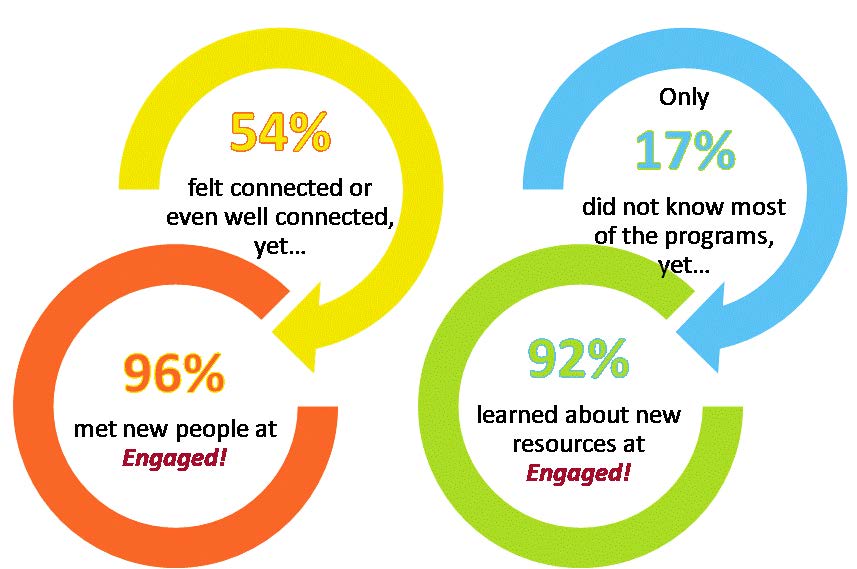
The Engaged! summit was an effort to convene people participating in diverse and possibly disconnected conversations on community engaged research occurring across WSU. This summit helps connect these threads and contribute to the ongoing dialogue around how to further enable community engaged research at WSU. An overarching message from the Engaged! summit was a reinforcement of the value of the ongoing efforts to foster and support community engaged research at WSU, combined with highlights of the need and opportunities to go further (Figure 4). Though 54% of respondents to our evaluation survey considered themselves “connected” or “well connected” to others involved in community engaged research before the summit, 96% stated they met new people, and almost half already had plans to follow up with them. Similarly, though only 17% of respondents stated they did not know most of the programs and resources discussed, only 8% considered they had not learned about new, relevant resources during the summit. The new, relevant resources they called out included many of the Centers, Extension, the ORAP seed grants, Givepulse, and the Community Engaged Scholarship Working Group’s tenure and promotion guidelines.
Considering the challenges faced when embarking on community engaged research, the deeply held commitment to research that makes a real-world difference, the diversity of actions—top down and bottom up—that WSU is already investing in to support community engaged research, and the variety and depth of recommendations across all key elements of successful community engaged research synthesized in this report, we offer the following two priorities that we believe can, in the near term, best leverage and amplify WSU’s strengths for fostering community engaged research that can tackle current wicked environmental problems:
- Establish a University-wide leader or unit empowered to foster community engaged research, whose responsibility it is to connect, coordinate and leverage all existing efforts, and strategically work with relevant units (e.g. Extension, Centers, Development team) to expand and enhance their ability to serve community engaged research across the University. The need to develop diverse mechanisms to facilitate aligned connections between WSU researchers and community partners is an element that urgently needs focus and attention.
- Design a mechanism to designate community engaged researchers across the University, and actively recruit and engage researchers to pursue such a designation. The clarity and visibility such a program would provide would streamline, connect and accelerate progress across all key elements of community engaged research—especially aligning connections—as well as better serving researchers and, in addition, graduate students interested in community engaged research.
- In addition to these two near-term priorities which will require action from WSU leadership, we hope that all participants in Engaged! will continue to innovate together, individually and collectively amplifying and leveraging the different efforts occurring across WSU to enable exceptional and valuable community engaged research. We hope you will take these recommendations, consider them, refine them, and help build a model for how to institutionalize and further foster community engaged research across WSU, so that together we can further advance our land grant mission. The CEREO co-directors are considering the role this Center can play in advancing these recommendations, and we plan to actively reach out to units across WSU that may have a role to play as well. If you are interested in exploring how to work together to implement one or more of these recommendations, please contact us:
- Sonia A. Hall, sonia.hall@wsu.edu, (509) 293-8797
- Julie Padowski, julie.padowski@wsu.edu, (509) 335-8539
- Sasha McLarty, sasha.richey@wsu.edu, (509) 335-1691
Thank you to everyone who joined Engaged! and generously shared their perspectives and ideas. We look forward to continuing the conversation.
Supporting Information
Acknowledgements


Contributors to Success
Our deep appreciation for everyone who helped in running the show and making everything go smoothly, including breakout group facilitators Teal Potter, Julie Padowski, Jan Boll, and Sasha McLarty, notetakers Mike Berger, Hannah Haemmerli, Philip Moffatt, Julianna Hallza, Hailey Smith, and Evan Leacox, and food and space coordinator extraordinaire Jacqueline McCabe. And a heartfelt thank you to everyone who came together, shared their knowledge and perspectives, contributed experiences and ideas and co-developed recommendations. The success of the summit, and our ability to use this report as a platform to move forward in enabling community engaged research at WSU, is thanks to all of you.
Funding
The Engaged! Summit was hosted on March 4, 2025 by the Center for Environmental Research, Education and Outreach (CEREO), and was possible thanks to Office of Research funding that supported Sonia Hall’s 2024-25 CEREO Fellowship, in combination with support from the Center for Sustaining Agriculture and Natural Resources (CSANR). Additional funding and support for community engaged research and related approaches was provided by the Intermountain West Transformation Network (NSF grant #2115169) and the Rivers, Watersheds and Communities National Science Foundation Research Traineeship Program (NRT) (NSF DGE 2125758).
Footnotes
- Though the examples highlighted in the discussion came from those used by Extension professionals (specifically, Community and Economic Development), Centers across WSU also practice community engaged research. Highlighting these Centers as a resource was a strong thread throughout the Engaged! discussions. Therefore, considering how to leverage Centers’ skills and strengths, in addition to Extension’s, should also be considered in this recommendation. Faculty and staff from CEREO, CSANR, Ruckelshaus Center, Center for Native American Research and Collaboration and Center for Civic Engagement participated in Engaged!
- Note that the Office of Research Advancement and Partnerships (ORAP) offers three tiers of INSPIRE! grants, ranging from $3,000 to $20,000, all directed at the pre-work involved in engaging with community partners to, together, “move the research agenda to a stage to apply for substantial external funding.”
- Note that the earlier recommendation to have a faculty designation for those doing community engaged research would also fulfill this recommendation: students who choose to work with a designated community engaged research advisor could expect to enter existing community engaged research processes.
- The recommendation that emerged from the Engaged! conversation focused specifically on the Community and Economic Development Extension Unit. However, this was derived from an idea developed at CSANR and with the Agriculture and Natural Resources Extension Unit, so we propose that it can be expanded to both other Extension units and to subject matter and other Centers.
- Note that, though not explicitly called out during the Engaged! discussions, building community partners’ funding needs into funding requests requires collaborating with those partners well before budgets are developed and proposals are submitted. It is also important that these efforts not tokenize funding for communities by writing in stipends for community members without their engagement in the budgeting process.
- Note that Drs. Boll, Padowski and McLarty have been applying the Wayfinder approach in their research.
- Note that Office of Research has hosted multiple Information Sessions related to community engaged research, though not focused on an agreed-upon definition and if and how to differentiate it from related activities. Definitions and evaluation metrics for tenure and promotion are also being developed by the Community Engaged Scholarship Working Group.
- Note that this should be designed to align with the new proposed Key Performance Indicator (KPI) for WSU: Community engagement.
- Note that this should connect with the Community Engaged Scholarship Working Group’s tenure and promotion guidance on community engaged research.
- Note that any such designation should be established in ways that provide additional credentials while avoiding excluding or implying a “demotion” of faculty and staff who are doing other kinds of research already well captured with traditional academic metrics and recognition systems.
Suggested Citation
Hall, S.A., McLarty, S., Padowski, J.C., Boll, J. 2025. Engaged! A Conversation on Enabling Community Engaged Research at WSU. Center for Environmental Research, Education and Outreach (CEREO). Washington State University.
References
- Driscoll, A., 2009. Carnegie’s new community engagement classification: Affirming higher education’s role in community. New Directions for Higher Education 2009, 5–12.
- Enfors-Kautsky, E., Järnberg, L., Quinlan, A. and Ryan, P., 2021. Wayfinder: a new generation of resilience practice. Ecology & Society, 26(2),
- Freeman, K.N, Hall, S.A. 2024. Practical Guide to Community Engagement: Approaches to Help Researchers Get Started. Center for Sustaining Agriculture and Natural Resources at Washington State University and the Intermountain West Transformation Network.
- Hacker, K., 2013. Community-Based Participatory Research. SAGE Publications, Inc.
Appendices
- Appendix A: Summit Agenda and Panelists
- Appendix B: Challenges To Effective Community Engaged Research, “Challenges” sheet.
- Appendix C: Top Programs, Initiatives and Resources at WSU, “Programs and Resources” sheet
- Appendix D: Additional Challenges and Programs and Resources, Not Covered by Panelists, “What’s Missing” sheet
- Appendix E: Top Recommendations for Fostering Community Engaged Research at WSU, “Recommendations” sheet