Manure can be a valuable source of organic matter and other nutrients for soils and crops.
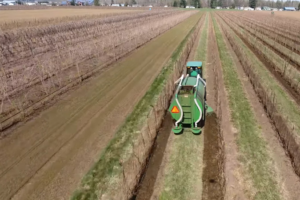
With ongoing increases in herd productivity and concentration over the last half century, the dairy industry has had to manage increasing concentrations of manure. Handling, storage and application of these manures and the associated nutrients to soils have in some areas contributed to air and water quality impairment. The distribution of these nutrients to adjacent horticultural farms, where nutrients are needed, has been limited due to costs of handling and transport, problematic nutrient balance, and food safety concerns.
This project:
- Assessed the commercialization of new nutrient-recovery technologies that aim to recover nitrogen, phosphorus, and other nutrients in a concentrated form that can be easily transported off farm.
- Utilized red raspberries and blueberries as the test crop by using manure-derived fertilizer products, facilitating movement of nutrients from “dairies to berries” to improve watershed nutrient balance, soil quality, and horticultural production.
- Tested whether these products might exacerbate food safety risks through on-farm trials.
- Quantified the willingness to pay for such products to support local watershed-level marketing of manure-derived fertilizers.
- Explored the ability of such products to meet nearby crop demands through an analysis of county-wide nutrient flows.
Products from this Project
- Video
Approaches to Nutrient Recovery from Dairy Manure: Webinar, Part 1 - Report
Dairies to Berries: Dairy-Manure Derived Fertilizers for Use in Raspberry and Blueberry Cropping Systems – Evaluation for Agronomic, Soil Health and Food Safety Efficacy - Publication
Microbial Safety of Dairy Manure Fertilizer Application in Raspberry Production - Publication
Evaluation of Pre-harvest Microbiological Safety of Blueberry Production With or Without Manure-Derived Fertilizer - Peer-Reviewed Extension Publication
Approaches to Nutrient Recovery from Dairy Manure - Video
Approaches to Nutrient Recovery from Dairy Manure: Webinar, Part 2 - Peer-Reviewed Extension Publication
Nutrient Recovery: Products from Dairy Manure to Improve Soil Fertility - Perspectives Post
Can Fertilizer Derived from Dairy Manure Be Used to Produce Raspberries with Minimal Food Safety Risk? - Publication
Demand for Bio-Based Fertilizers from Dairy Manure in Washington State: a Small-Scale Discrete Choice Experiment - Publication
Estimating and Comparing Cropland Nitrogen Need with Dairy Farm Nutrient Recovery: a Case Study in Whatcom County, WA
People
Benedict, C., Yorgey, G., Zhu, M., Kruger, C., and Hills, K.
Project Dates
2016– 2020
Area of Focus
- Value from Waste
Topics
- Crops
- Food Systems
- Soils & Fertility
- Waste Management
Collaborator
Funding Sources
- Conservation Innovation Grants Program