Each year, CSANR sponsors travel for students to attend the Tilth Conference. Find student takeaways from past conferences on the CSANR Tilth page.
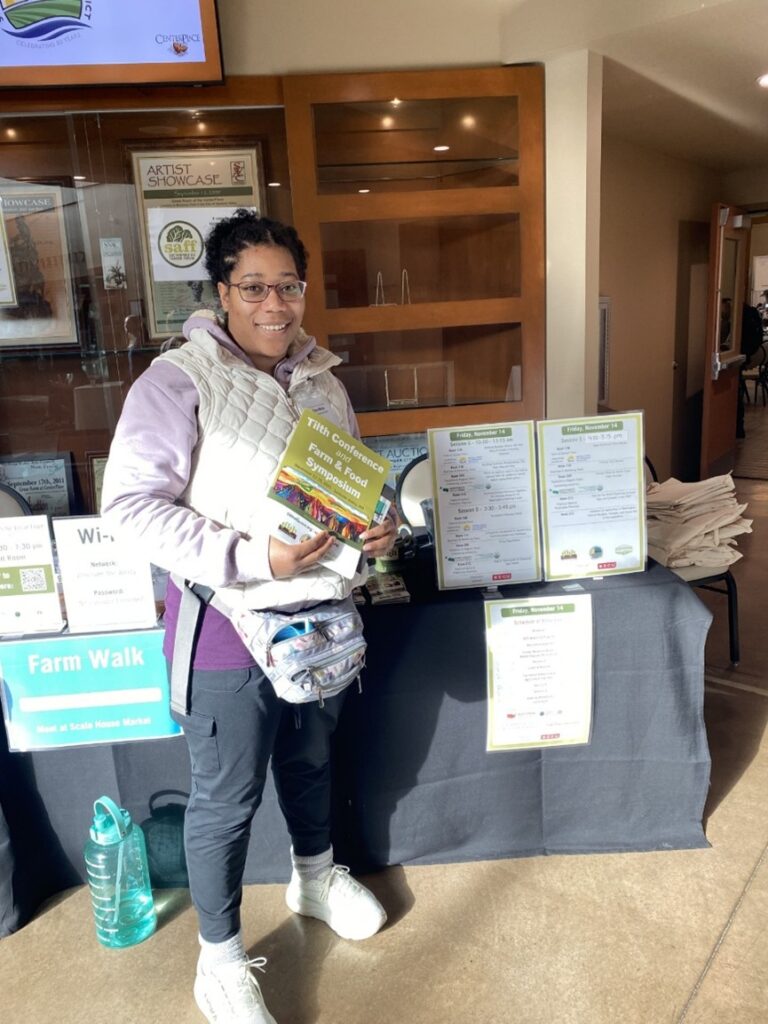
Cierra White: Looking for data in regenerative agriculture
My name is Cierra White, and I am a senior majoring in Organic and Sustainable Agriculture. Before I transferred to the Pullman campus, I lived in Seattle. My home was only 2.5 miles away from Tilth Alliance’s Rainier Beach Urban Farm and Wetlands.
When I found out that the Tilth Conference was taking place during my semester at Pullman, I knew I had to attend. I didn’t know what to expect at first, but the attendees were very welcoming.
I was able to talk with producers from Idaho and Oregon. Based on the programs and presentations, I felt that the conference was more geared toward farmers and producers than students and educators, which was reinforced by how often people asked me, “Where is your farm located?”
When it came to the presentations, it was difficult to identify which presenters most closely shared my viewpoints. I hold strong beliefs in data-supported research, as well as in the efficacy of ecological farming systems.
There were both positive and negative aspects of the Tilth Conference presentations. Most of the conference’s themes were centered on biology-based farming, biological soil practices, and human health.
The third presentation that aligned with my interests was How to Brew? Compost Teas and Extracts in the PNW by Lynne Carpenter-Boggs, Maren Freisen, Carol McFarland and Josh Riddle. A compost extractor was demonstrated during a segment of the presentation.
I was especially interested in one idea and one tool for my future research: analyzing vermicompost from various organisms and implementing compost extract on a larger scale. I thought that the presentation Compost Workshop: Building Biologically Complete Thermophilic and Vermiculture by Todd Harriton and Vivian Kaloxilos did not provide enough research and context, yet the use of compost extract and vermiculture fascinated me.
Unfortunately, there was limited information presented to challenge beliefs about organic agriculture or related practices, and few studies were referenced. Since there is limited research on ecologically based farming systems, there were more narrative examples rather than studies during some of the presentations.
The experience of attending the Tilth Conference was eye-opening; I was surprised by the limited data presented on regenerative systems. There just wasn’t enough data about ecologically based agroecosystems to provide science-based information to farmers, which makes implementing sustainable practices more difficult.
I would love to contribute to regenerative or ecologically based research in the future. And, if given the opportunity, I would also like to take more courses about composting and soil science, which was a big topic during the conference.
Eventually I want to become an organic farm inspector for the WSDA. I believe some of the concepts presented by the conference along with my courses will aid me in the future. Overall, the Tilth Conference was a good experience, and I hope to attend again next year!
Meredith Raymond: finding value in both research and practice
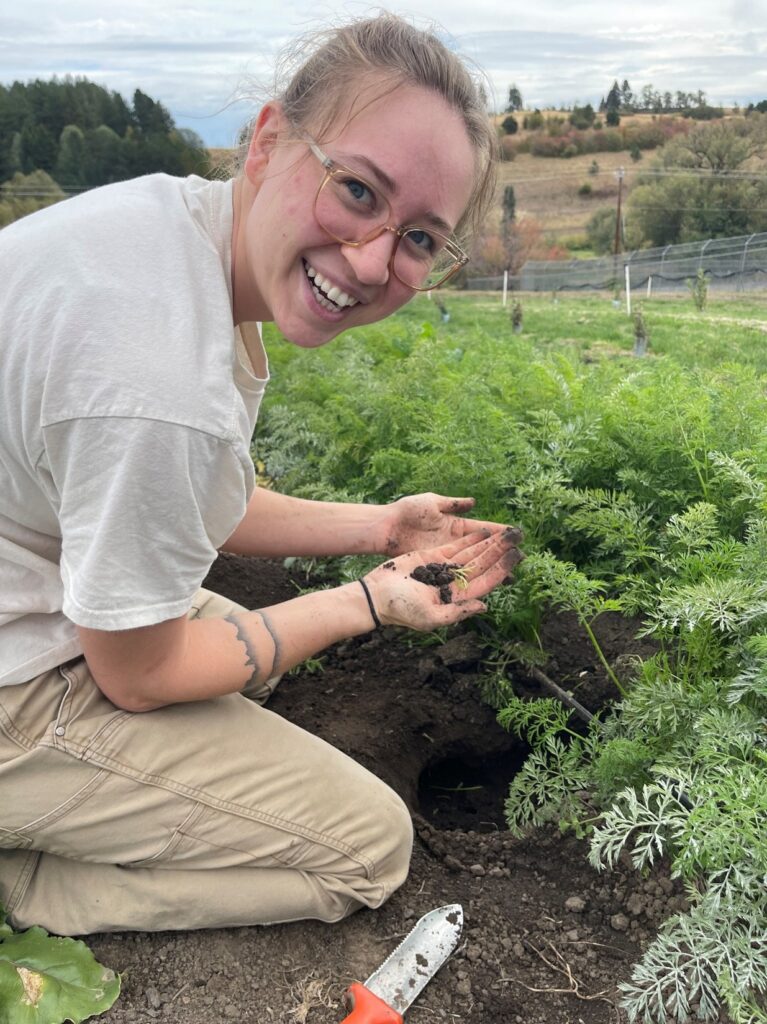
I am currently in my fourth year studying Organic and Sustainable Agriculture and Soil Science at WSU. During my time in CAHNRS, I’ve worked in field and lab research with Rachel Wieme and at the WSU Eggert Family Organic Farm with Brad Jaeckel.
What struck me almost immediately was how distinct the cultures of these two groups felt. The Tilth side felt familiar: sessions anchored in research, references to published work, and a clear thread of the scientific method running through presentations. The Spokane Conservation District side felt more story-driven and practice-focused. Neither of those is inherently better or worse, but the difference in dynamics, focus, and goals for the conference as a whole was very noticeable.
After three and a half years at WSU, I’ve been thoroughly trained to look for references, data, and clear methodology when I’m presented with new information. So, when I watched presentations by speakers brought in through the Spokane Conservation District, I noticed right away that they didn’t include citations or mention formal studies. Curious and a little skeptical, I searched for peer-reviewed publications by the three speakers, but I didn’t find anything. I found myself questioning their recommendations because they didn’t meet the academic standards I’ve been trained to rely on.
When I brought this up with a few professors and academics I respect, they shared similar concerns. They questioned the lack of references and formal research backing the recommendations being made. It was validating to hear that my critical instincts weren’t totally off base. But it wasn’t the whole story.
Talking with farmers at the conference, some of whom I already knew and deeply respected, and others who I met for the first time, added another layer. Several pushed back on the idea that a lack of citations or publications automatically equals “not credible.” They reminded me that formal research is expensive and competitive; not everyone who does thoughtful, careful work has access to grants and research staff, or has time to publish. Others pointed out that most farmers are working every hour just to keep their operations afloat.
Designing perfect experiments and writing peer-reviewed articles simply isn’t realistic for them.
I found myself caught between two mindsets. On one side was the academic training that says if there are no references, no advanced degrees, and no publications, then the information should be treated with caution. On the other side was a more empathetic perspective that recognizes the very real barriers to conducting and publishing research at an academic standard.
In that tension, I kept coming back to a message I’ve heard repeatedly from experienced farmers and agricultural professionals since I started at WSU: a college degree only takes you so far. You can’t truly understand agriculture until you’ve done the hard, dirty work yourself, navigating disasters, financial stress, broken equipment, unpredictable weather, and the mental load it all brings. That lived experience also produces knowledge, even if it never appears in a journal article.
Where I have landed is that there is genuine value in both worlds. Academic research and the scientific method are incredibly important. They provide tools to test claims, reveal patterns we can’t easily see on the ground, and help avoid repeating mistakes at scale. But farmers’ experiential knowledge, built through trial, error, and survival, is also research in its own way. Academics have a responsibility to listen to and learn from people on the front lines, and farmers can also benefit from understanding why rigorous experiments and peer review matter, even when they feel distant from day-to-day reality.
The challenges facing our food systems are enormous and constantly evolving. No single group, whether researchers, farmers, conservation districts, or policymakers, can solve them alone. The “critical thinking skills” emphasized in nearly every WSU course I’ve taken are crucial, but they need to be paired with humility and an awareness of the broader context: economics, labor, climate, culture, and more.
Although I personally tend to lean toward pessimism, I am working to actively choose hope. That means focusing on the people in agriculture who also choose hope and show up to conferences like Tilth to share knowledge, argue respectfully, and improve what they can, even when the problems feel overwhelming.
All in all, my second year at the Tilth Alliance Conference was incredibly fruitful. Beyond the reflections I’ve shared here, I had many conversations that helped clarify what I might want to do after I graduate in May, and I made a few concrete connections that could turn into post-grad opportunities. I’m deeply grateful to ASWSU for funding my attendance for a second year and for investing in students who want to be part of building more sustainable, resilient food systems. I hope that sharing my thoughts encourages the university to continue supporting students to attend in the future.
Megan Pyle: Community, participation, and sustainable agriculture
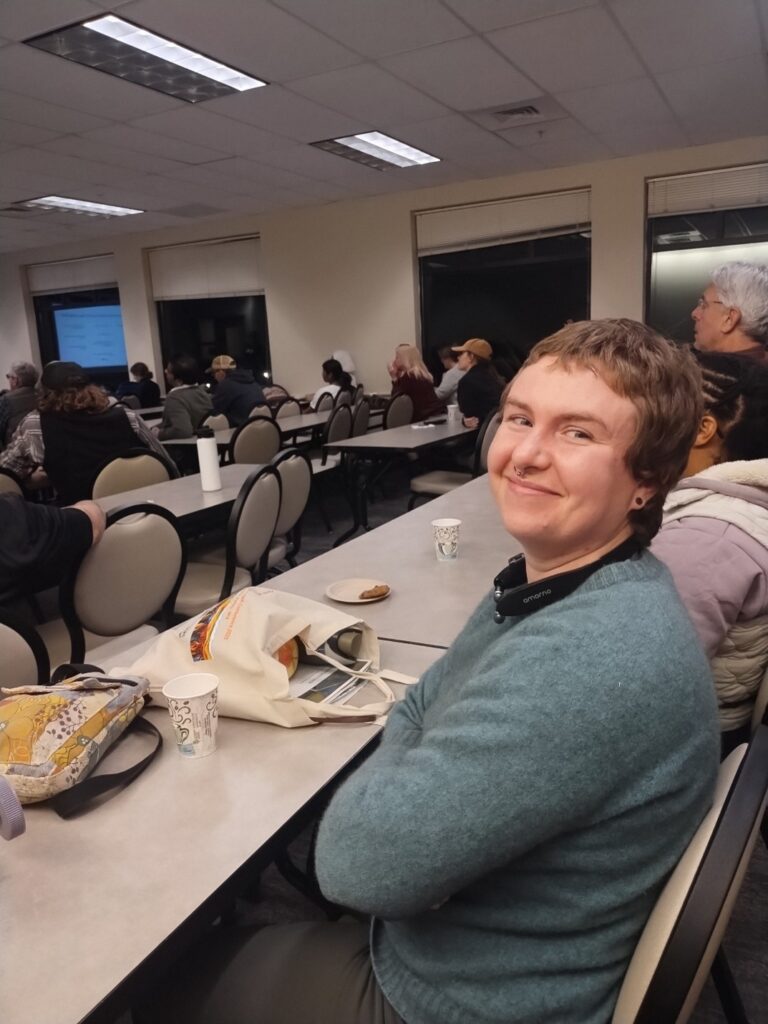
My name is Megan Pyle, and I’m in my 4th year at WSU majoring in Organic & Sustainable Agriculture and Human Nutrition & Food Systems, and minoring in Soil Science. I’m a long-time resident of Pullman but do not come from an agricultural background. I was drawn to WSU’s Organic Ag program because of a desire to contribute to sustainable agriculture, protecting the environment that sustains us while producing wholesome, nutritious food free from unnecessary pesticide residues. I attended the 50th Anniversary Tilth Conference in 2024 and am grateful for CSANR’s sponsorship to attend again in 2025.
The Tilth Conference provides a nexus of collaboration and learning among like-minded individuals who value sustainable agriculture and has a huge draw for me because it creates a sense of community that I would be hard-pressed to find elsewhere. Tilth 2024 had a profound impact on me, and I was eager to attend again. Although the conference was smaller, there were still many sessions and diverse speakers to choose from.
Perhaps the most impactful for me was the keynote from Valerie Segrest with the Native Plants and Foods Institute, “Finding Strength Through Growing Together,” during which she highlighted the importance of communal resiliency and reciprocity, like that found in an old-growth forest. It was heartening to have her set the tone, reminding us not only that we need each other, but of the strength that comes from diversity—no one thrives alone. Her talk helped to remind me that I want to follow a path that helps us reconnect with the generosity of the environment around us, and that following a path like this is possible. I was excited to hear of the Native Plants and Foods Institute for the first time, and hope that I could work with an organization with similar goals in the future. Her discussion and how it made me feel also served as a gentle reinforcement of my interest in a course on Native American Food Systems taught by Landon Charlo, which I am taking this spring.
The Town Hall session was an impactful, unique listening experience for me as constituents raised concerns and offered ideas up to Representative Kristine Reeves, Senator Shelly Short, and Senator Marcus Riccelli. Funding was a primary issue discussed during this session, including a desire for grants and loans to be made available up front to implement on-farm changes for sustainability and climate resilience because farmers often don’t have the capital for this; the possibility of developing a cost-share program for organic certification; and the erosion of Extension agent availability and support related to funding and instability. This session also included powerful stories about the impact of access to fresh, nutritious food for people who are low-income, citing that kids “clean their plates” when the food is fresh. People also expressed concern about loss of farmland to outside entities or due to zoning. One man discussed how cottage food laws differ in Wisconsin, allowing individuals to sell food directly to other individuals without regulation, without an associated increase in foodborne illness. He expressed a desire for changes to Washington’s cottage food laws to reduce regulation in this way, to increase food sovereignty, and to reduce obstacles in non-profit related food distribution. These are changes I’d be interested in seeing. It was powerful both to see farmers and others voice their concerns and ideas, and powerful to see representatives listen. I have never participated in something like this before but hope to again in the future.
The Tilth Conference is supported in part by the USDA Sustainable Agriculture Research and Education Professional Development Program.