Modeling food, energy, and water interactions to evaluate storage strategies that improve resilience in the Columbia River Basin.
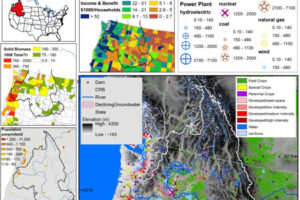
Resilient natural resource management in the western United States depends on understanding the complex interactions among food, energy, and water systems. In the Columbia River Basin, irrigated agriculture, hydropower production, and environmental flows for fish compete for limited surface water resources. This interdisciplinary project examines how technological and institutional innovations can improve resilience across these interconnected systems.
Researchers are developing a modeling framework to evaluate the food–energy–water nexus at multiple spatial and temporal scales. Using conceptual and biophysical regional models, the project explores strategies for managing water storage and allocation while considering impacts on agricultural productivity, hydropower generation, and aquatic ecosystems. The framework also incorporates stakeholder feedback to identify barriers to innovative solutions and assess potential co-benefits across sectors. By integrating technical modeling with institutional and policy considerations, the project aims to inform regional water storage strategies that support both economic activity and environmental sustainability in the Columbia River Basin.
Products from this Project
Project Dates
2017– 2019
Areas of Focus
- Climate & Environment
- Research Engagement & Communication
- Water Resources & Policy
Topics
- Climate Change
- Energy
- Food Systems
- Natural Resources
- Water Resources
Project Status
Complete