Perspectives
Practical insights and opinions from agriculture and natural resources experts—brought to you by the Center for Sustaining Agriculture and Natural Resources.
Unraveling the Brix-Insect Story
By Andrew McGuire, CSANR Senior Extension Fellow
The claim that high leaf-sap Brix protects crops from insects offers appealing certainty, but little research or basic insect biology supports it.
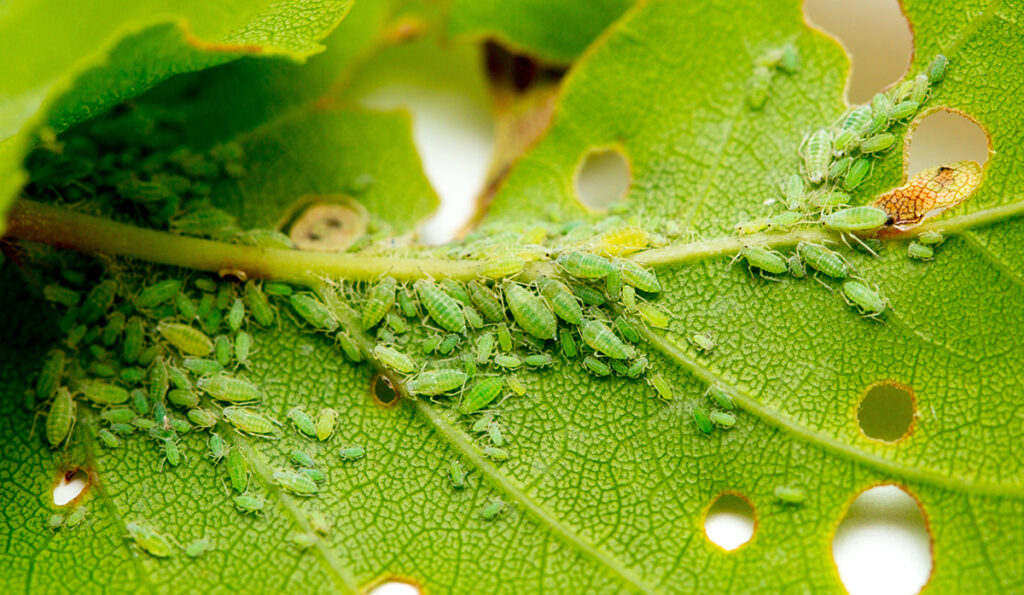
A farmer goes to a field, presses some sap out of a crop’s leaves, puts it in a refractometer and reads the sap’s soluble solids level in units called Brix. If the Brix reading is 12, or ideally 14 or higher, the farmer is relieved; the plant is healthy and will have no insect pests. But a Brix level below 12 is cause for concern. Soluble solids levels below 12 Brix show increasingly unhealthy plants, allowing an increased number of insects to attack them.
The assumptions behind this approach are:
- Insects do not attack healthy plants, and
- Soluble solids levels in leaf sap indicate plant health.
The explanation is that insects cannot tolerate or digest the sap above a certain level of soluble solids, and they can detect these healthy plants and so leave them alone. The threshold Brix level depends on the type of insect pest.
That is the theory, popular in some circles and promoted for years. I searched for research support and found none. Insect biology also contradicts it. And the claim is structured so that no result can count against it.
What Brix measures
Here are the uncontroversial parts. Refractometers can measure soluble solids in plant sap, and the measurement units are Brix, technically °Brix. I will use “Brix” to mean “soluble solids” from here on. Brix levels of plant sap mostly indicate sugars, which are the result of photosynthesis. Because it indicates sugar levels, Brix levels are used to estimate fruit and vegetable ripeness, judge consumer quality (taste), evaluate forage quality, schedule harvests, and choose varieties (Kleinhenz & Bumgarner, 2013). Brix is also used to evaluate grapes for winemaking. These examples do not use leaf sap, nor do they evaluate plant health, nor do they manage pests with the tool.
The current story
Thomas Dykstra is currently the most prominent promoter of the Brix-Pest control theory. Like those before him, he stresses how Brix levels of plant leaves (not fruit, roots, or stems) indicate plant health. His novel contribution is the threshold Brix levels for control of various insect groups: at ≥12 Brix, or better yet ≥14 because of fluctuations in Brix levels, all insects are repelled, but at lower levels some groups of insects can feed (see Figure 2) (Dykstra, 2019).
Virtually no insects will attack a plant at 12 Brix.
Dykstra (2019)
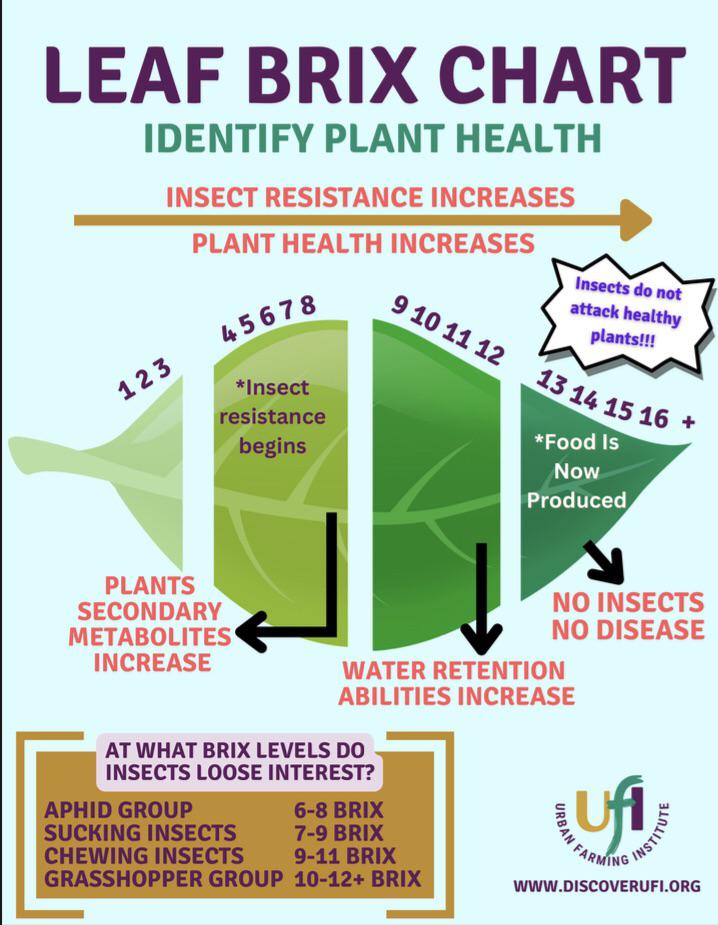
According to Dykstra, the mechanism behind this benefit of high Brix is the “simple digestive system” of insects; “They do not have the digestive enzymes to break down healthy proteins from high-Brix plants, only the broken or incomplete proteins from low-Brix plants.”
John Kempf, a regenerative ag influencer and self-professed fan of Dykstra, adds a major caveat to Dykstra’s claims (Kempf, 2020). Kempf expands the effects of high Brix to diseases, but with the limitation that “the location and time with the lowest Brix level determines the degree of insect or disease resistance for the whole crop.”
Little evidence found
Given the potential usefulness of the Brix method for controlling insect pests, you’d think there would be lots of research on the topic. There’s not. I searched, and found a report (Syrovy & Prasad, 2010) based on a similar search. They found the same few papers I did.
A two-year study in eight California vineyards found no support for the proposed Brix-leafhopper relationship as promoted by Dykstra and others (Mayse 1996). In other studies on the effects of soluble solids levels of grapes, not leaves, on the pest spotted wing drosophila, research found that higher soluble solids made things better (Little et al., 2017), or worse (Ioriatti et al., 2015; Lee et al., 2011, 2016), or made no difference (Pelton et al., 2017).
Similarly, soluble solids levels were not related to insect resistance in susceptible or resistant sugarcane varieties (Triplett, 2020) or in potatoes (Rademan et al., 2025). In potatoes, although Brix levels varied significantly over the season, neither biostimulant products nor irrigation scheduling increased leaf Brix levels.
That’s it for published evidence of the Brix-insect pest link. If you know of more, let me know.
Regarding this lack of evidence, I found an online article on the topic in which the author claims to have contacted Dykstra and asked him for published evidence. When pushed, Dykstra is reported to have said, “I am not aware of any studies that have been undertaken or funded to analyze the question of insects and Brix” (Pavlis, 2024).
Inconvenient insect biology
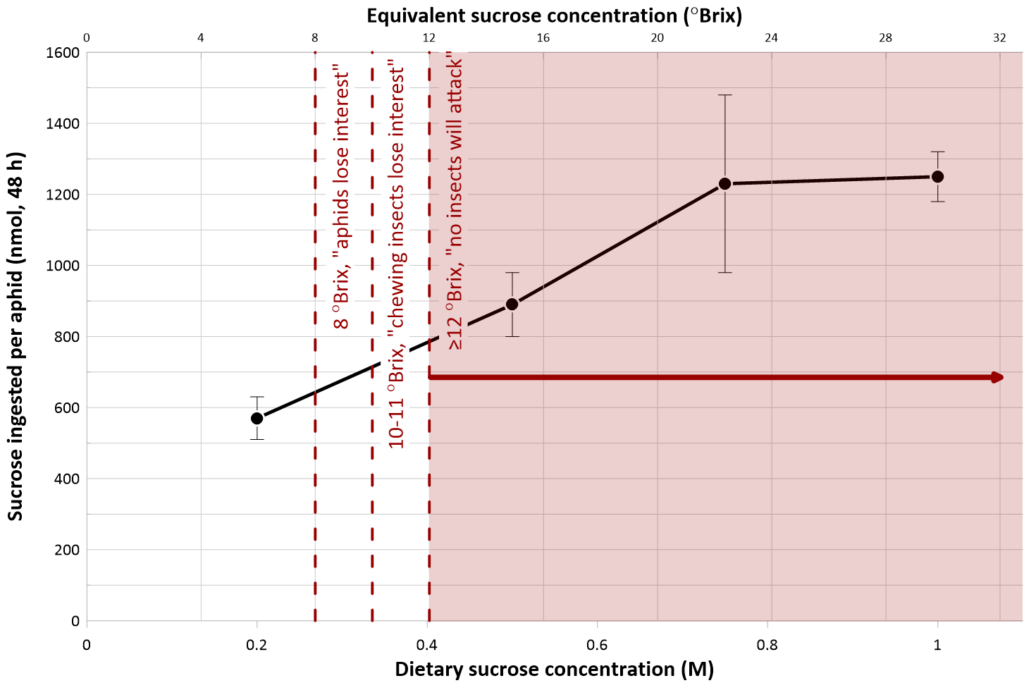
Besides the pest research results, basic insect biology does not support Dykstra’s confident Brix thresholds for various insect groups. The claimed Brix threshold for aphids is 8. In direct contradiction to this are feeding studies of aphids. A paper on the nutritional needs of aphids reports a study in which pea aphids were fed diets ranging from 6.7 to 30.4 Brix (Douglas, 2003). These aphids ingested more total sugars from higher Brix diets (Figure 3).
Aphids also have a specialized gut system that allows them to handle concentrated sugar levels that would normally kill an organism (Douglas 2003). This system switches on at right about the level where the Brix-insect story says the aphid’s digestive system cannot handle the sugar concentrations.
Viewed in a broader context
The “insects don’t attack healthy plants” theory fits under the broader Plant Stress Hypothesis of herbivore feeding preferences; insect pests of plants prefer to feed on stressed or unhealthy plants. The alternative is the Plant Vigor Hypothesis, where herbivores prefer to feed on vigorous, healthy plants. A review of the vigor hypothesis (Price 1991) found evidence supporting it in some insect groups but not others. The author concludes that there is a range of herbivore preferences supporting both the plant stress and vigor hypotheses. Several later reviews found a similar spectrum of responses based on the type of insect feeding (Koricheva et al., 1998; Awmack & Leather (2002); Humberty and Denno (2004); Cornelissen et al., 2008) with feeding by some insect groups increasing and others decreasing with plant stress levels (health). The relevant verdict: if insects that feed differently respond to plant stress in opposite directions, then no single number can predict insect response.
This lack of a single, clear explanation for insect pest feeding in these studies argues for a more complex story, and not a theory that fits all insect pests of all plants.
The history of the story
These claims about soluble solids and insect pests have been around for a long time. The timing is unclear, but in the 1960s or ‘70s, Carey Reams made his claim that soluble solids levels indicate fruit suitability for human health, with higher being better (Harrill 1998). He published a table with specific levels for various fruits and vegetables. Then Phillip Callahan, an entomologist, took up Ream’s Brix health concept and connected it with his own ideas on how insects can tell healthy from unhealthy plants (Wheeler & Ward, 2024). Dan Skow, Arden Andersen, and others expanded on this to get to the theory promoted today by Dykstra (Kempf 2020; Wheeler and Ward, 2024). There are many other popularizers of the idea, with Acres USA serving as the long-term published source for farmers and gardeners interested in the purported benefits of high Brix.
Reality vs. pop ecology
The legacy of Reams, Callahan, Andersen, Dykstra, and Kempf is over 50 years of one untested claim building on another. How has it survived so long? It’s a tidy pop ecology story.
The Brix-insect story provides a straightforward cause to insect and disease problems, one that you can measure any day with a simple, inexpensive tool that gives you precise numbers to aim for to achieve insect-free crops. This is classic pop ecology, trading scientific nuance for an oversimplified certainty.
Reality is not so generalizable: what works for some insects will not work for others. There is not one solution for all plant-feeding insects or all plants.
Nutrient management and Brix
Among promoters, management for higher Brix levels is mostly about “balanced soil nutrient management.” And most of them, including Dykstra and Kempf, sell products that will allow you to get your levels right. However, “balanced” is a vague term used to justify many a false claim. Here it means optimum nutrient levels for a crop, neither too low nor too high, mainly referring to N, K, and some micronutrients. Finding the optimum nutrient levels for a crop can have significant positive effects and is the likely source of any crop yield benefits tied to maximizing Brix levels. There is also much more research looking at the effect of plant nutrient levels on pests, but the results are not nearly as straightforward as the Brix theory. Different pests react differently to different nutrients in different crops. So again, there is no one, simple, pop ecology story to fit them all.
Finally, the lack of evidence also doesn’t mean that plant health is irrelevant to pest pressure. Healthy plants can resist insect feeding better than unhealthy plants, but Brix levels don’t necessarily follow plant health. For example, Brix levels in drought-stricken plants often increase while plant health declines.
Insect pests are not your fault, usually
High Brix won’t save you, but here’s the good news. When you go to your field or garden and you find insects eating your crops, don’t automatically think you have failed. Remember the reality: you could be seeing a coincidental occurrence of the right pest, on the right crop, at the right time, in the right conditions—not your fault.
References
Awmack, C. S., & Leather, S. R. (2002). Host Plant Quality and Fecundity in Herbivorous Insects. Annual Review of Entomology, 47(Volume 47, 2002), 817–844.
Cornelissen, T., Wilson Fernandes, G., & Vasconcellos-Neto, J. (2008). Size does matter: Variation in herbivory between and within plants and the plant vigor hypothesis. Oikos, 117(8), 1121–1130.
Douglas, A. E. (2003). The nutritional physiology of aphids. Advances in Insect Physiology, 31(31), 73–140.
Dykstra, T. (2019). Picky-Eater Insects Pass On High Brix Plants. Acres USA.
Harrill, R. (1998). Using a refractometer to test the quality of fruits and vegetables. Pineknoll.
Huberty, A. F., & Denno, R. F. (2004). Plant Water Stress and Its Consequences for Herbivorous Insects: A New Synthesis. Ecology, 85(5), 1383–1398.
Ioriatti, C., Walton, V., Dalton, D., Anfora, G., Grassi, A., Maistri, S., & Mazzoni, V. (2015). Drosophila suzukii (Diptera: Drosophilidae) and its Potential Impact to Wine Grapes During Harvest in Two Cool Climate Wine Grape Production Regions. Journal of Economic Entomology, 108(3), 1148–1155.
Kempf, J. (2020, April 21). The challenges of managing nutrition with Brix readings. John Kempf.
Kleinhenz, M., & Bumgarner, N. (2013). Using °Brix as an Indicator of Vegetable Quality: An Overview of the Practice. Ohio State University Extension.
Koricheva, J., Larsson, S., & Haukioja, E. (1998). Insect Performance on Experimentally Stressed Woody Plants: A Meta-Analysis. Annual Review of Entomology, 43(Volume 43, 1998), 195–216.
Lee, J. C., Bruck, D. J., Curry, H., Edwards, D., Haviland, D. R., Van Steenwyk, R. A., & Yorgey, B. M. (2011). The susceptibility of small fruits and cherries to the spotted-wing drosophila, Drosophila suzukii. Pest Management Science, 67(11), 1358–1367.
Lee, J. C., Dalton, D. T., Swoboda-Bhattarai, K. A., Bruck, D. J., Burrack, H. J., Strik, B. C., Woltz, J. M., & Walton, V. M. (2016). Characterization and manipulation of fruit susceptibility to Drosophila suzukii. Journal of Pest Science, 89(3), 771–780.
Little, C. M., Chapman, T. W., Moreau, D. L., & Hillier, N. K. (2017). Susceptibility of selected boreal fruits and berries to the invasive pest Drosophila suzukii (Diptera: Drosophilidae). Pest Management Science, 73(1), 160–166.
Mayse, M. (1996). Leaf Sap Brix and Leafhoppers in Vineyards—OFRF Organic Research Hub. Organic Farming Research Foundation.
Pavlis, R. (2024, September 18). Brix, Molasses and Pests—New Science or Fantasy? Gardenmyths.Com.
Pelton, E., Gratton, C., & Guédot, C. (2017). Susceptibility of cold hardy grapes to Drosophila suzukii (Diptera: Drosophilidae). Journal of Applied Entomology, 141(8), 644–652.
Price, P. W. (1991). The Plant Vigor Hypothesis and Herbivore Attack. Oikos, 62(2), 244–251.
Rademan, R., van den Berg, J., du Plessis, M. J., & van den Berg, J.-12319724. (2025). Effect of plant growth stimulants on the response of Phthorimaea absoluta (Lepidoptera: Gelechiidae) larvae and moths to tomato plants.
Syrovy, L., & Prasad, R. (2010). Brix manipulation for reducing pest pressure: Literature Review (p. 18). ES Cropconsult Ltd.
Triplett, E. L. (2020). Significance of photoperiod on the fitness of the sugarcane aphid and applicability of Brix refractometry as a potential method to predict and detect resistance of sorghum. Thesis, West Texas A&M University.
Wheeler, P., & Ward, R. (2024). The Non-Toxic Farming Handbook. Acres U.S.A., Inc.
Comments