Perspectives
Practical insights and opinions from agriculture and natural resources experts—brought to you by the Center for Sustaining Agriculture and Natural Resources.
The Case Against Chasing Soil Microbial Diversity
By Andrew McGuire, CSANR Senior Extension Fellow
Calls to increase soil microbial diversity often assume that more kinds of microbes mean better soil function. But research suggests cropped soils are already highly diverse, and the specific microbes present may matter more than their overall variety.
Do this test to rate your soil’s microbial diversity.
Grow this mixture to promote your soil’s microbial diversity.
Spray this product to increase your soil’s microbial diversity.
All these demands rest on two assumptions:
- Cropped soils have lost soil microbial diversity, and
- Restoring it pays off in yield, nutrient supply, disease suppression, and more.
Published science seems to back this: “Our findings provide evidence that any loss in microbial diversity will likely reduce multifunctionality, negatively impacting… soil fertility and food and fiber production by terrestrial ecosystems.” (Delgado-Baquerizo et al., 2016; emphasis mine)
“Any loss,” is a big claim, extraordinary even. But as I’ve stated before, diversity claims often fall short of their billing, especially in crop production. This claim does not disappoint.
Lab and greenhouse experiments don’t represent field reality
Support for chasing higher soil microbial diversity to improve soil function comes from a series of experiments that manipulated soil microbial diversity. Many of the studies did this through filtration by size (Wagg et al., 2014, 2019, 2021; Bender & van der Heijden, 2015; Bender et al., 2023; Romero et al., 2023; Romero et al., 2025), but fumigation and dilution were also used (Griffiths et al., 2000; Osburn et al., 2023; Philippot et al., 2013;). While many of these studies found a positive relationship between microbial diversity and soil function, the results cannot be generalized to cropped soils because, regardless of the method, they all modified the soil in some way that does not represent real field soils; they produced extreme reductions in microbial diversity, usually in pots, in labs or greenhouses, and in disturbed soils.
In many of these studies, the diversity reductions needed to show an effect were much greater than we’d expect to find with normal farming practices. For example, Romero et al. (2023) found a tipping point at a 50% reduction, while Romero et al. (2025) found the bar even higher: an order-of-magnitude reduction (~10x) in diversity was needed to show an effect. A review of the topic (Bardgett & van der Putten, 2014) concluded that microbial diversity changes were only consequential at the low end of the manipulated diversity levels. Again, these low levels are the result of reductions that we would not expect to see from normal farming practices, and are levels we’ll see don’t apply to cropped soils. And although Wagg et al. (2021) compared the filtration results to tillage, they gave no evidence to support this comparison.
These limitations did not stop other researchers from citing the studies and promoting the “higher diversity gives higher function” idea. However, to date, these results have not been confirmed in actual fields.
“Although the current dogma seems to be that higher taxonomic diversity is beneficial, the extent to which loss of diversity ultimately impacts crop health remains an open question.” French et al. (2021)
Diversity is a number; composition is what matters
When researchers look past the diversity count to the presence or absence of specific organisms, the pattern changes: it’s not diversity itself linked to benefits, but specific microbes. Several cropped-system studies with the strongest positive results found the benefits linked to the presence or absence of mycorrhizal fungi (Bender & van der Heijden, 2015; Bender 2023). In these cases, a diversity count that moved from 40 to 4 species meant nothing for soil function if one of the four is a mycorrhizal fungus.
Similarly, in a study of the soilborne disease take-all in wheat, disease suppression was better linked to specific organisms in the soil microbiome, antibiotic-producing pseudomonads, than to the actual diversity of soil microbes (Potter et al., 2024).
Finally, in a field soil study of potatoes (Lankau et al., 2022), researchers found that suppression of common scab was “explained as well or better by microbial composition rather than diversity per se.” And while the same research did find positive yield effects of microbial diversity at low nutrient levels, the effect disappeared at higher nutrient levels. As Lankau et al. (2022) state, “Mechanistically, ecosystem functions must result from the activities of particular microbial populations—diversity is, after all, simply a calculated number.” It’s the specific composition of the community that matters.
Looking for mechanisms, finding correlations
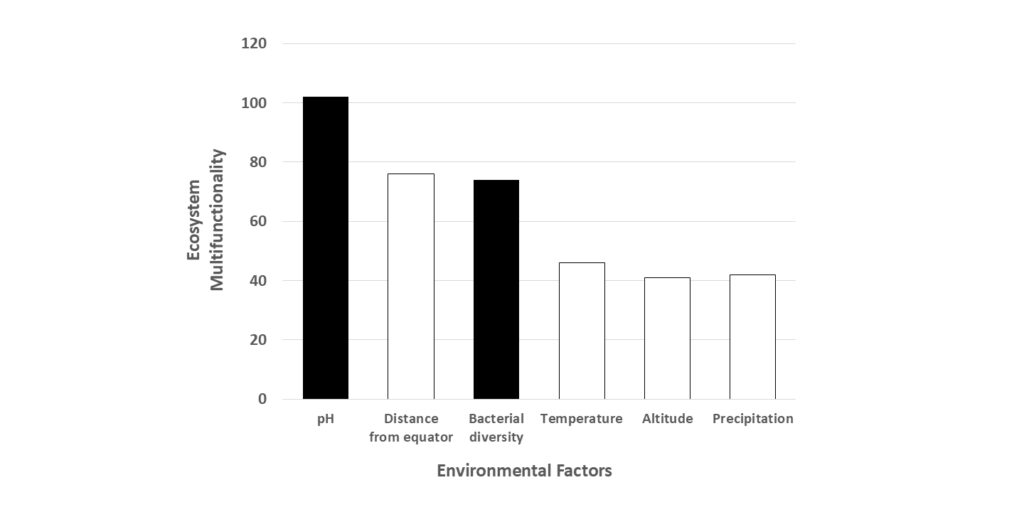
The authors of the “any loss” claim (Delgado-Baquerizo et al., 2016) based their statement on soils from mainly unmanaged ecosystems, with one of the two datasets including annually cropped soils from Scotland. Unlike experiments that manipulated soil bacterial diversity, they analyzed soils from actual fields. They found that higher bacterial diversity (fungal diversity was not measured for the Scotland soils) was correlated with higher multifunctionality. However, correlation doesn’t tell you which factor causes the other, or whether there’s a third factor driving both. In this case, both ecosystem type and pH could be the driving factors, or a mixture of them. The authors took measures to account for this, but statistical techniques are not the same as controlling factors experimentally.
Taking a correlation like this one and claiming causation (A caused B) as this paper does in its title, “Microbial diversity drives multifunctionality in terrestrial ecosystems,” is common among biodiversity studies. However, using the study’s own data (see Fig. 2b), the title could have been “Soil pH drives multifunctionality in terrestrial ecosystems,” Yet the paper has 1978 citations (Scopus), see Figure 1.
Cropland microbial diversity is not degraded
We began with two assumptions:
- Cropped soils have lost soil microbial diversity, and
- restoring it pays off in yield.
The research results I’ve covered challenge the second assumption, but what about the first? Turns out it’s wrong.
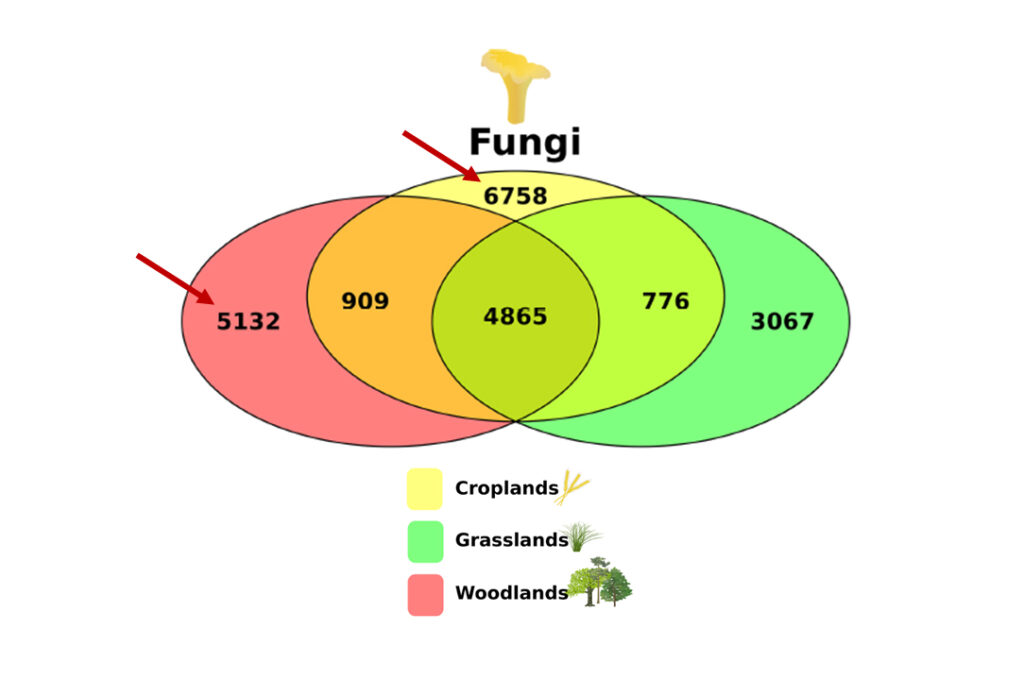
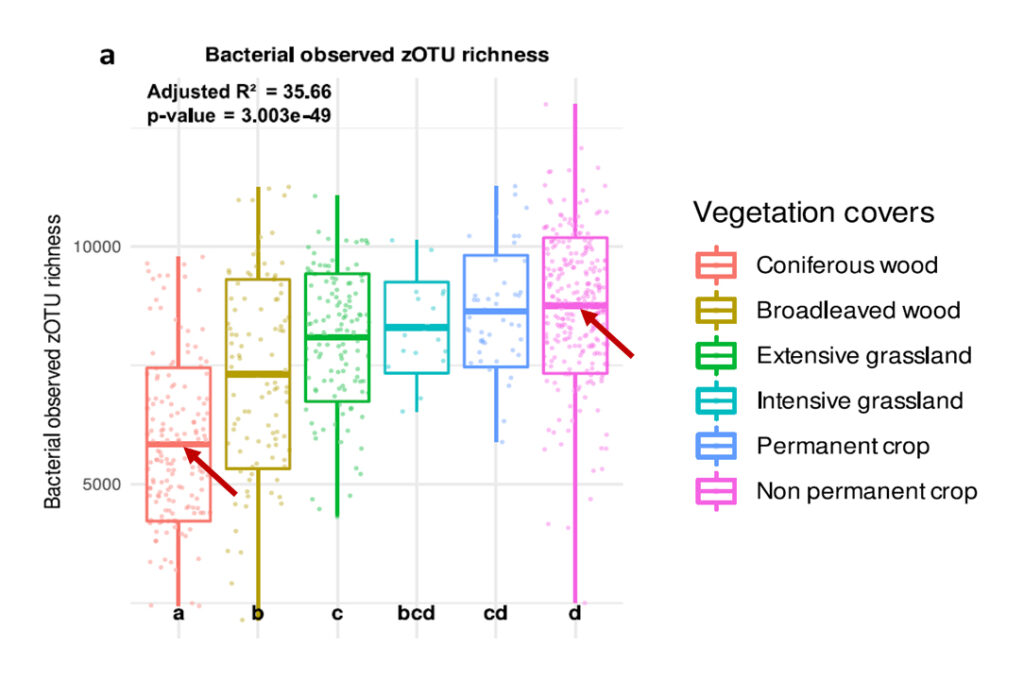
Two recent studies analyzed soil microbial diversity from soils across Europe. One looked at bacteria and fungi (Labouyrie et al., 2023) and the other evaluated fungi by a different method, along with a range of non-microbe organisms (Köninger et al., 2023). Existing forest and grassland soils are the best available stand-in for what was there before the conversion to cropland, and their microbial diversity isn’t higher. Here’s what they found in their own words:
We found the lowest bacterial and fungal diversity in less-disturbed environments (woodlands) compared to grasslands and highly-disturbed environments (croplands).
Labouyrie et al., 2023
We found that the diversity of fungi, protists, rotifers, tardigrades, nematodes, arthropods, and annelids was predominantly shaped by ecosystem type (annual and permanent croplands, managed and unmanaged grasslands, coniferous and broadleaved woodlands), and higher diversity of fungi, protists, nematodes, arthropods, and annelids was observed in croplands than in less intensively managed systems, such as coniferous and broadleaved woodlands.
Köninger et al., 2023
Croplands have soil diversity similar to existing grasslands and higher than existing forests. See Figure 2 and 3.
Some implications of this finding:
First, recall that the lab and greenhouse experiments needed to cut diversity by 50%, sometimes by an order of magnitude, before soil function suffered. Cropland soils aren’t anywhere near that degraded in microbial diversity; they’re as diverse as grasslands and more diverse than forests. So, there’s no need to confirm those experiments in real fields. The diversity losses they depend on don’t happen there.
Second, if the assumption being tested by all those studies, that higher microbial diversity provides better soil function, is true, then cropland soils would function better than forest soils. That’s nonsense. Cropland and forest soils function differently because they have different plants, pH and nutrient levels, and disturbance. And as I’ve pointed out elsewhere, they must function differently because one exports a large amount of biomass to feed us and the other doesn’t. But there’s no reason to think that because one has a higher microbial diversity, it functions better. What then? Might it be that diversity was never the cause of function in the first place?
Results from Köninger et al. (2023) and Labouyrie et al. (2023) suggest, as other studies have, that the composition of the microbes present in a soil is more important than the diversity differences. The higher diversity of cropland included fewer mycorrhizal fungi and N-fixers, and more fungal pathogens than forests. Pathogens are a good example of added diversity that is not beneficial.
Labouyrie’s own team makes this point directly: “our study indicates that greater microbial taxonomic richness/diversity does not necessarily imply beneficial outcomes, as highly-perturbated soils, hosting higher taxonomic richness, harboured a greater prevalence of potentially undesired taxa (e.g. pathogens).” (Labouyrie et al., 2023)
Why diversity can’t be a cause
The long-standing underlying assumption is that higher diversity causes better ecosystem function (here, the soil). A recent paper makes a strong case against this. Schoolmaster et al. (2020) claims that biodiversity is not a causal factor but rather just a number derived from species composition—defined as the specific species present and their abilities—which is the real cause. Given the large amount of research suggesting biodiversity causes function, there was pushback to Schoolmaster’s challenge from senior biodiversity researchers (Grace et al., 2022), which was defended point by point (Schoolmaster Jr. et al., 2022).
Here is my explanation of Schoolmaster et al.’s argument as a hand of poker (see Figure 4). The dealer (environment) deals a hand of five cards (species composition). From those cards, you can determine two different things: how many different cards you have (diversity, as determined by rank and suit) and what the rules say your hand is worth (the effect of species composition). The standard ecology view is that diversity determines the outcomes, at least partly, but Schoolmaster et al. argue that species composition is the real driver of function and diversity. The composition of the cards in your hand determines both its diversity and its value for winning the game (function). They are two different summaries of the same five cards. One does not feed into the other, and only one tells you the value of your hand, or the function of the ecosystem. You can increase the diversity in your hand without changing its value in the game, just as you can reduce the diversity—four of a kind—and win.
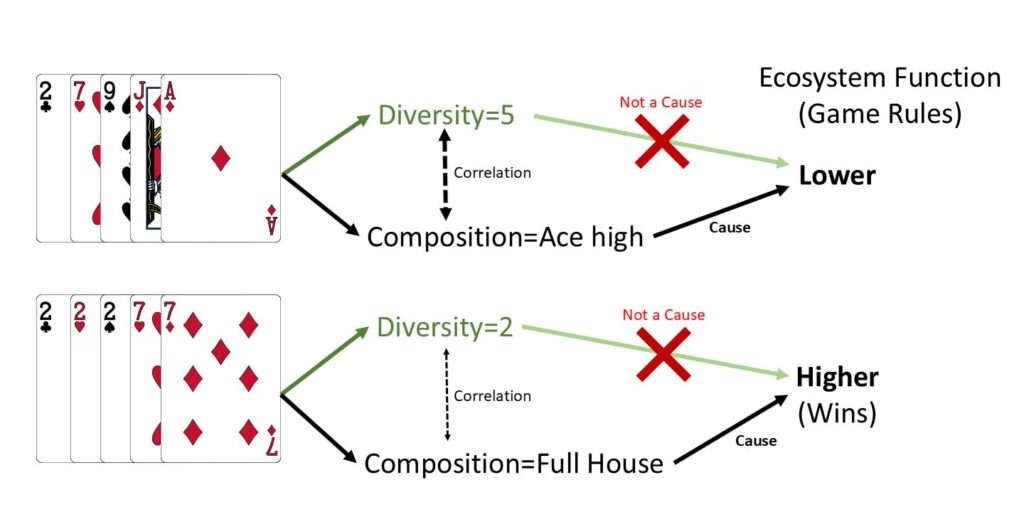
At times, composition and diversity can be related, such as when you have five different cards (high diversity) that include a high card (high value according to the rules). Strong correlations between diversity and function (high R2 in statistics) don’t mean that diversity is the cause. If the rules of the game are that the high card wins (composition), getting dealt a diversity of cards will make getting that winning hand more likely than if you get four of a kind, but it’s still composition that matters. Diversity is not the actual cause of a winning hand.
One proven benefit of diversity is called bet-hedging or the redundancy benefit of diversity (see previous discussion of this in relation to cover crop mixtures). This is where people often say diversity earns its keep: a bigger, more varied hand should survive more changes of the game rules (environmental conditions), providing a kind of insurance. But look at what actually protects you. It isn’t how many different cards you hold; it’s whether those cards are useful across different rule sets/conditions. Four aces are still low diversity and useless in a game that doesn’t reward pairs. Five cards spanning every suit and rank are still useless if none of them form a hand that any of the games reward. What insures you against a change of rules/conditions is holding cards suited to different games, not holding more different cards (Elmqvist et al., 2003). In all this, diversity is the passenger; composition is the driver.
Soil microbial management is what you do for crop production
There’s a strong case against chasing soil microbial diversity for benefits in crop production:
- Studies that manipulated soil microbial diversity do not represent field conditions.
- The benefits of higher diversity are only found at low levels of diversity, also not representative of cropped fields
- Soil microbial diversity in cropped fields is similar to grasslands and is high relative to forests.
- Soil microbial diversity may be only a correlation, not a cause of soil function.
And this doesn’t even get to the hard questions: How much diversity is enough? How do you increase soil microbial diversity consistently? How do you measure the relatively small benefits of a change in soil microbial diversity in the noise that is the soil of a cropped field?
It’s safe to say you can ignore the calls to measure, manage, and apply soil microbial diversity. Diversity isn’t the target. And while we can’t yet consistently manage the soil’s species composition for benefits, we know the practices that do improve or maintain soil health:
- Soil pH adjustment, with its documented effects on the soil microbiome.
- Plant biomass inputs: cash crop residues, cover crops, perennial crops, and organic amendments like manure and compost.
- Crop rotation and reduced tillage systems.
These are time-proven practices in part because they support the soil microbial function that supports crop production. Stick with them.
References
Bardgett, R. D., & van der Putten, W. H. (2014). Belowground biodiversity and ecosystem functioning. Nature, 515(7528), Article 7528.
Bender, S. F., Schulz, S., Martínez-Cuesta, R., Laughlin, R. J., Kublik, S., Pfeiffer-Zakharova, K., Vestergaard, G., Hartman, K., Parladé, E., Römbke, J., Watson, C. J., Schloter, M., & van der Heijden, M. G. A. (2023). Simplification of soil biota communities impairs nutrient recycling and enhances above- and belowground nitrogen losses. New Phytologist, 240(5), 2020–2034.
Bender, S. F., & van der Heijden, M. G. A. (2015). Soil biota enhance agricultural sustainability by improving crop yield, nutrient uptake and reducing nitrogen leaching losses. Journal of Applied Ecology, 52(1), 228–239.
Delgado-Baquerizo, M., Maestre, F. T., Reich, P. B., Jeffries, T. C., Gaitan, J. J., Encinar, D., Berdugo, M., Campbell, C. D., & Singh, B. K. (2016). Microbial diversity drives multifunctionality in terrestrial ecosystems. Nature Communications, 7(1), Article 1.
French, E., Kaplan, I., Iyer-Pascuzzi, A., Nakatsu, C. H., & Enders, L. (2021). Emerging strategies for precision microbiome management in diverse agroecosystems. Nature Plants, 7(3), 256–267.
Grace, J. B., Loreau, M., & Schmid, B. (2022). A graphical causal model for resolving species identity effects and biodiversity–ecosystem function correlations: Comment. Ecology, 103(2), e03378.
Griffiths, B. S., Ritz, K., Bardgett, R. D., Cook, R., Christensen, S., Ekelund, F., Sørensen, S. J., Bååth, E., Bloem, J., De Ruiter, P. C., Dolfing, J., & Nicolardot, B. (2000). Ecosystem response of pasture soil communities to fumigation-induced microbial diversity reductions: An examination of the biodiversity–ecosystem function relationship. Oikos, 90(2), 279–294.
Köninger, J., Ballabio, C., Panagos, P., Jones, A., Schmid, M. W., Orgiazzi, A., & Briones, M. J. (2023). Ecosystem type drives soil eukaryotic diversity and composition in Europe. Global Change Biology.
Labouyrie, M., Ballabio, C., Romero, F., Panagos, P., Jones, A., Schmid, M. W., Mikryukov, V., Dulya, O., Tedersoo, L., Bahram, M., Lugato, E., van der Heijden, M. G. A., & Orgiazzi, A. (2023). Patterns in soil microbial diversity across Europe. Nature Communications, 14(1), Article 1.
Lankau, R. A., George, I., & Miao, M. (2022). Crop performance is predicted by soil microbial diversity across phylogenetic scales. Ecosphere, 13(5), e4029.
Osburn, E. D., Yang, G., Rillig, M. C., & Strickland, M. S. (2023). Evaluating the role of bacterial diversity in supporting soil ecosystem functions under anthropogenic stress. ISME Communications, 3(1), Article 1.
Philippot, L., Spor, A., Hénault, C., Bru, D., Bizouard, F., Jones, C. M., Sarr, A., & Maron, P.-A. (2013). Loss in microbial diversity affects nitrogen cycling in soil. The ISME Journal, 7(8), 1609–1619.
Potter, T. S., Zalewski, Z., Miao, M., Allsup, C., Thompson, K. M., Hayden, D., George, I., Lankau, R. A., & Lankau, E. W. (2024). Applying causal reasoning to investigate multicausality in microbial systems. Ecosphere, 15(5), e4782.
Romero, F., Hilfiker, S., Edlinger, A., Held, A., Hartman, K., Labouyrie, M., & van der Heijden, M. G. A. (2023). Soil microbial biodiversity promotes crop productivity and agro-ecosystem functioning in experimental microcosms. Science of The Total Environment, 885, 163683.
Romero, F., Jiao, S., & van der Heijden, M. G. A. (2025). Impact of microbial diversity and pesticide application on plant growth, litter decomposition and carbon substrate use. Soil Biology and Biochemistry, 208, 109866.
Schoolmaster Jr., D. R., Zirbel, C. R., & Cronin, J. P. (2020). A graphical causal model for resolving species identity effects and biodiversity–ecosystem function correlations. Ecology, 101(8), e03070.
Schoolmaster Jr., D. R., Zirbel, C. R., & Cronin, J. P. (2022). A graphical causal model for resolving species identity effects and biodiversity–ecosystem function correlations: Reply. Ecology, 103(2), e03593.
Wagg, C., Bender, S. F., Widmer, F., & Heijden, M. G. A. van der. (2014). Soil biodiversity and soil community composition determine ecosystem multifunctionality. Proceedings of the National Academy of Sciences, 111(14), 5266–5270.
Wagg, C., Hautier, Y., Pellkofer, S., Banerjee, S., Schmid, B., & van der Heijden, M. G. (2021). Diversity and asynchrony in soil microbial communities stabilizes ecosystem functioning. eLife, 10, e62813.
Wagg, C., Schlaeppi, K., Banerjee, S., Kuramae, E. E., & van der Heijden, M. G. A. (2019). Fungal-bacterial diversity and microbiome complexity predict ecosystem functioning. Nature Communications, 10(1), Article 1.
Zhou, Z., Wang, C., & Luo, Y. (2020). Meta-analysis of the impacts of global change factors on soil microbial diversity and functionality. Nature Communications, 11(1), 3072.
Comments