Perspectives
Practical insights and opinions from agriculture and natural resources experts—brought to you by the Center for Sustaining Agriculture and Natural Resources.
Encouraging Compost Use Through Incentives
By Michael Brady, School of Economic Sciences; and Heleene Tambet and Georgine Yorgey, CSANR
This story is part of the 2024–2025 CSANR Biennial Report.
A pilot program to reimburse compost use helped farmers turn organic waste into healthier soils while providing insights for future climate and waste-reduction policies.
In 2022, the Washington State Legislature passed ESHB 1799 to keep organic waste out of landfills, and the Compost Reimbursement Program (CRP) launched in 2023. The program reimbursed farms for 50% of eligible costs—up to $10,000 per farm per year as long as funds were available—for compost purchases and field application.4 Although the program ended in 2025, a partnership between the Washington State Department of Agriculture (who shared anonymous data from the program), WSU Researchers (who analyzed the data and wrote this article) and the Solid Waste Management Program of the Washington Department of Ecology (who funded the work) provided insights into the program and more broadly contributed to better understanding of agricultural demand for compost.
Compost production
In 2023, Washington had 54 permitted composting facilities across 26 of the state’s 39 counties,5 processing 1.16 million tons of organics. Diversion rates have been roughly 50% over the past decade, and substantial increases will be needed to reach the state’s goal of 75% by 2030. Counties producing the most compost are Snohomish (29% of all compost produced in the state by weight), King (17%), Pierce (10%), and Lincoln (8%). All other counties together produced less than 5% of the total. Feedstocks were largely mixed food scraps and yard debris (75% by volume). Food processing waste, manure with bedding, and other materials each accounted for 5% or less.
Program design
The CRP reimbursed farms for up to 50% of compost purchases and costs associated with application. In total, $2.92 million was available through two rounds of funding. However, the two rounds differed in some important aspects.
While the first round required that compost come from a permitted compost facility, the second round of the program in fall 2024 allowed participating farms to accept compost from permit-exempt facilities. This removed some barriers to participation for farms in rural counties. Another change to the program design was that applications were not accepted on a first-come, first-served basis; everyone was able to apply during an application window and a lottery was used if applications exceeded available funds. This change was intended to remove the advantage that bigger, better-resourced farms may have had in submitting applications quickly.
In the first round, reimbursements were capped at $10,000 for all farms. However, in the second round, the funding cap differed by farm size: the maximum reimbursement amount was $10,000 for farms of 10 acres or less, $15,000 for farms between 10 and 50 acres, and $20,000 for 50 acres or more.
Participating farms
The CRP was available to farmers across the state (Figure 1), attracting many first-time compost users but fewer first-time acres. In other words, most of the land receiving compost under the program had compost applied in the past, but many farms used compost for the first time due to the program. This pattern reflects the fact that farms that had not previously used compost spent less on compost. For farms spending less than $15,000 in total on compost, half were trying compost from a compost facility for the first time. This percentage fell to 28% among those spending between $15,000 and $25,000. There were no first-time compost users amongst farms spending over $25,000.
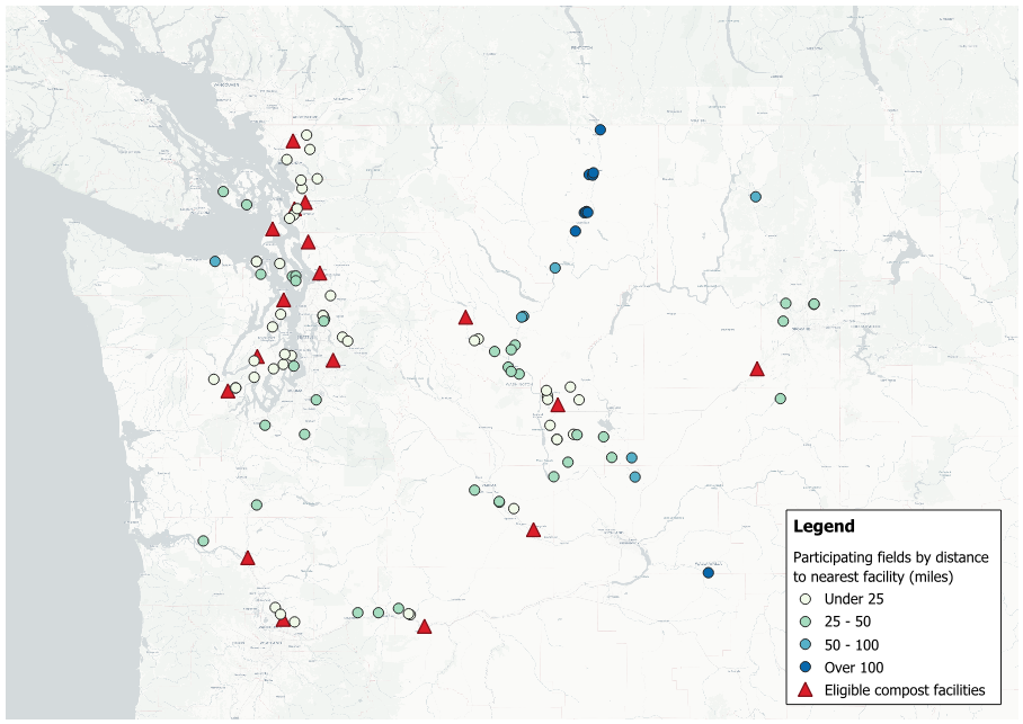
Organic farms made up a relatively large share of farms that participated in the program that were not first-time compost users. New users often applied compost to small areas and on crops like vegetables, while past users frequently applied compost to large orchards. Because legislative guidance indicated that one goal of the program was to increase the number of farms using compost, these findings supported maintaining the maximum reimbursement at $10,000.
Though organic farms participated at a high rate—accounting for 40% of applicants despite only representing 2.5% of all farms in the state—conventional farms accounted for more first-time users of compost. Conventional farms submitted 60% of applications, operated more acreage, were more likely to apply compost annually, and applied at higher application rates (likely due to their crop types).
Interest in the program grew from the first to the second year. Over half (55%) of the second-year participants had not participated in the first year. Building a robust platform has been a WSDA priority, limiting outreach efforts.6 Still, the program was nearly fully subscribed, suggesting that more interest—including from first-time users—could be garnered with more intentional outreach.
Compost use on farms
The most common reasons for purchasing compost with the CRP were to improve soil health and structure, enhance plant growth, and manage water and weeds. Respondents also cited reducing or eliminating the need for synthetic fertilizers.
Of the 84 farms that participated in the first year, the median volume of compost purchased was 73 cubic yards (ranging from 6 to 975 cubic yards). The average area of application was 19.7 acres, but the median was only 3 acres, indicating that a few operations applied compost across large areas.
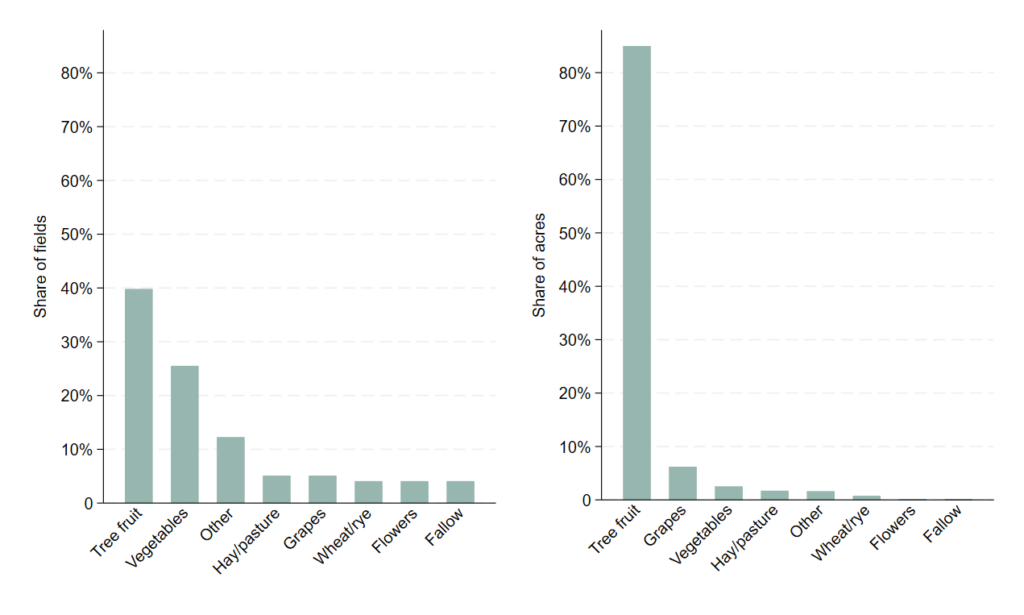
Compost was most frequently applied to tree fruit, with orchards comprising 40% of all fields and 85% of all acreage in the program (Figure 2). Most of these orchards were growing apples (19% of fields and 47% of acreage), followed by pears (16% and 35%), and cherries (6% and 3%). The second largest category was various vegetables, which represented 24% of fields but a small share of acreage. This category included tomatoes, garlic, broccoli, squash, carrots, kale, pumpkin, and “market crops,” each constituting less than 6% of fields and 1% of acreage. The “other” category, which included raspberries and Christmas trees, had the third-highest field share at 12%.
Over one-third of participating fields (40%) were organically certified, but the share differed by crop: nearly two-thirds of tree-fruit acreage, half of wheat and rye, and 35% of vegetable fields were certified.
Program outcomes
One way to assess the program’s cost, and success, is by comparing it to the value of the greenhouse gas emissions it helps avoid. The program’s public cost is estimated at $53 to $114 per metric ton of CO2e, slightly higher than the $50-per-metric-ton price in Climate Commitment Act auctions as of March 2025. However, the program delivers additional benefits, including reduced waste, improved soils, and knowledge that supports future compost use. Over time, some costs could shift elsewhere in the organic waste system, for example, if municipal residents who want their waste recycled share more of the expense. The transportation and application costs, which made up about 32% of total participant spending, could also decrease as demand and markets mature due to increased efficiency from greater specialization in this activity.
Another way to evaluate success is to ask how well it achieved its stated goal of encouraging farmers to try compost. The program effectively reached farmers who had never used compost and who may have been uncertain of its benefits. Roughly 40% of fields participating in round one tried compost from a compost facility for the first time. Even among organic farms, nearly a quarter had not used compost before participating in the program. For first-time farms in particular, the subsidy helped reduce uncertainty about an untried practice, allowing farmers to observe its effects and practice application methods.
If a compost subsidy program is reintroduced, it could build on the CRP by encouraging first-time users to access the program and encourage expanded data collection. Continued subsidies could also help farms manage uncertainty given the variable impacts of applying compost due to compost composition, soils, crops, and other environmental factors.
Looking forward
While subsidies can be helpful, they should complement these broader efforts to reduce barriers to compost use in agriculture.2 Additional efforts to encourage compost use could include continued research, addressing contamination issues, and lowering barriers to applying compost—for example, by offering spreading equipment through conservation districts. Public support for expanding compost adoption could divert waste from landfills, reduce emissions, improve soil, and contribute to a more circular economy by helping Washington capture the value of its organic resources.
References
- Gale, E.S., Sullivan, D.M., Cogger, C.G., Bary, A.I., Hemphill, D.D., Myhre, E.A. (2006). Estimating plant-available nitrogen release from manures, composts, and specialty products. Journal of Environmental Quality 35, 2321–2332.
- Hills, K., Brady, M., Yorgey, G. and Collins, D. (2019). Differentiating the Value and Cost of Compost Across Likely Farm Use Scenarios in Western Washington. A technical report for the Waste to Fuels Technology Partnership, 2017-2019 biennium. Center for Sustaining Agriculture and Natural Resources, Mount Vernon, WA.
- Hills, K., Jobson, T., and Yorgey, G. (2020). Survey of Large Commercial Compost Facilities in Washington. A Report for the Washington Department of Ecology. Center for Sustaining Agriculture and Natural Resources, Mount Vernon, WA.
- Washington State Department of Agriculture. (2024).
- Washington Department of Ecology. (2023). Washington State Waste Generation and Recovery Data, 2021.
- Thedell, D., Washington State Department of Agriculture, personal communication.
Revised December 18, 2025: A previous version incorrectly stated that funding was provided by the Solid Waste Division of the WSDA.
Comments