Composting as a practical solution
By Margaret Griset, CSANR; Rachel Wieme, WSU Extension; Chad Kruger, CSANR
Washington’s small-scale meat processors generate an average of 6,000 pounds of animal byproducts every week, yet shrinking disposal options threaten operations. Decades of CSANR-sponsored research and demonstrations offer a practical, sustainable way to address a pressing challenge: offal composting.
A growing crisis in waste management
Nearly 10,000 small and direct-marketing farms, ranches, and families raising livestock and poultry depend on Washington’s small-scale meat processors and slaughter facilities. This network of facilities produces substantial amounts of animal byproduct waste, mostly raw offal (internal organs and other unusable parts) from slaughter.
For decades, most of this material was sent to rendering plants where it could be converted into usable products like fats and proteins. But that outlet is rapidly disappearing. Some regions have lost access to rendering services entirely, others face new restrictions on what is accepted, and many processors are struggling with sharply higher costs and longer hauling distances.
Research that was ready when needed
For years, CSANR had been supporting research on how to convert animal mortalities into safe, nutrient-rich compost. Beginning in the mid-2000s, Andy Bary led pioneering research on mortality composting, initially focusing on poultry before Lynne Carpenter-Boggs expanded the work to large animal mortalities. This mortality composting research proved directly transferable to processing waste—the same temperature and management principles that work for whole carcasses also work for offal.
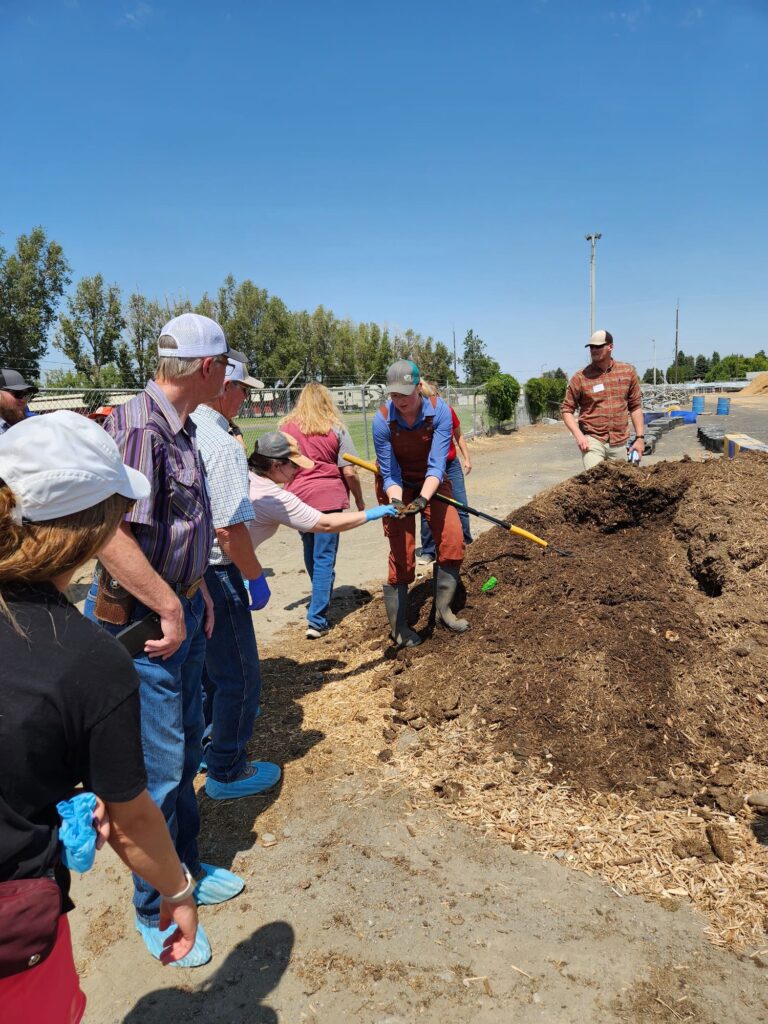
“We were able to respond quickly to requests from processors because of our history with projects about composting animal remains” says Rachel Wieme, who leads Extension outreach on offal composting. “We’ve been able to bring together our agency partners again to not only provide demonstrations but also guidance for the regulatory aspects.”
Composting allows farms and butchers to transform deceased livestock and offal into pathogen-free compost that’s safe for soil application when managed correctly. While using animal-derived compost might seem unconventional, WSU scientists have rigorously tested and monitored the practice for decades.
This research-backed approach emphasizes careful management of the composting process. Compost piles are designed to reach temperatures high enough to neutralize pathogens, while moisture and aeration are monitored to ensure efficient decomposition. The resulting compost is similar to standard compost in nutrient content.
Environmental and economic benefits
Offal composting offers advantages that extend far beyond waste disposal. The practice reduces greenhouse gas emissions compared to alternatives like transport or incineration. Nutrients remain within the local soil system, supporting healthier pastures and croplands over time while reducing dependence on external fertilizer inputs.
CSANR’s early investment in supporting mortality composting research enabled WSU to respond when demand surged for offal disposal options. Extension outreach led by Rachel Wieme has been instrumental in translating research into practice. Through workshops and on-farm demonstrations, she helps producers, processors, regulators, conservation districts, and compost facility operators understand safe process management, nutrient optimization, and integration with existing operations. She also addresses practical challenges from pile construction to regulatory compliance, ensuring processors can adopt offal composting with confidence.
Innovation meets opportunity
Researchers continue to refine their methods, exploring improvements in nutrient retention, odor management,
and integration with other composting systems. Collaboration with other universities and industry partners ensures mortality composting can be scaled responsibly across the Pacific Northwest.
Offal composting offers a safe disposal method, an effective soil enhancement tool, and the potential to develop new markets for locally produced compost. By supporting rigorous research, comprehensive outreach, and readiness to respond when needed, CSANR helped ensure Washington’s producers and processors have access to innovative solutions that are both practical and sustainable.
Resources
On-Farm Composting of Large Animal Mortalities
Price, C. and L. Carpenter-Boggs. WSU Extension Bulletin EB2021E. 2008.
Composting can be a safe and effective method for disposing of on-farm mortalities when the correct procedures are followed and the system is managed well.
Composting of Poultry Offal Demonstration Project
Bary, A., C. Miles and K. Gilbert. 2001. Report of a demonstration project conducted at Middle Farm, Lopez Island. Objectives included developing a successful composting process for poultry offal and producing finished compost.
Livestock Mortality Composting Webinar
Carpenter-Boggs, L., Wieme, R. 2020. Webinar hosted by WSU Extension on techniques and lessons learned from mortality composting.
The Space It Takes: Footprint Calculator for Composting Butcher Waste
Schwarz, M., Bonhotal, J. 2010. Cornell Waste Management Institute. A tool and guide for estimating the land area needed for composting butcher waste.
Natural Rendering: Composting Livestock Mortality and Butcher Waste.
Bonhotal J, Telega L, Petzen J. Natural Rendering: Composting Livestock Mortality and Butcher Waste. Cornell Waste Management Institute. 2002, updated 2010. A foundational guide to composting mortality and butcher waste.
Comments