By Andrew McGuire, CSANR Senior Extension Fellow.
There is no shortage of advice on soil health. Cover crop cocktails, reduced tillage, livestock integration…the list goes on. With so many options, it’s hard to know what matters most. Two principles can cut through all that, both grounded in the most influential factor for soil health: soil organic matter. These principles can help you make sound soil health decisions and avoid unsound advice.
Stay in Business
Before I get to the principles, there is one condition that must be met regardless of the value of any soil health practices or products: the farm must stay in business. Every soil health decision is made within the constraints of economic survival. It makes no sense to have the best soil in the county while headed to the auctioneer. If we acknowledge this first, then the principles become realistic guides rather than unyielding dogma.
Two Principles of Soil Health
Soil health management can be distilled into two principles: MAXIMIZE Photosynthesis and minimize tillage.
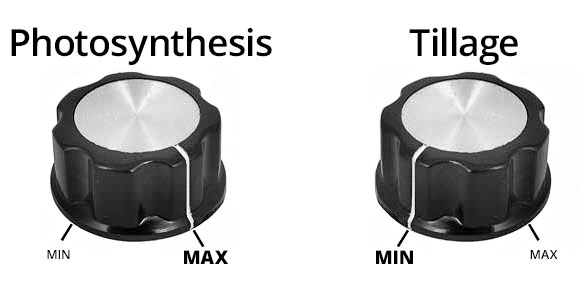
Maximizing photosynthesis is all about managing plants to intercept sunlight to power their growth (Janzen, 2015). Plant biomass—the carbohydrates produced by photosynthesis—feeds both us and everything in the soil. The more crop biomass we can grow, the more energy there is in the system for all the biology.
So, fill the space you have with plant growth. Aim for a full-time, full canopy as much as possible. And fill the time you have with plant growth, year-round plant growth, although I doubt we could tell if you missed a couple of weeks over the course of a year. To fill time and space will require a soil with sufficient nutrients, optimum pH, and structure conducive to seedling emergence and root growth, which brings us to the second principle.
Minimizing tillage focuses on reducing soil disturbance. Of all our farming practices, tillage is the largest disturbance of the soil, bigger than pesticides and fertilizers. Tillage damages soil structure and reduces protective residue cover. Minimizing tillage maintains soil structure and, by leaving crop residues, keeps the soil protected from erosion.
Together, Maximize Photosynthesis and minimize tillage provide the foundation of soil health: building or maintaining soil organic matter.
Soil Health≈Soil Organic Matter
Soil organic matter affects nearly every aspect of soil functioning: microbial activity, aggregation, infiltration, drainage, resistance to compaction, surface crusting, nutrient cycling, etc. (Viaene et al., 2025). Although there is no clear threshold of soil organic matter levels (SOM) for soil health (Loveland & Webb, 2003; Prout et al., 2020), having more is better than having less.
There is a simple equation for changes in soil organic matter levels:
ΔSOM (change in SOM) = INPUTS – LOSSES
Inputs are crop biomass, the result of photosynthesis (Janzen et al., 2022; Rubio et al., 2025). Losses are the decomposition of existing soil organic matter, which can be beneficial or detrimental (Janzen, 2006). Feeding soil microbes is a large but beneficial loss, while the tillage-induced loss of soil organic matter and disruption of soil structure is the main detrimental loss. Maximizing photosynthesis increases INPUTS and minimizing tillage reduces the most damaging LOSS of SOM – the principles affect both of the factors in this equation, favoring an increase of SOM over time.
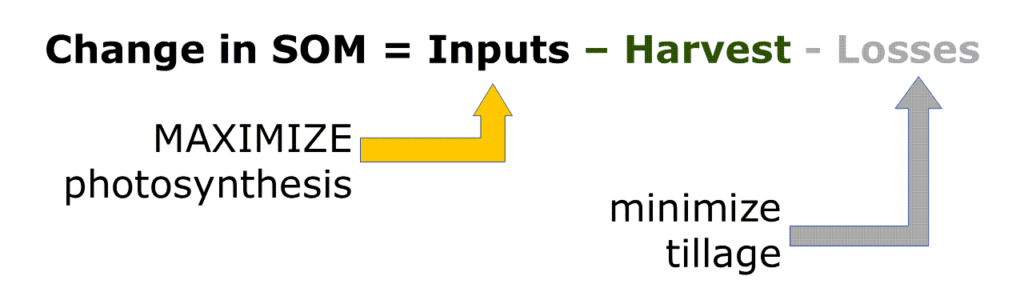
Translate this back to the dials above: Maximize Photosynthesis controls the Inputs, Minimize Tillage controls the Losses. Combined, the Max and min principles produce a soil with the organic matter concentrated at the soil surface, where it can do the most good. The flow of carbon through the soil is nearly continuous, both from plants and from decaying crop residue. In the long-term, and sometimes in the short-term, these two principles can address real soil problems. The practices you already use to manage pH, nutrients, and pests all contribute to maximizing photosynthesis.
Practices from Principles
These are principles; they tell you what you want from the practices you choose. Each principle can be implemented through different practices depending on your system. Here is a partial list of practices for each principle. Some practices facilitate other practices and some address both principles.
| Practices that Help Maximize Photosynthesis: | Practices that Help Minimize Tillage, in descending order of effectiveness: |
| Relay crops | No-till/Direct seeding |
| Cover crops | Strip-till |
| Perennial crops | Vertical tillage |
| Overwintering crops and cover crops | Non-inversion tillage |
| Manure/compost, imported photosynthesis | |
| Practices that facilitate the above practices: | Practices that facilitate the above practices: |
| Livestock grazing | Livestock grazing |
| Crop rotation | Crop rotation |
| Nutrient management | Residue management |
| Pest management | Weed management |
| Irrigation | |
| No-till, strip-till, practices that reduce field prep time between crops |
These principles also assume that erosion, which is the opposite of building soil, is minimized. You cannot build health into soil that is losing ground.
Back to Staying in Business
Of course, it’s not that simple. These principles must be adjusted for many factors: climate, markets, economics, crops, pests, soils, regulations, equipment, technology, etc. and all the inherent trade-offs of agriculture. The constraints of “staying in business” often mean that the Maximize knob will never be at maximum, and the minimize knob never at minimum. This is what the equation reflects: a system optimized to your real constraints, not someone else’s ideal of soil health.
Two principles, Many Applications
That’s it, two principles. You have two dials to work with: turning one up and the other down can mean increased soil organic matter and soil health, all within the real-world constraints of your farm.
References
Janzen, H. H. (2006). The soil carbon dilemma: Shall we hoard it or use it? Soil Biology and Biochemistry, 38(3), 419–424. https://doi.org/10.1016/j.soilbio.2005.10.008
Janzen, H. H. (2015). Beyond carbon sequestration: Soil as conduit of solar energy. European Journal of Soil Science, 66(1), 19–32. https://doi.org/10.1111/ejss.12194
Janzen, H. H., van Groenigen, K. J., Powlson, D. S., Schwinghamer, T., & van Groenigen, J. W. (2022). Photosynthetic limits on carbon sequestration in croplands. Geoderma, 416, 115810. https://doi.org/10.1016/j.geoderma.2022.115810
Loveland, P., & Webb, J. (2003). Is there a critical level of organic matter in the agricultural soils of temperate regions: A review. Soil & Tillage Research, 70(1), 1–18.
Prout, J. M., Shepherd, K. D., McGrath, S. P., Kirk, G. J. D., & Haefele, S. M. (2020). What is a good level of soil organic matter? An index based on organic carbon to clay ratio. European Journal of Soil Science, n/a(n/a). https://doi.org/10.1111/ejss.13012
Rubio, V., Núñez, A., Berger, A., & van Es, H. (2025). Biomass inputs drive agronomic management impacts on soil health. Agriculture, Ecosystems & Environment, 378, 109316. https://doi.org/10.1016/j.agee.2024.109316
Viaene, J., Quataert, P., Joos, L., De Tender, C., Debode, J., & Vandecasteele, B. (2025). Link Between Soil Organic Carbon and Microbial Soil Health Indicators in Arable Fields: Management and Spatial Drivers. European Journal of Soil Science, 76(6), e70250. https://doi.org/10.1111/ejss.70250
Comments
I’m down with everything except herbicides. Can you clarify?
Hi Bekka,
Thanks for the comment. Weeds are often killed with tillage. Without tillage, herbicides are the usual and easier to manage choice. There are non-herbicide options available but they can be more expensive, more difficult to manage, or they only work with specific cropping systems.
Hi Andrew, I’m a fan of your writing and thinking! Still reeling from that Regenerative brouhaha from a few years ago…? Or that all in a day’s work for you? I cannot believe how much work you did to carry on that “discussion.”
Do you have thoughts on, or can you recommend information resources on whether or not it is realistic (with adoption of all of the above practices, and maybe more) to cause there to be a net increase in soil carbon storage? I’ve heard people talk about this like it’s the biggest no-brainer in the world. I’m not convinced, but I am not up on the latest thoughts on this. I’m just always amazed at how people talk about all of this- it’s the way in which they talk about it that reveals how little they actually know about agriculture.
Thanks, and keep up the great work!
Andy, thanks for the comments. Yes, definitely, net increases in soil C storage are possible. It often depends on the starting point. Here in our previously arid but now irrigated soils, just the addition of water and high yield, high residue crops like wheat and corn, and perennials like alfalfa have increased soil C levels above native levels. In other regions, it depends on what you take as the baseline. Using prairie native soils as a baseline it will be hard to match, but with no-till and cover crops and a decent rotation, I think soil C levels can increase.
[…] line with the regenerative agriculture principle, “maintain living roots in soil” and with “maximize photosynthesis and minimize tillage.” Increased active crop time may also produce more stable crop yields (Sanford et al. […]
[…] of soil health can be reduced to these two principles. The rest is figuring out the details, and how to do it while making a […]