This study examines how media richness influences perceived trustworthiness in social media posts communicating publicly funded artificial intelligenc
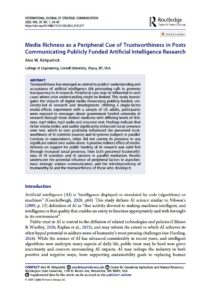
This study examines how media richness influences perceived trustworthiness in social media posts communicating publicly funded artificial intelligence (AI) research. Drawing on media richness theory and heuristic processing frameworks, the authors investigate whether the inclusion of richer media elements—such as images or video—serves as a peripheral cue that enhances credibility judgments. Using experimental methods, the research evaluates how audiences interpret AI research content when presented in varying media formats. Findings suggest that media richness can function as a heuristic signal of trustworthiness, even when the underlying scientific content remains constant. The study contributes to science communication scholarship by identifying how visual and multimedia elements shape public perceptions of publicly funded research. These insights are particularly relevant for universities, government agencies, and research institutions seeking to effectively communicate emerging AI technologies while maintaining public trust.
This product is hosted on an external website and may not meet current digital accessibility standards.
Authors
Kirkpatrick, A.
Related Product
Related Project
Suggested Citation
Kirkpatrick, A. 2026. Media richness as a peripheral cue of trustworthiness in posts communicating publicly funded artificial intelligence research. International Journal of Strategic Communication 20(1): 24–43. https://doi.org/10.1080/1553118X.2025.2515277
Year Published
2025
Area of Focus
Research Engagement & Communication
Topic
Community Engaged Research