Why Growers Hesitate: Molly Sayles Bridges Science and Practice
By Margaret Griset, CSANR
This story is part of the 2024–2025 CSANR Biennial Report.
With support from a CSANR BIOAg grant, Molly Sayles is investigating why pear growers may hesitate to adopt Integrated Pest Management. Her research highlights barriers and helps guide more effective outreach.
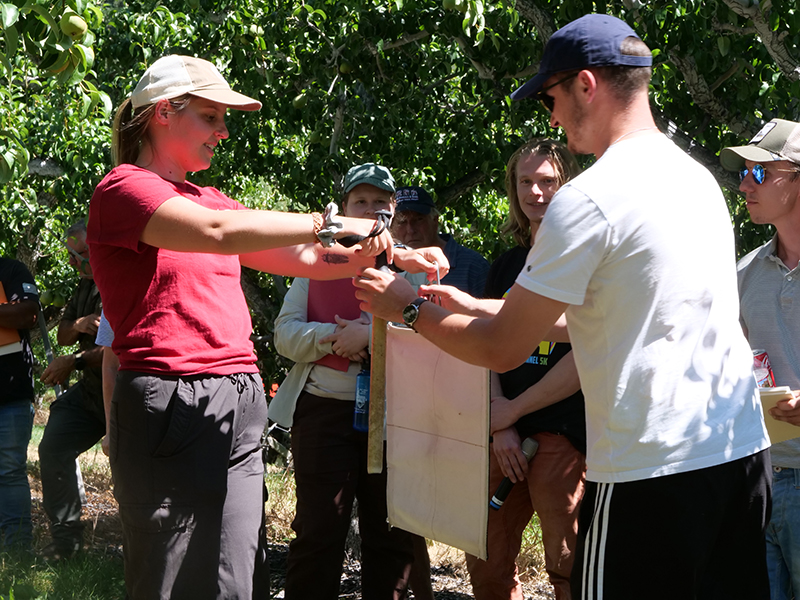
As an undergraduate, Molly Sayles was inspired by a visiting entomologist.
She liked the idea of studying bugs, but also wanted to work with people. Her interest in the interactions between insects and people led her to WSU, where she recently graduated with her PhD. She appreciated the program’s down-to-earth atmosphere and strong mentorship.
Molly’s research, supported by a BIOAg grant, focused on a persistent pest in Wenatchee Valley pear orchards: the pear psylla. This tiny insect produces sticky excretions that damage fruit. Growers have long relied on insecticides for control, but resistance is increasing and sprays can harm beneficial insects that keep psylla in check.
Integrated Pest Management (IPM) offers a more sustainable solution. It combines tools like pruning, conserving natural enemies, and carefully timing sprays. Other Pacific Northwest regions have broadly adopted IPM, but Wenatchee Valley growers have been slower to make the shift.
The BIOAg grant was crucial to Molly’s research, funding travel for in-person interviews, educational workshops, outreach materials, and recording equipment needed to capture detailed conversations.
“Very few people in entomology do qualitative social research like this,” she said. “This grant allowed me to fill a vital gap in applied pest management research by focusing on people as well as bugs.”
Revised 1/2/2026 to update Molly Sayles’ degree status.