Perspectives
Practical insights and opinions from agriculture and natural resources experts—brought to you by the Center for Sustaining Agriculture and Natural Resources.
Why Soil Inoculants Fail
By Andrew McGuire, CSANR Senior Extension Fellow
From fermentation tanks to field soils, most microbial inoculants face barriers they can’t overcome.
Farmers and agronomists have never had more soil inoculant products to choose from. Marketed as biologicals, these products contain live microbes meant to improve soil biology and crop performance. Yet whether a company sells single-organism products or complex mixtures, bacterial inoculants or fungi, every product faces the same test: do the microbes survive long enough to benefit the crop? Research shows that most do not. Four compounding obstacles explain why (Kaminsky et al., 2019).
We Can Only Use a Tiny Fraction of Soil Microbes
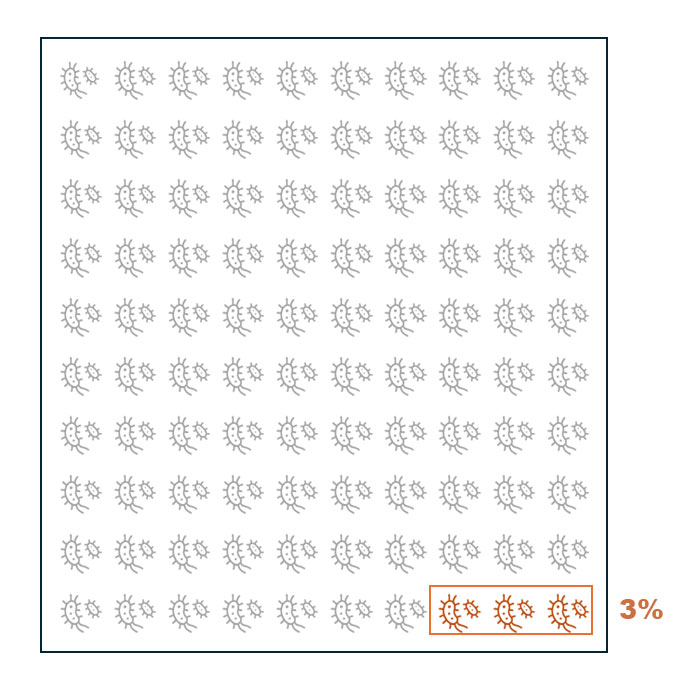
The first obstacle is that we cannot cultivate most soil microbes in the lab. Genomic tools can detect them, but we can grow fewer than 3% of the species that live in soil (Steen et al., 2019). If we cannot grow a microbe, we cannot study what it does, and we certainly cannot manufacture it as an inoculant. This constraint means that before researchers even ask whether a microbe benefits crops or soils, they must first ask whether it grows well in a fermentation vat. The selection process filters for industrial compatibility, not agronomic value.
Fermentation Conditions Don’t Prepare Microbes for Soil
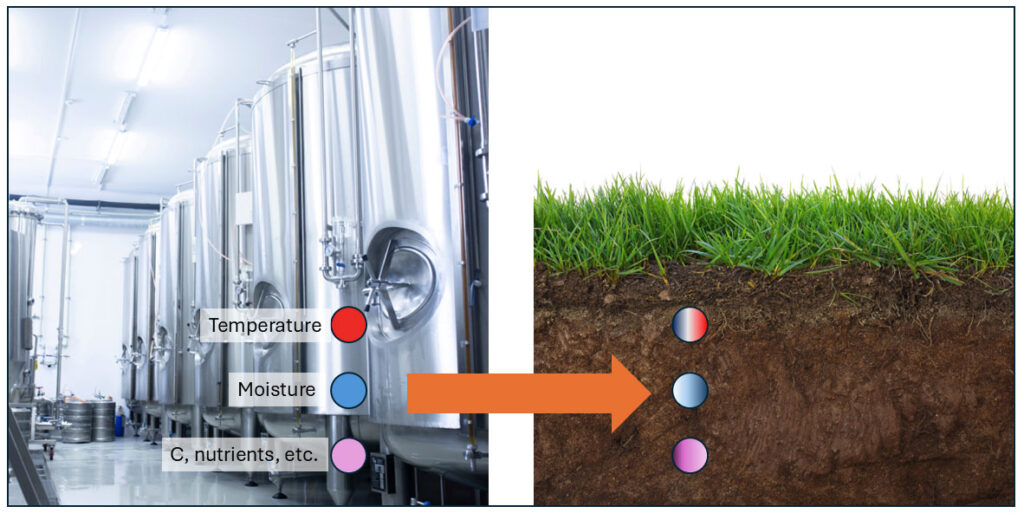
The second obstacle is that soil microbes are highly sensitive to their micro-environments (Bunemann et al., 2018). Because temperature, moisture, and nutrient levels can vary across distances as small as micrometers, each micro-habitat supports its own distinct microbial community (Young et al., 2008). A microbe that thrives in a warm, moist, carbon-rich fermentation tank will encounter something very different when it enters the soil: fluctuating temperatures, erratic moisture, and low-level nutrients. Some inoculant microbes may stumble into a hospitable micro-habitat, but even then they will face a second, equally daunting problem.
If the “right” microbes don’t thrive in your soil right now, why would applied microbes thrive in those same conditions?
Native Microbes Have a Home-Field Advantage
Obstacle three is the vast, well-adapted community of microbes already in soils—they don’t yield territory easily. Native organisms have numbers on their side and hold the habitats that inoculant microbes need. Even rhizobium, the most successful example of soil inoculation we have, illustrates this problem; researchers who introduce improved rhizobium strains find those strains are often outcompeted by native strains already in the soil, and so they fail to colonize root nodules (Thies et al., 1991; De Bruin et al., 2010). If the best-case inoculant struggles to establish itself, what chance does the typical inoculant have?
A Single Product Cannot Suit Every Soil
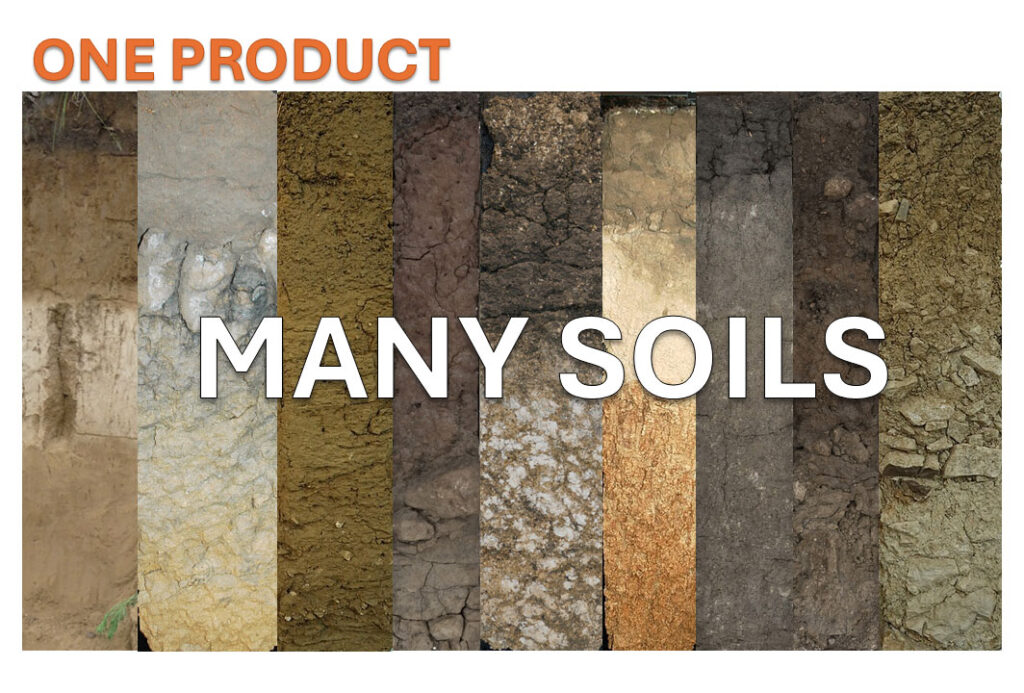
The final obstacle is that different soil types produce crops across many environments and soil microbial communities vary across both large distances and tiny ones (Fierer, 2017). We know these soils harbor different microbial communities, yet most inoculant companies market a single product for all soils. There is little reason to expect one product to work on soils from heavy red clays in the South and silt loams on the High Plains, to irrigated sands in the West. This mismatch explains why inoculant results are so inconsistent: effective in one field, ineffective in the neighboring field; effective one year, ineffective the next. Finding an organism that performs well across all soil types, weather patterns, crops, and management systems is, again, searching for a rare exception.
When These Obstacles Compound, Inoculants Fail
Commercial inoculants must overcome multiple obstacles from the start. Manufacturers select microbes from the tiny fraction of cultivable species, optimize them for fermentation rather than field performance, and sell them as universal solutions despite enormous variation in soil conditions across farms and regions.
When inoculants cannot overcome these obstacles, the applied microbes typically decline rapidly after entering the soil. They fail to establish, fail to provide measurable benefits, and fail to justify their cost. Decades of research show this is the norm, not the exception (O’Callaghan et al., 2022).
The pattern extends beyond commercial products. Microbes introduced through organic amendments such as compost, manure, and their extracts and teas, follow a similar trajectory (Schlatter et al., 2022, 2023; Semenov et al., 2021). Even when researchers applied manure-borne microbes to sterilized soil, those organisms died off quickly. The conclusion: “soils appear to provide a strong barrier against invasion of manure-borne fungi [and bacteria].”
Build Your Soil; Your Soil Will Determine Your Microbes
The search for exceptional inoculants will continue, and breakthroughs may come, but the pattern of failure raises a more fundamental question: are cropped soils actually missing the microbes that inoculants supply, or are those microbes (or functionally equivalent ones) already present and suppressed by poor soil conditions?
“Everything is everywhere, but the environment selects.”
Ecologist Lourens Baas Becking (Wit & Bouvier, 2006)
Parts of this essay appeared in an earlier Perspective, A Problem with Inoculants.
All Perspectives from Andrew McGuire
References
Bünemann, E. K., Schwenke, G. D., & Van Zwieten, L. (2006). Impact of agricultural inputs on soil organisms—A review. Soil Research, 44(4), 379–406.
De Bruin, J. L., Pedersen, P., Conley, S. P., Gaska, J. M., Naeve, S. L., Kurle, J. E., Elmore, R. W., Giesler, L. J., & Abendroth, L. J. (2010). Probability of Yield Response to Inoculants in Fields with a History of Soybean. Crop Science, 50(1), 265–272.
Fierer, N. (2017). Embracing the unknown: Disentangling the complexities of the soil microbiome. Nature Reviews Microbiology, 15(10), 579–590.
Kaminsky, L. M., Trexler, R. V., Malik, R. J., Hockett, K. L., & Bell, T. H. (2019). The Inherent Conflicts in Developing Soil Microbial Inoculants. Trends in Biotechnology, 37(2), 140–151.
O’Callaghan, M., Ballard, R. A., & Wright, D. (2022). Soil microbial inoculants for sustainable agriculture: Limitations and opportunities. Soil Use and Management, 38(3), 1340–1369.
Schlatter, D. C., Gamble, J. D., Castle, S., Rogers, J., & Wilson, M. (2022). Abiotic and biotic filters determine the response of soil bacterial communities to manure amendment. Applied Soil Ecology, 180, 104618.
Schlatter, D. C., Gamble, J. D., Castle, S., Rogers, J., & Wilson, M. (2023). Abiotic and Biotic Drivers of Soil Fungal Communities in Response to Dairy Manure Amendment. Applied and Environmental Microbiology, 0(0), e01931-22.
Semenov, M. V., Krasnov, G. S., Semenov, V. M., Ksenofontova, N., Zinyakova, N. B., & van Bruggen, A. H. C. (2021). Does fresh farmyard manure introduce surviving microbes into soil or activate soil-borne microbiota? Journal of Environmental Management, 294, 113018.
Steen, A. D., Crits-Christoph, A., Carini, P., DeAngelis, K. M., Fierer, N., Lloyd, K. G., & Thrash, J. C. (2019). High proportions of bacteria and archaea across most biomes remain uncultured. The ISME Journal, 13(12), 3126–3130.
Thies, J. E., Singleton, P. W., & Bohlool, B. B. (1991). Influence of the Size of Indigenous Rhizobial Populations on Establishment and Symbiotic Performance of Introduced Rhizobia on Field-Grown Legumes. Applied and Environmental Microbiology, 57(1), 19–28.
Wit, R. D., & Bouvier, T. (2006). ‘Everything is everywhere, but, the environment selects’; what did Baas Becking and Beijerinck really say? Environmental Microbiology, 8(4), 755–758.
Young, I. M., Crawford, J. W., Nunan, N., Otten, W., & Spiers, A. (2008). Microbial Distribution in Soils: Physics and Scaling. In Advances in Agronomy (Vol. 100, pp. 81–121). Academic Press.
Comments