Perspectives
Practical insights and opinions from agriculture and natural resources experts—brought to you by the Center for Sustaining Agriculture and Natural Resources.
Choose Soil-building Practices Over Soil Health Products
By Andrew McGuire, CSANR Senior Extension Fellow
With the soil health movement has come a multitude of products claiming to improve various aspects of soils, from activators, boosters, and enhancers, to optimizers, revitalizers, and stimulators (Figure 1). With so many products on the market, finding any independent research on most of them is impossible, leaving farmers with little to go on in evaluating individual product claims. So, what’s to be done? I recommend that you start by identifying your specific problem. Then try a time-tested practice as a solution rather than an unproven product. Here’s why.
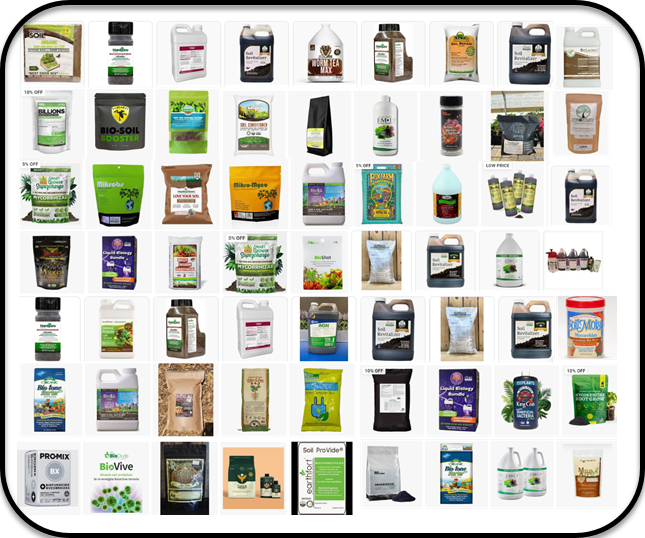
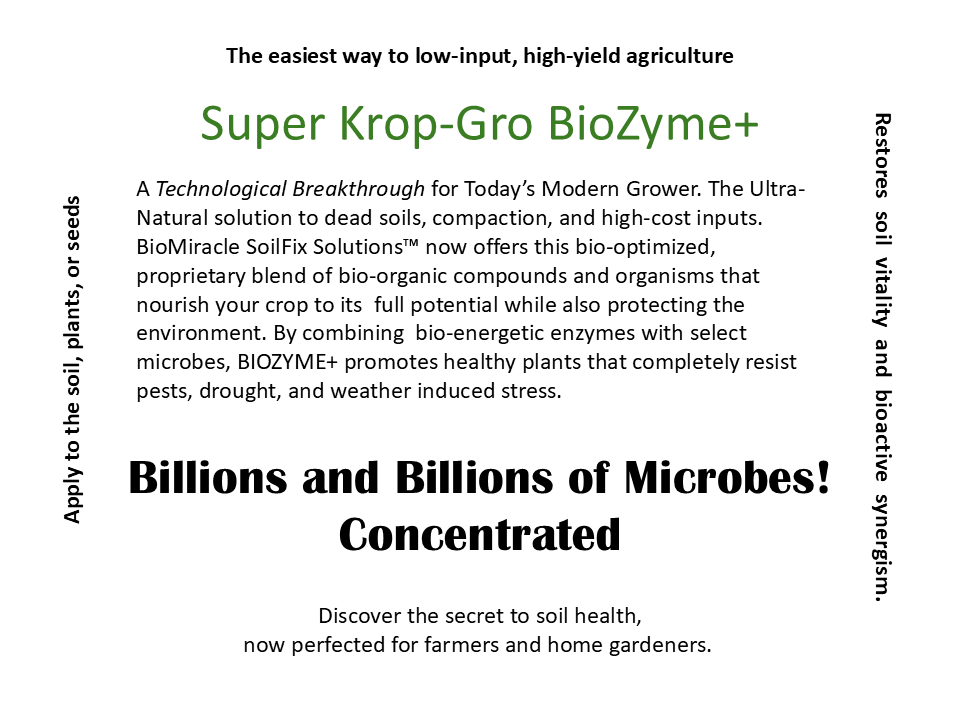
Figure 1. Left, a small sample of the many soil health products on the market. Right, a made-up soil health product label that draws from many of the actual product labels I’ve seen.
First, identify your specific problem
Before you even look for a solution, identify your specific problem. Convincing people they have a problem that a product can solve is Marketing 101. For example, “I need more soil health” may be accurate, but lacks the specifics you need to figure out a solution. Getting very specific about your problem will protect you from being sold on problems that you don’t have. It will also help you identify the most viable solutions for your problem.
Consider the problems of “depleted soil biology,” “dead soils,” and similar. What evidence do you have that this is a problem in your soil? Can you measure it? What will change for you when the problem is solved? Soil testing labs now offer more soil health tests than ever before, but it’s not clear that chasing a particular soil health test value will meaningfully change the way your soil functions.
For example, what evidence is there that your soil’s fungal:bacterial ratio is a problem (Fierer et al. 2021; Wang et al. 2019)? What would an ideal ratio for that number even be? Contrast that with problems like soil compaction, crusting, and poor infiltration, which have specific, negative effects on plant growth and specific, evidence-based solutions.
Also, be wary of someone telling you it’s a problem that your farm isn’t working like nature. Annual cropping does not work like nature by design. The goal of agriculture is to reliably produce food and fiber for large numbers of people year after year, something that nature doesn’t do. While we can learn things from nature, we shouldn’t make it a goal to mimic nature mindlessly. Focus on concrete problems like “soil erosion” rather than abstract goals like “mimic nature.”
Next, choose a time-tested practice
Once you have identified your specific problem, you need a solution. Before spending your money on an unproven product, try a time-tested practice. In my experience, many of the soil problems that farmers face can be addressed with practices summarized in two principles: maximize photosynthesis and minimize tillage (Figure 2). For example, if you have trouble with soil compaction, you’ll have much better success with increasing the amount of organic material being added to the soil and decreasing the amount you disturb the soil than you will with any of the new soil health products on the market.
| Practices that Help Maximize Photosynthesis: | Practices that Help Minimize Tillage, in order of effectiveness: |
|---|---|
| Relay crops | No-till/Direct seeding |
| Cover crops | Strip-till |
| Perennial crops | Vertical tillage |
| Overwintering crops and cover crops | Non-inversion tillage |
| Manure/compost, imported photosynthesis |
| Practices that facilitate the above practices to maximize photosynthesis: | Practices that facilitate the above practices to help minimize tillage: |
|---|---|
| Livestock grazing | Livestock grazing |
| Crop rotation | Crop rotation |
| Nutrient management | Residue management |
| Pest management | Weed management |
| Irrigation | |
| No-till, strip-till, practices that reduce field prep time between crops |
Figure 2. Two soil health principles and the practices that produce or facilitate them. One advantage of practices over products is that, despite growing knowledge of soil biology, the suite of soil-building practices has changed little over the past several decades.
The practices associated with these principles have been shown to provide soil benefits across a range of cropping systems, soils, and climates over decades, if not centuries. See “Building Soils for Better Crops”, a free online resource, for more details about time-tested practices that can address various soil problems.
Also, note that these practices directly address specific problems through well documented and clear mechanisms. Cover crops decrease erosion directly by holding the soil with their roots and slowing water flow with their shoots. No-till decreases erosion directly by leaving protective crop residues in place. Adding bulk amounts of compost and manure improves soil structure directly by adding soil organic matter. The mechanisms that solve the problems are understandable, not the “vitalize, optimize, and energize” of supercharged product marketing.
Why prefer practices over products?
Here are two reasons to prefer a soil-building practice over a soil health product:
- Soil health products don’t improve the soil’s physical conditions, soil-building practices do.
- Microbes in soil inoculants don’t survive long after being applied to soils.
These have been observed over decades and have solid explanations behind them.
You can’t bio-product your way to soil health.
Most soil health products are aimed at changing the soil’s biological state. However, a soil’s biological state is largely determined by the physical and chemical conditions of the soil.
- Physical: aggregates, soil structure, pores etc. (Young et al., 2008)
- Chemical: pH, nutrient levels, flow of carbon through the soil (Janzen, 2015)
If a soil’s physical or chemical state is poor, then neither existing nor applied microbes will thrive. Why add microbes to a soil where existing microbes aren’t thriving? Instead, the solution is to improve the conditions using soil-building practices so the existing microbes can flourish. It’s the “Field of Dreams” approach: build the right conditions, and they will come. This includes practices used to manage pH, like liming. Known as the master variable, pH is important in driving microbial communities (Zhou et al., 2020)
And if the soil’s physical and chemical conditions are good, conducive to a thriving biology, then it’s a safe bet that your soil already contains all the microbes and bio-chemicals it needs (with some exceptions, like Rhizobium for certain legumes).
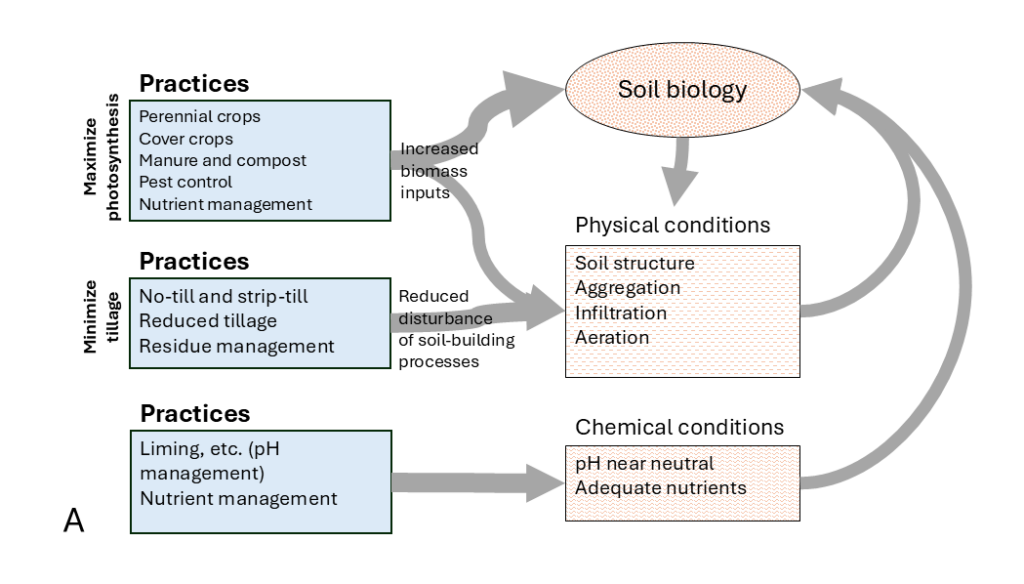
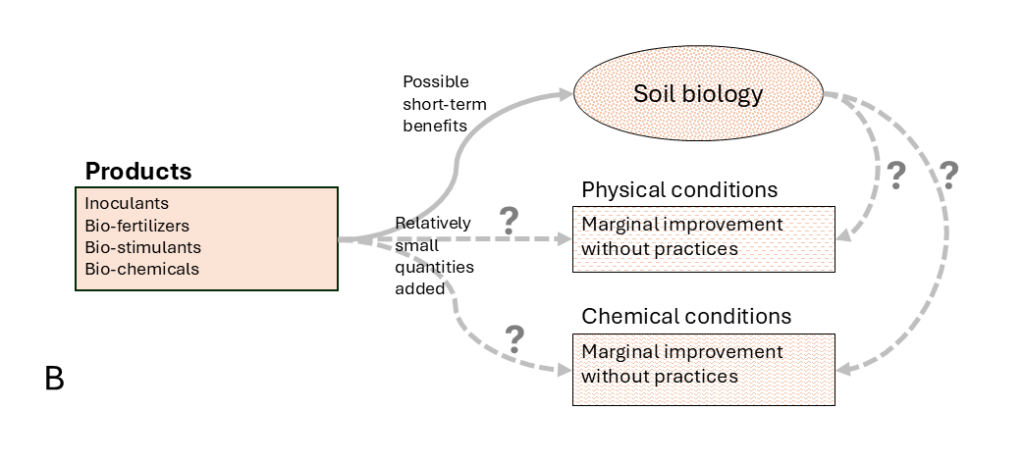
Figure 3. Comparing effects of practices and products on soil physical, chemical and biological aspects. (A) Starting with Practices benefits soil physical, chemical and biological conditions. (B) Starting with Products might provide short-term biological benefits but compared to time-proven practices, does little for the physical or chemical conditions that favor soil biology.
Hostile soil conditions and native microbes
Another reason to prioritize soil building practices over soil health products is that the microbes in soil inoculants don’t survive long after being applied to soil in any condition. This is because of the way soil inoculants are produced. First, only a small portion of soil microbes can be cultivated outside their natural environment, leaving many unavailable for use in inoculants (Steen et al., 2019). Then, from this limited group, companies select microbes that can be mass produced and stored for future application. The selected microbes are then produced within a narrow range of controlled conditions, much different from the wide range of micro-environments found in cropped soils. Finally, introduced microbes face competition from well-adapted native microbes. Because of all these factors, applied microbes typically decline rapidly after application (van Veen et al., 1997; Kaminsky et al., 2019; O’Callaghan et al., 2022; Fadiji et al., 2024).
“A key factor involved in the lack of success [of microbial releases into soils] has been the rapid decline of the size of populations of active cells, to levels ineffective to achieve the objective…”
van Veen et al. (1997)
For example, in two recent studies (Fischer et al., 2010; Sharma et al., 2017) in pots with high inoculation levels, microbes declined rapidly and were undetectable after two months. Similar rapid declines are observed even with those microbes abundant in manure and compost (Schlatter et al., 2022; 2023), and, I presume, their extracts and teas. This widely observed decline of inoculant microbes is thought to be the main reason for their inconsistency in many field trials (Practical Farmers of Iowa PFI, 1995) including recent field studies of products in potato production (Thurgood et al., 2023), soybean seed treatments (Temple, 2024), and nitrogen-fixing bacteria (Franzen et al., 2023).
“Microbial inoculants tend to be chosen based on their activity in controlled laboratory screenings and for ease of mass cultivation,”
Kaminsky et al. (2019)
So, it’s unlikely that non-native, mass-produced microbes, introduced in relatively small amounts, will thrive on your farm, especially if your soil conditions don’t support the microbes already present. And if you need to improve your soil’s physical condition, the best way is through proven soil-building practices.
Skeptical open-mindedness
Given the increasing number of soil health products on the market and the boldness of their claims about soil health, I recommend approaching everything with a healthy dose of skepticism. However, as I mentioned in my previous post about published science, the goal isn’t to reject every new product or claim but to approach them with skeptical open-mindedness.
Be skeptical, because marketing often tries to convince us to buy things we don’t need. And be open-minded, because breakthrough products are possible. Our understanding of soils, especially its microbiology, is still incomplete, so it’s possible that some products may end up proving useful or even revolutionary. Only time will tell. However, until these new products are as reliable and consistent as time-proven practices, choose soil-building practices over soil health products.
“Used to be anybody could farm. All you needed was a strong back…but nowadays you need a good education to understand all the advice you get so you can pick out what’ll do you the least harm.”
Vermont saying, mid-1900s.
All Perspectives from Andrew McGuire
References
Fadiji, A.E., C. Xiong, E. Egidi, and B.K. Singh. 2024. Formulation challenges associated with microbial biofertilizers in sustainable agriculture and paths forward. Journal of Sustainable Agriculture and Environment 3(3): e70006. doi: 10.1002/sae2.70006.
Fierer, N., S.A. Wood, and C.P. Bueno de Mesquita. 2021. How microbes can, and cannot, be used to assess soil health. Soil Biology and Biochemistry 153: 108111. doi: 10.1016/j.soilbio.2020.108111.
Fischer, S.E., E.C. Jofré, P.V. Cordero, F.J. Gutiérrez Mañero, and G.B. Mori. 2010. Survival of native Pseudomonas in soil and wheat rhizosphere and antagonist activity against plant pathogenic fungi. Antonie van Leeuwenhoek 97(3): 241–251. doi: 10.1007/s10482-009-9405-9.
Franzen, D., J. Camberato, E. Nafziger, D. Kaiser, K. Nelson, et al. 2023. Performance of selected commercially available asymbiotic N-fixing products in the north central region. North Dakota State Extension 4.
Ikoyi, I., A.M. Duff, J.A. Finn, D.P. Wall, T. Kostic, et al. 2024. Manipulation of sward diversity is a more effective management strategy than addition of microbial inoculants in intensively managed grassland. Plant Soil. doi: 10.1007/s11104-024-06849-7.
Janzen, H.H. 2015. Beyond carbon sequestration: soil as conduit of solar energy. European Journal of Soil Science 66(1): 19–32. doi: 10.1111/ejss.12194.
Kaminsky, L.M., R.V. Trexler, R.J. Malik, K.L. Hockett, and T.H. Bell. 2019. The Inherent Conflicts in Developing Soil Microbial Inoculants. Trends in Biotechnology 37(2): 140–151. doi: 10.1016/j.tibtech.2018.11.011.
McQuilken, M.P., P. Halmer, and D.J. Rhodes. 1998. Application of Microorganisms to Seeds. In: Burges, H.D., editor, Formulation of Microbial Biopesticides: Beneficial microorganisms, nematodes and seed treatments. Springer Netherlands, Dordrecht. p. 255–285
O’Callaghan, M., R.A. Ballard, and D. Wright. 2022. Soil microbial inoculants for sustainable agriculture: Limitations and opportunities. Soil Use and Management 38(3): 1340–1369. doi: 10.1111/sum.12811.
Practical Farmers of Iowa PFI. 1995. OnFarm Research of Biologicals 1986-1994 Practical Farmers of Iowa – SARE Grant Management System. SARE.
Schlatter, D.C., J.D. Gamble, S. Castle, J. Rogers, and M. Wilson. 2022. Abiotic and biotic filters determine the response of soil bacterial communities to manure amendment. Applied Soil Ecology 180: 104618. doi: 10.1016/j.apsoil.2022.104618.
Schlatter, D.C., J.D. Gamble, S. Castle, J. Rogers, and M. Wilson. 2023. Abiotic and Biotic Drivers of Soil Fungal Communities in Response to Dairy Manure Amendment. Applied and Environmental Microbiology 0(0): e01931-22. doi: 10.1128/aem.01931-22.
Sharma, R., J.S. Paliwal, P. Chopra, D. Dogra, V. Pooniya, et al. 2017. Survival, efficacy and rhizospheric effects of bacterial inoculants on Cajanus cajan. Agriculture, Ecosystems & Environment 240: 244–252. doi: 10.1016/j.agee.2017.02.018.
Steen, A.D., A. Crits-Christoph, P. Carini, K.M. DeAngelis, N. Fierer, et al. 2019. High proportions of bacteria and archaea across most biomes remain uncultured. The ISME journal 13(12): 3126–3130.
Temple, L. 2024. Biological Seed Treatments: The Big Picture – Research Highlight – Soybean Research & Information Network – SRIN. Soybean Research and Information Network. (accessed 26 August 2024).
Thurgood, C.R., F. Gonzalez-Tapia, Z.J. Holden, and M.J. Pavek. 2023. Nontraditional production additives fail to improve potato yield and economic return. Agronomy Journal 115(2): 801–816. doi: 10.1002/agj2.21259.
van Veen, J.A., L.S. van Overbeek, and J.D. van Elsas. 1997. Fate and activity of microorganisms introduced into soil. Microbiology and Molecular Biology Reviews 61(2): 121–135. doi: 10.1128/mmbr.61.2.121-135.1997.
Wang, X., W. Zhang, Y. Shao, J. Zhao, L. Zhou, et al. 2019. Fungi to bacteria ratio: Historical misinterpretations and potential implications. Acta Oecologica 95: 1–11. doi: 10.1016/j.actao.2018.10.003.
Young, I.M., J.W. Crawford, N. Nunan, W. Otten, and A. Spiers. 2008. Microbial Distribution in Soils: Physics and Scaling. Advances in Agronomy. Academic Press. p. 81–121
Zhou, Z., C. Wang, and Y. Luo. 2020. Meta-analysis of the impacts of global change factors on soil microbial diversity and functionality. Nat Commun 11(1): 3072. doi: 10.1038/s41467-020-16881-7.
Comments