Adaptive grazing and holistic management improve rangeland health, forage production, and economic resilience in semi-arid ranching systems.
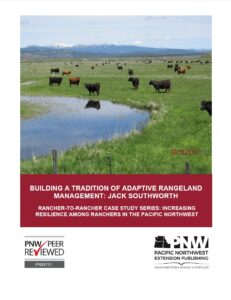
This case study profiles Jack Southworth, who manages a cow-calf-yearling operation in the high-desert rangelands and dry forests near Seneca, Oregon. Southworth applies holistic management principles that integrate ecological, economic, and social goals to support long-term ranch viability. His approach emphasizes adaptive grazing, including high-density, short-duration grazing with long recovery periods, delayed spring grazing based on plant phenology, and annual monitoring of vegetation and soil conditions. He has also improved degraded rangelands by seeding non-native perennial species and diversifying forage resources to increase productivity and extend the grazing season. These practices support soil health, water retention, and nutrient cycling while maintaining forage production. Southworth’s operation remains flexible through strategies such as adjusting herd size in response to forage availability and experimenting with grazing, seeding, and herd genetics. Overall, the case highlights how adaptive management, monitoring, and diversification can improve resilience to climate variability while sustaining profitability and rangeland health.
This publication is part of an archive and may not meet current digital accessibility standards. CSANR is working to improve digital accessibility of all materials. If you need this content in an alternative format, please contact csanr@wsu.edu.
Authors
Hall, S. A., Hudson, T., Yorgey, G., Neibergs, S., and Reeves, M.
Related Products
- Grazing Management that Achieves Multiple-Use Goals: Russ Stingley
- Grazing for Multiple-Use Goals: The Stingleys Video
- Building Resilience Through Engagement: Brenda and Tony Richards
- Building Resilience Through Engagement: Brenda and Tony Richards Video
- Ranching, Grass, Cattle, and Community: Jack Southworth Video
- Maximizing Water Through Holistic Management: Maurice and Beth Robinette Video
- The Benefits of Summer Calving: Maurice and Beth Robinette Video
- A Community-Based Response to Flooding: Jay Gordon
- A Community-Based Response to Flooding: Jay Gordon Video
- Deficit Irrigation of a Diverse Irrigated Rotation: Jake Madison
- Deficit Irrigation: Jake Madison Video
- Strip Tillage for Onions and Sweet Corn: Lorin Grigg
- Strip Tillage in Onions: Lorin Grigg Video
- Strip-tilled and Direct-seeded Vegetables Integrated with Cattle Grazing: Eric Williamson
- Strip Tillage of Vegetables with Livestock Integration: Eric Williamson Video
- Stripper Header and Direct Seeding: Ron and Andy Juris
- Stripper Header and Direct Seeding: Ron and Andy Juris Video
- Variable Rate Nitrogen Application: Eric Odberg
- Precision Nitrogen Application: Eric Odberg Video
- Biofumigant Cover Cropping in Potatoes: Dale Gies
- Mustard Cover Cropping in Potatoes: Dale Gies Video
- Diversifying Dryland Direct Seed Systems: Steve and Nate Riggers
- Growing Diverse Crops: Steve and Nate Riggers Video
- Grazed Cover Cropping: Drew Leitch
- Grazed Cover Cropping: Drew Leitch Video
- Enhancing Crop Diversity: Steve and Becky Camp
- Enhancing Crop Diversity: Steve and Becky Camp Video
- Flex Cropping: Bill Jepsen
- Flex Cropping: Bill Jepsen Video
- Conservation Tillage in a Winter Wheat–Fallow System: Ron Jirava
- Conservation Tillage in a Winter Wheat–Fallow System: Ron Jirava Video
Related Project
Year Published
2019
Area of Focus
Agricultural Practices and Climate & Environment
Topics
Livestock, Natural Resources, and Production Systems
Collaborator

Funding Sources
- McIntire-Stennis
- USDA Great Plains Climate Hub