Drew Leitch integrates grazed cover crops into dryland rotations to support soil health and livestock production.
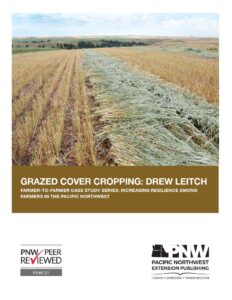
This publication profiles Drew Leitch, a dryland farmer and cattle producer near Nezperce, Idaho, who is experimenting with grazed cover crops in wheat-based rotations. Leitch grows winter and spring wheat, Kentucky bluegrass, canola, garbanzo beans, peas, and lentils, while also managing a cow-calf operation. The case study describes how he uses spring-seeded cover crop mixes to provide summer forage when pasture quality declines, while leaving roots, residues, and manure to support soil health. It also discusses fall cover crops planted after winter wheat, grazing management, forage quality, residue management, water concerns, soil compaction, soil acidification, disease risks such as black leg in brassicas, and costs and benefits of replacing an annual crop with grazed cover crops. The publication frames grazed cover cropping as an early-stage but promising approach for improving soil health, livestock profitability, and farm resilience.
This publication is part of an archive and may not meet current digital accessibility standards. CSANR is working to improve digital accessibility of all materials. If you need this content in an alternative format, please contact csanr@wsu.edu.
Authors
Yorgey, G., Borrelli, K., Painter, K., and Finkelnburg, D.
Related Products
- Grazing Management that Achieves Multiple-Use Goals: Russ Stingley
- Grazing for Multiple-Use Goals: The Stingleys Video
- Building Resilience Through Engagement: Brenda and Tony Richards
- Building Resilience Through Engagement: Brenda and Tony Richards Video
- Building a Tradition of Adaptive Rangeland Management: Jack Southworth
- Ranching, Grass, Cattle, and Community: Jack Southworth Video
- Maximizing Water Through Holistic Management: Maurice and Beth Robinette Video
- The Benefits of Summer Calving: Maurice and Beth Robinette Video
- A Community-Based Response to Flooding: Jay Gordon
- A Community-Based Response to Flooding: Jay Gordon Video
- Deficit Irrigation of a Diverse Irrigated Rotation: Jake Madison
- Deficit Irrigation: Jake Madison Video
- Strip Tillage for Onions and Sweet Corn: Lorin Grigg
- Strip Tillage in Onions: Lorin Grigg Video
- Strip-tilled and Direct-seeded Vegetables Integrated with Cattle Grazing: Eric Williamson
- Strip Tillage of Vegetables with Livestock Integration: Eric Williamson Video
- Stripper Header and Direct Seeding: Ron and Andy Juris
- Stripper Header and Direct Seeding: Ron and Andy Juris Video
- Variable Rate Nitrogen Application: Eric Odberg
- Precision Nitrogen Application: Eric Odberg Video
- Biofumigant Cover Cropping in Potatoes: Dale Gies
- Mustard Cover Cropping in Potatoes: Dale Gies Video
- Diversifying Dryland Direct Seed Systems: Steve and Nate Riggers
- Growing Diverse Crops: Steve and Nate Riggers Video
- Grazed Cover Cropping: Drew Leitch Video
- Enhancing Crop Diversity: Steve and Becky Camp
- Enhancing Crop Diversity: Steve and Becky Camp Video
- Flex Cropping: Bill Jepsen
- Flex Cropping: Bill Jepsen Video
- Conservation Tillage in a Winter Wheat–Fallow System: Ron Jirava
- Conservation Tillage in a Winter Wheat–Fallow System: Ron Jirava Video
Related Project
Year Published
2016
Area of Focus
Agricultural Practices
Topics
Crops, Livestock, Production Systems, and Soils & Fertility