Perspectives
Practical insights and opinions from agriculture and natural resources experts—brought to you by the Center for Sustaining Agriculture and Natural Resources.
Can Sticks and Small Trees Power Planes?
By Chad Kruger, Chris Sater, Margaret Griset, Kristin Brandt, Dane Camenzind, Joshua Cardin, Jonathan Male, and Andy Perleberg, Washington State University; Francesca Pierobon and Daniel Santosa, Pacific Northwest National Laboratory
Forest biomass is already being used to produce jet fuel but scale up requires a long-term public-private partnership that values the benefits of good forest management.
The U.S. Sustainable Aviation Fuel (SAF) Grand Challenge aims to domestically produce 3 billion gallons of SAF by 2030 and 35 billion gallons by 2050 (DOE et al. 2022). SAF is an alternative fuel used for air transportation made from non-petroleum feedstocks. According to a recent study, the U.S. could supply enough biomass to meet SAF demand, including roughly 63 million tons from forests (Billion Ton Report 2023). Processes like pyrolysis, hydrothermal liquefaction (HTL) and gasification can transform woody material into biocrude intermediates that can be turned into SAF.
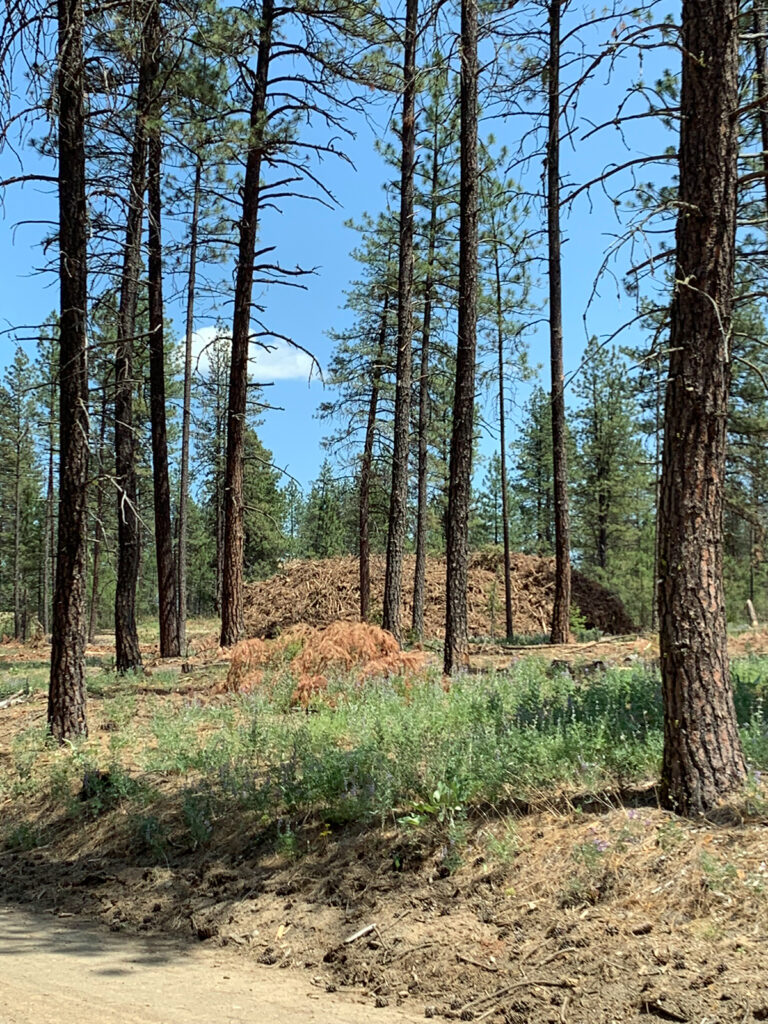
Forest biomass for SAF production includes post-timber harvest (“logging”) residues, consisting of tops, live/dead branches, and foliage. This biomass is currently underutilized and left on the forest floor to decompose or piled and burned in prescribed fires. It is estimated that the U.S. Pacific Northwest could provide enough forest residues to feed two jet-fuel plants of a size of about 0.78 MM dry t/y in WA and OR.
To learn more about the promise and challenges of gathering and using forest biomass for jet fuel production, Pacific Northwest National Laboratory partnered with Washington State University’s Extension Forestry Program and Center for Sustaining Agriculture and Natural Resources to host seven listening sessions with over 140 participants, including landowners, foresters, tribes, state agency staff, environmental advocates, and others. Participants were asked to provide their perspective about perceived economic, environmental, and fire management challenges associated with forest biomass collection for biofuel production.
The discussion focused on three main topics:
- Operational challenges related to getting forest residues out of the woods;
- Economics of collecting and transporting forest residues;
- Other impacts, e.g., wildfires. Participants also discussed potential solutions to overcome current barriers.
Operational challenges
The listening sessions revealed that private forest landowners are eager to participate in bioenergy programs if widespread practical hurdles can be overcome, starting in the woods. First, it is difficult to maneuver chippers in dense stands, and there may be limited room for a dump truck or chip van to collect chips. It is also hard to move material down to a flat, accessible spot where it can be piled and loaded onto trucks. On steep ground and in dense stands, getting material to these landing sites is a major share of the work. Currently few contractors have the right machines, and trained labor is limited. Renting specialized equipment can be expensive.
Economics of collecting and transporting forest residues
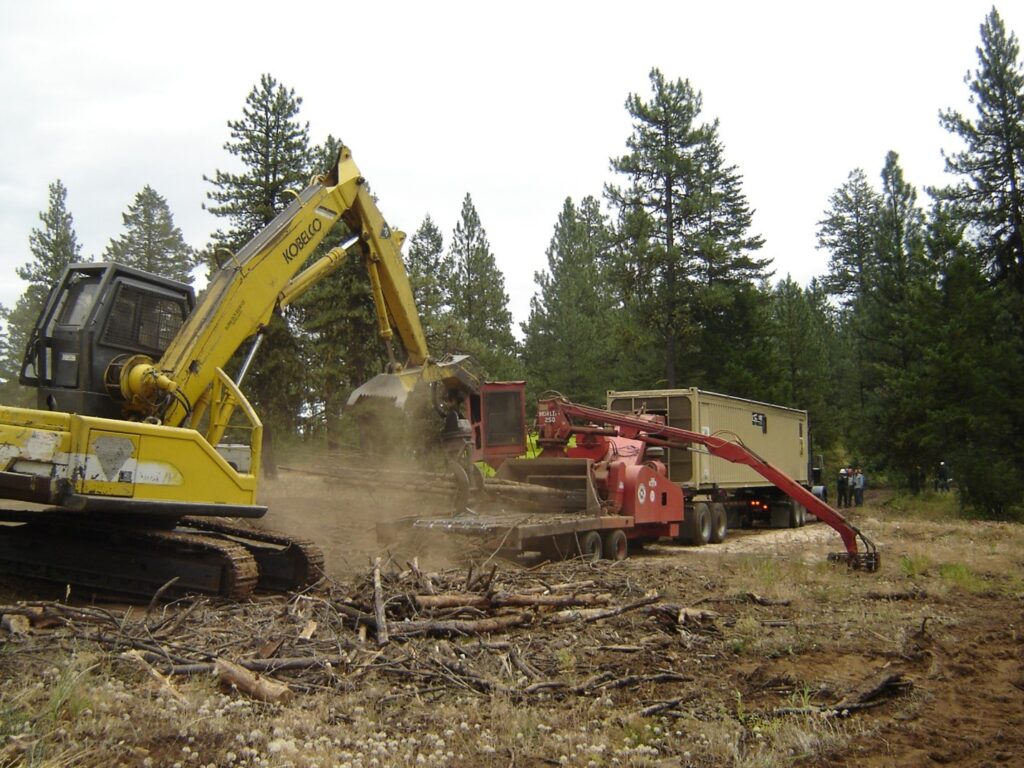
For forest biomass to be cost competitive, the price of biomass paid to forest landowners and loggers needs to be sufficient to cover biomass collection costs. Examples of costs shared in the sessions included about $4,500 per acre in southeast Washington for thinning, pruning, and slash disposal; in the northeast, removing brush and dead trees was cited at $1,500–$3,000 per acre, plus $3,000–$4,000 per acre to chip the material. One campground paid about $2,000 per acre to grind, collect, and load forest material that was already at a landing, not including hauling.
The distance to processing facilities is an important cost factor. Participants said a facility would generally need to be within 30 to 75 miles of where material originates, with less than 50 miles preferred to limit trucking costs. The scale of a facility also matters to the type of product produced, with higher value fuel products needing larger facilities that draw from greater geographic areas.
The impact of wildfires
Participants discussed the importance of preventing large forest fires. Thinning small trees, taking off lower limbs, and clearing dead brush can reduce “ladder fuels” and help keep fire on the ground rather than in the canopy. They also pointed to the broader impacts of large fires, such as damaged soil and habitat, losses in salmon streams, threats to homes and communities, and health costs from smoke. Referencing a Headwaters Economics study (2018), it was suggested that the true community cost of wildfire can be multiple times higher than the cost of fighting large fires. Participants emphasized that getting forests back on a sustainable trajectory that reduces the fire risk was one of their biggest priorities, recognizing the role of biomass removal to achieve that goal. Participants agreed on the importance of forest health, but not on how to achieve it. Most participants advocated active forest management, with a small number suggesting no intervention is the best solution.
Overall, leaving excess biomass in the woods represents a missed opportunity and can cause air pollution when slash piles are combusted in managed burns or wildfires. Controlled combustion in energy facilities releases far fewer fine particles because particles are captured from the flue gas. Using some of this material for energy and/or fuel production can reduce human health impact and local pollution.
References
U.S. Department of Energy. 2023 Billion‐Ton Report: An Assessment of U.S. Renewable Carbon Resources. M. H. Langholtz (Lead). Oak Ridge, TN: Oak Ridge National Laboratory. ORNL/SPR-2024/3103. doi: 10.23720/BT2023/2316165 (2024).
U.S. Department of Energy, U.S. Department of Transportation, and U.S. Department of Agriculture, in collaboration with the U.S. Environmental Protection Agency. 2022. SAF Grand Challenge Roadmap: Flight Plan for Sustainable Aviation Fuel.
Headwaters Economics. 2018. The Full Community Cost of Wildfire.
Acknowledgement
This material is based upon work supported by the U.S. Department of Energy’s Office of Critical Minerals and Energy Innovation (CMEI) through Bioenergy Technologies Office under the Award Number DE-NL0053422 and DE-AC05-76RL01830.
Comments
I work on the supply side (forester) and have always wanted a way to deal with all the non-merchantable products rather than just piling and burning. We do a lot of fuels reduction projects for small landowners. None of these projects can be done without cost share programs as most landowners will not do the work if it is all out of pocket costs.
Even with timber harvest included merchantable product prices are essentially the same as they were in the late 70’s to early 80’s while extraction costs have risen to the point that landowners are lucky to get 20 to 35% return from gross revenues on a timber harvest while they were able to make 50 to 60% 20 years ago. This makes the incentive to reinvest in their timber lands very low.
All alternative methods for dealing with excess biomass / slash/ unmerchantable products are extremely expensive even if the work is coupled with merchantable product harvest. Extraction of the non-merch is really a separate process from the merch harvest and requires different equipment. Each type of process merch or non-merch requires very high capital costs to begin and sustain operations. Most companies cannot afford the scale of operations of equipment to keep all processes sustainable without sustainable markets. Most of these operations have a small geographic operating base area of several counties and it becomes cost and manpower prohibitive to move much outside this area. Rarely does a harvesting type operation move outside this operating area.
The logistics of where and how to set up final product plants always seems to be on a grand scale. Meaning very large facilities to meet final product production economies of scale but end up with extremely high raw materials costs because the plants are setup with final product transportation costs and plant operations in mind.
Regulatory barriers and permitting costs (especially in WA) should also be considered. These will usually push to larger processing facilities to cover the start up and annual permitting costs as well as emissions requirements construction costs that are much cheaper at the margin on a much larger facility. Our own regulations and rules push us to unsustainable sizes of production facilities. In much of the forested areas of Europe many small villages create their own electricity from small scale biomass energy plants. Our regulatory environment makes this more than impossible here in the US.
Has anyone looked at small scale production facilities where electricity can be generated for localized markets and create by-products that can be used for the sustainable fuels as well as other final product uses. This way the raw materials are already more refined before they get to a larger final product facility which should help reduce transportation costs significantly.
Raw product supply in the inland NW will be tied heavily to federal lands. Federal lands make up much more of the available supply than any of the NIPF lands. NIPF in the WUI areas will contribute some but extremely small portion compared to federal lands. Even though there are extreme needs for sustainable management on federal lands, the political will, regulatory environment and public acceptance of this type of management will need to be addressed to create the supplies that will be needed.
I wish you well and hope you can find solutions to all of these parts and pieces. I have been watching this develop the last 20 years and have been thinking about these things over my more than 40 yr career and unfortunately just watched it get chewed up in the political, regulatory and research funding games that get played.
With respect to removing lower limbs, I have learned by hard experience that doing so on Larch trees on south facing slopes causes the bark to sunscald on the Southwest side and often kills the tree. This fact is mentioned but quite heavily buried in the literature.