Perspectives
Practical insights and opinions from agriculture and natural resources experts—brought to you by the Center for Sustaining Agriculture and Natural Resources.
Common Ground: A Narrow Organic Vision of Regenerative Agriculture
By Andrew McGuire, CSANR Senior Extension Fellow
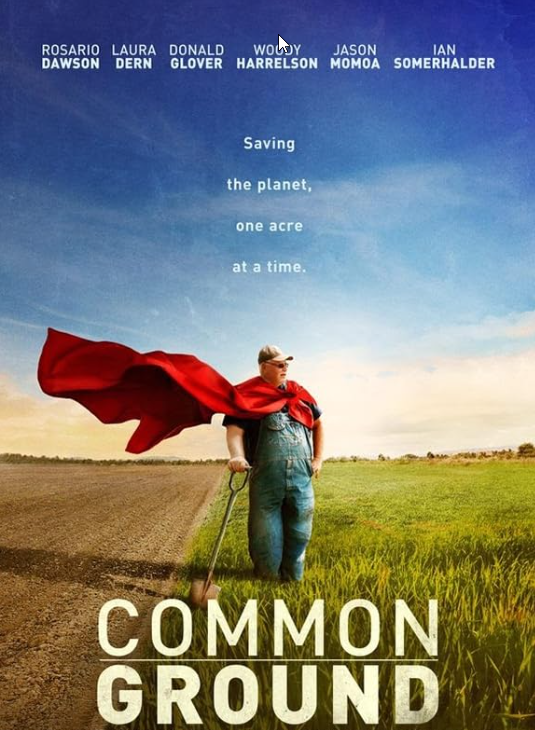
Released in April 2025 on Amazon Prime, the documentary Common Ground offers a visually entertaining, emotionally charged vision of farming change. Framed by celebrity narration and personal stories, it promotes regenerative agriculture and a host of other changes it says are needed to transform agriculture. But beneath the slick editing and heartfelt anecdotes lies a selective version of reality, one that elevates organic production without synthetic chemicals while dismissing the broader spectrum of successful farming systems in use today.
Soil Erosion: A Strong Starting Point
“With much of the planet’s soil turned to dust [due to agriculture] we found ourselves in a race towards extinction.” So goes the film’s dramatic opening montage narrated by various celebrities. Ignoring the hyperbole, which continues throughout, Common Ground highlights one of agriculture’s long-term challenges: soil erosion. Scenes of a bare, tilled field adjacent to a perennial pasture with tree windbreaks show how land management affects soil stability. This is the Common Ground’s strongest and most valid point. Erosion is an ongoing concern that deserves serious attention.
This would have been a good point in the film to highlight conventional no-till cropping, but the directors had a different agenda.
A Narrow Organic Version of Regenerative Agriculture
Regenerative agricultural practices can help control erosion. Unfortunately, the regenerative agriculture promoted in Common Ground is selective, limited to the organic version. The film presents four core practices as defining regenerative agriculture: no tillage, cover crops, planned grazing with animals—so far, so good—and then “no synthetic chemicals” or “NO CHEMICALS” as shown on the screen. The rest of the film builds on this preference for organic farming.
As an example, the film highlights Rick Clark, an organic farmer managing 7,000 acres. His farm is presented as a model of large-scale regenerative success. The film praises his use of roller crimpers, cover crops, and a no-till drill, and claims that if all farmers followed his example, they could each save a million dollars per year. Little detail is provided about crop yields or the price premiums needed to make the economics work on the farm. Nor is there any mention of what food prices would be if our whole system switched to organic.
Throughout, the film reinforces its organic orientation by never missing an opportunity to use the word “chemical,” often preceded by “toxic.” It also repeats common tropes: attacking genetically modified crops, glyphosate, and Monsanto without engaging with nuance or evidence.
The vast majority…95% of farmers and ranchers, they don’t understand [the soil].
Gabe Brown in Common Ground
Personal Stories as Proof: The Danger of Anecdote
Continuing with the organic promotion, the film strongly suggests that pesticides cause illness. Its evidence: anecdotes. Farmers and families share personal health crises—cancer, Crohn’s disease—that are attributed to pesticide exposure. Near the end, it’s revealed that the film’s hero, Gabe Brown, was diagnosed with ALS and hints that this is also due to his exposure to pesticides. These stories are moving, but anecdotes are not evidence. These illnesses are complex and have multiple causes; linking them directly to pesticides misleads more than it informs. The film does not cite epidemiological studies or data about farming-related health risks (for such evidence, see Stoop, 2018). It leans on emotion, not evidence.
Nature as the Model: Idealism Over Realism
Throughout the film, the theme of “mimicking nature” is repeated. We are told that regenerative agriculture works with nature, not against it. Industrial agriculture is described as “killing things,” while regenerative agriculture is “working in harmony with nature.” The implication is that conventional agriculture tries to dominate or destroy natural systems. This is flawed thinking; agriculture has always been about controlling nature to some degree. Even practices promoted in the film, such as adaptive grazing or roller crimping, are forms of control requiring careful planning and management. Replacing herbicides with roller crimpers or animal grazing is not less artificial; it’s a different form of control. Organic systems use tillage and organic-approved pesticides that also kill things. Biocontrol and herbicides share similar aims. The film ignores integrated pest management, precision agriculture, and other evidence-based practices that don’t fit either extreme.
Nutrient cycling is another example of a questionable reliance on “natural.” The film suggests that microbes and mycorrhizal fungi can replace fertilizers by freeing phosphorus and potassium from the soil. It shows trees in a forest connected by fungal networks, implying that something similar happens in crop fields. But it never mentions the differences between wildlands and managed row crops. The science behind these claims is either oversimplified or not addressed.
We’re 50 years away from losing most life on this planet.
Jonathan Lundgren in Common Ground
Misleading History and Overblown Claims
The film’s historical framing is theatrical. While it mentions the Green Revolution, it fails to mention the dwarf wheat varieties and improved crop yields that were the key benefits of the event. It credits George Washington Carver with discovering how legumes fix nitrogen from the air and claims his vision of working with nature was abandoned after WWII in favor of “the killing power of chemical warfare.” Cue the dramatic footage of nuclear explosions and Nazis, followed quickly by crop spraying, to drive the point home. While such comparisons are visually gripping, they oversimplify a complex history.
Extraordinary claims are both regenerative agriculture’s attraction and a stumbling block. The film states that converting farmland to regenerative practices could offset all of our annual carbon emissions, a claim that exaggerates the potential of soil carbon sequestration and ignores scientific debate on the subject. One narrator claims that regenerative agriculture can go beyond restoring land to its pre-farming conditions and make it even better. How this is achieved is not addressed, and there are good reasons to think it’s impossible.
It goes on…claims about hemp as a miracle crop, legumes replacing nitrogen fertilizer needs, grazing practices making rain, and regenerative agriculture as a cure for the “human health crisis” are stated without context or nuance. The film promotes the idea that fungi will mine the soil for nutrients, but does not explain how that system supports continuous crop production or whether those nutrients must be replenished.
Hemp can save the world.
Common Ground
Science, Research, and Conspiracies
Related to these overblown claims, Common Ground casts suspicion on land-grant universities and the USDA, suggesting they are corrupt and suppress the truth. It claims students are “indoctrinated” into supporting industrial agriculture, yet it offers no evidence of widespread suppression or misconduct. Ironically, it ignores the fact that many of these institutions already promote organic agriculture (McGuire, 2017). There is no discussion of peer review, research safeguards, or the diversity of views in academic science.
Inspired by a True Story ≠ a True Story
Documentaries are based on facts, but as with fictional movies, they can be “based on a true story,” or merely “inspired by a true story.” Common Ground is the latter. It is persuasive filmmaking. The footage is striking, the editing tight, and the storytelling clever. But persuasive is not the same as accurate. Its portrayal of regenerative agriculture is limited to the narrow organic model, alienating most US farmers. And the arguments rely heavily on emotion and anecdote rather than strong evidence.
The film fails to show the reality of modern agriculture, instead opting for a simplistic version. It fails to show a conventional no-till cropping system. It fails to mention integrated pest management, precision agriculture, 4R nutrient management, or any practice that uses modern tools responsibly. A better future for agriculture will require honest conversations, acknowledging the inherent trade-offs of crop production, and robust evidence, not romanticizing nature or vilifying science. For those seeking a more factual analysis of agriculture, try Resetting the Table by Robert Paarlberg.
All Perspectives from Andrew McGuire
References
McGuire, A.M. 2017. Agricultural Science and Organic Farming: Time to Change Our Trajectory. Agricultural & Environmental Letters 2(1). doi: 10.2134/ael2017.08.0024.
Stoop, P. 2018. Pesticides and cancer among farmers: the rush towards irrefutability. European Scientist. www.europeanscientist.com/en/features/pesticides-and-cancer-among-farmers-the-rush-towards-irrefutability (accessed 5 May 2025).
Comments
Like politics, all agriculture is local.
I understand your scepticism 🙂
It’s really hard to understand that we are able to roll back time to before chemicals and still produce as farmers, but a lot do it anyway and successfully.
It’s a fact that pesticides etc. was invented for warfare by Fritz Harber for ww1 and later rebranded for agriculture when the sales from big chemical factories went down after ww2. check it.
Agreed that production facilities for ammonium nitrate as explosive could be used for fertilizer production post WWII. It helped stimulate the Green Revolution with the corresponding increase in yields.
There is an allegation that anhydrous ammonia, produced by Haber-Bosch was used to compact runways. Prof Olson, a WWII fighter pilot, a world authority on nitrogen, and one of my teachers said it was a myth. Our company has published a challenge that we would pay $1000 to anyone who could produce documentation of this use by the US military. In my 42-year career, I have had two persons accept the challenge, one phone call stating it was used in Korea, one in person for Viet Nam. After 20-plus years, I am awaiting the return response.
Yes, for a documentary, they favored storyline over holding to the facts.
There is a 15/20 second trailer for Common Ground on Prime. I find it interesting that the background music they use is the intro to “Teenage Wasteland” by The Who.
🙂