Limited observations require agricultural AI to combine existing knowledge, uncertainty, and more strategic data collection.
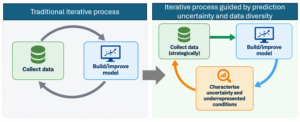
Agricultural datasets may contain extensive satellite imagery, sensor measurements, or other variables while still having relatively few high-quality observations for training and evaluating AI models. This Perspectives article examines that mismatch using agricultural examples, including a tillage-mapping project with approximately 600 ground-truth observations. Kirti Rajagopalan argues that AI models working with limited agricultural data should incorporate existing scientific knowledge rather than attempting to rediscover known relationships. Researchers should also quantify uncertainty for individual predictions and identify underrepresented crops, soils, production systems, environments, and years. Together, uncertainty and data diversity can guide researchers toward the observations most likely to improve a model. The goal is not merely to make agricultural datasets larger, but to develop AI approaches that use limited data and existing agricultural knowledge more effectively.
This publication is part of an archive and may not meet current digital accessibility standards. CSANR is working to improve digital accessibility of all materials. If you need this content in an alternative format, please contact csanr@wsu.edu.
Authors
Rajagopalan, K.
Related Products
- Deploying Satellite-Imagery Based Machine-Learning Models for Large-Scale Mapping of Tillage Practices: Final Report
- Deploying Satellite-Imagery Based Machine-Learning Models for Large-Scale Mapping of Tillage Practices: Progress Report
- From Roadside Surveys to Satellite-Based Maps: Mapping Tillage Practices in Eastern Washington
Related Project
Year Published
2026
Area of Focus
Agricultural Technology
Topics
Community Engaged Research and Production Systems