Statewide analysis quantifies water right forfeiture under Washington’s prior appropriation doctrine.
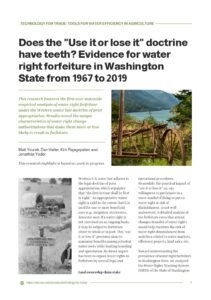
This research highlight presents the first statewide empirical analysis of water right forfeiture under Washington’s prior appropriation doctrine. Using data from the Washington Department of Ecology’s Water Rights Tracking System, the study examines forfeiture frequency and magnitude associated with water right change authorizations between 1967 and 2019. Results show that forfeiture frequency increased substantially after 2000, rising from roughly 10% prior to 2000 to 35% between 2001 and 2019. This shift reflects institutional, statutory, and court-driven changes that made review processes more stringent. While forfeiture frequency increased over time, forfeiture magnitude generally declined. Rates also varied by administrative region and by water right type, with irrigation rights exhibiting higher forfeiture risk and municipal/domestic rights showing greater forfeiture magnitude when reductions occurred. The findings clarify the real-world enforcement of the “use it or lose it” doctrine and provide important context for water market participation, irrigation efficiency changes, and land transactions.
This work was supported by the USDA National Institute of Food and Agriculture, project #1016467.
This publication is part of an archive and may not meet current digital accessibility standards. CSANR is working to improve digital accessibility of all materials. If you need this content in an alternative format, please contact csanr@wsu.edu.
Authors
Yourek, M., Haller, D., Rajagopalan, K., and Yoder, J.
Related Products
- Tech for Trade Water Management Survey: Summary Statistics and Documentation
- What Is the Accuracy of Seasonal Forecasts for Informing Agricultural Decisions?
- Can a Seasonal Drought Forecast Be Wrong and Still Worth Using for Making Water Leasing Decisions?
- Do Strong El Niño/La Niña Signals Translate to Higher Accuracy and Value of Seasonal Forecasts?
- Scientific Developments in Quantifying Consumptive Use and Crop Water Requirements for Washington State
- Crop Model-Data Fusion for On-Farm Estimation of Crop Evapotranspiration
- Integrating Satellite Images with Agriculture Modeling for Estimating Field Scale Crop Evapotranspiration and Irrigation Water Demand
- Water Markets in Washington State: What If Leasing Part of a Water Right Was Allowed?
- Nonpecuniary Effects on Farmer Behavior: Evidence from Washington State Farmers with Surface Water Irrigation
- Do “Nonpecuniary Benefits of Farming” or “Psychological Ownership” affect Water Markets?
- Agent-Based Model Development and Touchet Watershed Data Usage
- Use It or Lose It: The Economic Consequences of Forfeiture Rules Under the Prior Appropriations Doctrine
- A Field Level Economic Model of Regional Agricultural Production
- Open Water Trade: An Open-Source Smart Market for Water
- Incentivizing Multibenefit Outcomes in Surface and Groundwater Markets
- Open Water Trade: A Water Trading Exercise Software for Education and Water Market Design
- An Agent-Based Model for Assessing Agricultural Water Market Structure and Function
- Partnering with Practitioners in Developing Improved Information Technologies for Water Management
- Water Markets’ Potential for Addressing Drought, Water Availability
- Putting a Price on Water: Would Price Disclosure Increase Water Market Participation?
- Water Markets: The Complexity of Trading Private Rights to a Public Good
- A Framework to Evaluate Irrigation Efficiency Impacts Under a Changing Climate
- Climate Change & Stream Flow for Salmon: Barriers & Opportunities for Adaptation in Washington State
- Coevolution of Technology and Law for Water Management in Washington State and Beyond
- Lessons Learned from the Listening Sessions for the Technology for Trade Project
Related Project
Suggested Citation
Yourek, M., Haller, D., Rajagopalan, K., Yoder, J. 2024. Does the “Use It or Lose It” Doctrine Have Teeth? Evidence for Water Right Forfeiture in Washington State from 1967 to 2019. Technology for Trade Research Highlight. Washington State University.
Year Published
2024
Area of Focus
Water Resources & Policy
Topics
Production Systems and Water Resources