Support organizations face growing strain as heat and wildfire smoke increase risks for central Washington farmworkers.
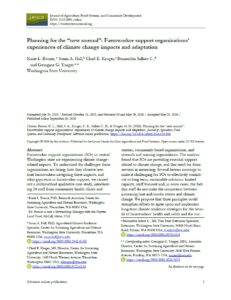
This qualitative case study examines how organizations supporting central Washington tree-fruit farmworkers are responding to increasing heat, wildfire smoke, and related climate impacts. Interviews with 24 staff, coalition meeting notes, and regional assessments revealed growing demand, limited organizational capacity, uneven recognition of climate change, and gaps in worker protections and enforcement. The authors recommend systemwide collaboration so adaptation strategies to benefit farmworker health and safety also contribute to sustainability of tree-fruit production.
This product is hosted on an external website and may not meet current digital accessibility standards.
Authors
Boone, K., Hall, S. A., Kruger, C., Sallato-Carmona, B., and Yorgey, G.
Related Products
- Practical Guide to Community Engagement: Approaches to Help Researchers Get Started
- Quick Reference Guide: Highlights of the Practical Guide to Community Engagement
- Practical Guide to Community Engagement: Resources to Help Researchers Go Deeper
- Engaged! A Conversation on Enabling Community Engaged Research at Washington State University
Related Project
Suggested Citation
Boone, K. L., Hall, S. A., Kruger, C. E., Sallato C., B., & Yorgey, G. G. (2026). Planning for the “new normal”: Farmworker support organizations’ experiences of climate change impacts and adaptation. Journal of Agriculture, Food Systems, and Community Development. Advance online publication. https://doi.org/10.5304/jafscd.2026.154.018
Year Published
2026
Area of Focus
Climate & Environment
Topic
Climate Change
Funding Sources
- Pacific Northwest Occupational Safety and Health Center