Perspectives
Practical insights and opinions from agriculture and natural resources experts—brought to you by the Center for Sustaining Agriculture and Natural Resources.
Soil Organic Matter in Natural Ecosystems vs. Cropped Fields: A Misleading Comparison
By Andrew McGuire, CSANR Senior Extension Fellow
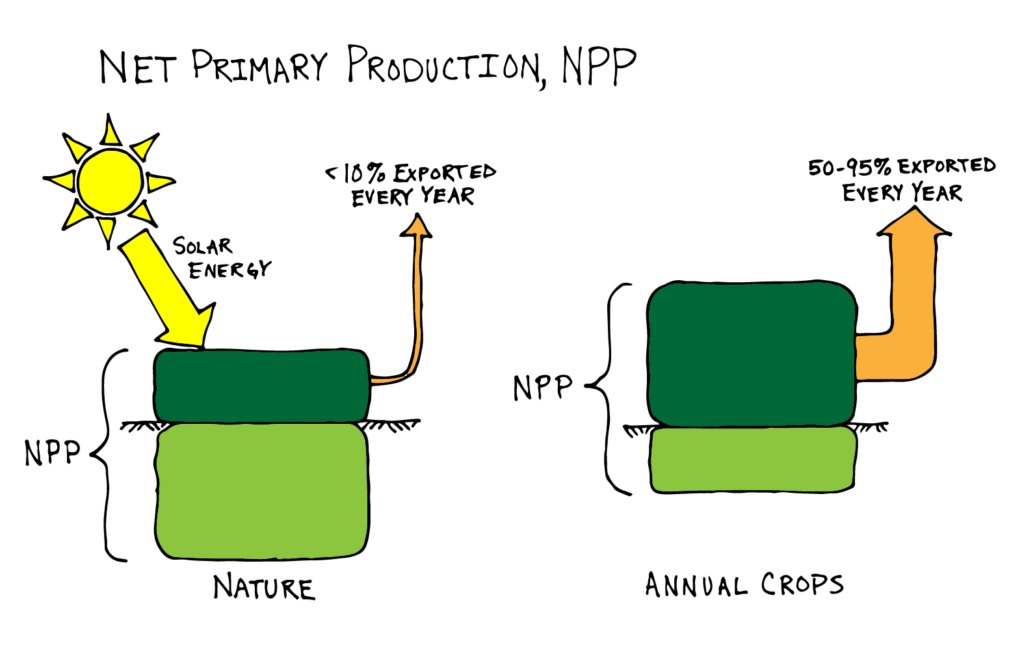
As described in a previous post, the energy flows of cropped fields and natural ecosystems differ greatly. In natural systems, most of the solar energy captured by plants stays within the ecosystem, cycling through local organisms and building soil organic matter. Cropping systems, however, are designed to harvest and export much of this energy as food, feed, or fiber. This necessary redistribution means cropped fields inherently support less non-crop life and accumulate less soil carbon compared to their natural counterparts, even if they produce similar or greater plant biomass. Understanding this trade-off is key to setting realistic soil health goals, whether it be for regenerative agriculture or for rating the health of soils.
Regenerative Agriculture Goals and Soil Health Evaluations
Although there are many definitions of regenerative agriculture, restoring the soil to the level of natural ecosystems is central to most of them. This is the main difference between regenerative and sustainable agriculture.
Similarly, soil health evaluations and ratings systems often use soil organic matter (SOM) levels of natural ecosystems as a standard for cropped soils. For example, a proposed “Soil Health Gap” is defined as “the difference between soil health in an undisturbed native soil and current soil health in a cropland in a given agroecosystem.” (Maharjan et al., 2020). And in a European rating of soils (Panagos et al., 2024), the SOM of cropland is compared to that of 40-year old permanent grassland. In each case, soils not reaching these standards are considered “degraded.”
But are they degraded, or just working under different constraints? And is restoring soils to natural ecosystem levels a realistic goal for regenerative agriculture? A few simple calculations illustrate how far cropped systems can realistically go in restoring soil organic matter.
Energy Flow and the Limits of Soil Restoration
Carbon (C) inputs from plants are the primary driver of soil organic matter levels (Janzen et al., 2022). Food exports reduce these inputs in cropped soils. Therefore, to rebuild cropped soils to pre-cropping levels, they would need to produce significantly more biomass to offset this export. Let’s see how much more is required.
Simple Calculation:
Let X represent nature’s productivity. After accounting for a 10% loss to exports, 90% remains for other uses, 0.9X.
For cropland productivity Y, half is exported as food, leaving only 50% to contribute to soil building, 0.5Y.
To roughly (see assumptions below) match natural soil carbon levels, 0.5Y must equal 0.9X, 0.5Y=0.9x or. Y=1.8X; crop productivity must be at least 1.8 times that of the local natural ecosystem.
This calculation is a best-case scenario for the cropping system with the following assumptions:
- 10% of nature’s net primary production is lost to exports. Most ecosystems will lose far less.
- High-yielding, high-residue crops like wheat or corn are grown, with a harvest index (HI) of 50%. Crops with higher HI (e.g., hay or vegetables) leave even less residue to build soil carbon.
- No-till practices minimize soil disturbance, which would otherwise favor natural systems.
- Both systems convert a similar proportion of carbon inputs into soil organic matter, though natural systems would often achieve higher efficiency due to lower disturbance.
- The calculations include only aboveground biomass.
Given these assumptions, in many situations croplands would need to produce double the biomass of natural ecosystems to achieve equal soil organic matter levels—an unlikely scenario in most regions. However, there are a few situations where this might be possible.
The substantial loss of soil C after converting natural ecosystems to cropland—the alleged gap available for future ‘sequestration’—largely reflects the sharply reduced inputs of biotic C to soil
Janzen et al. 2022
Regenerative Irrigation?
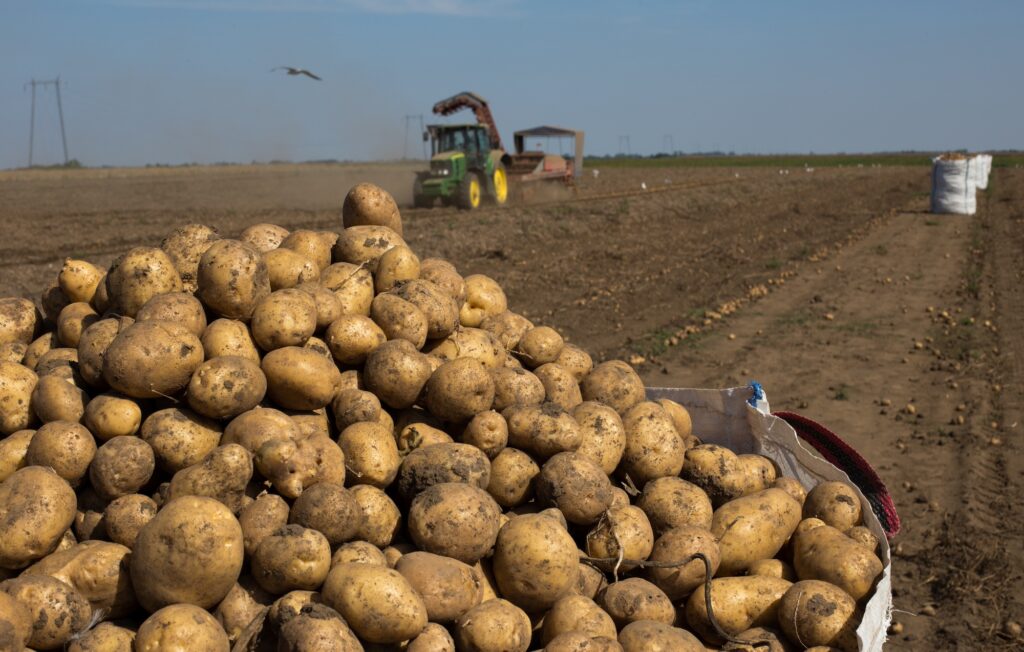
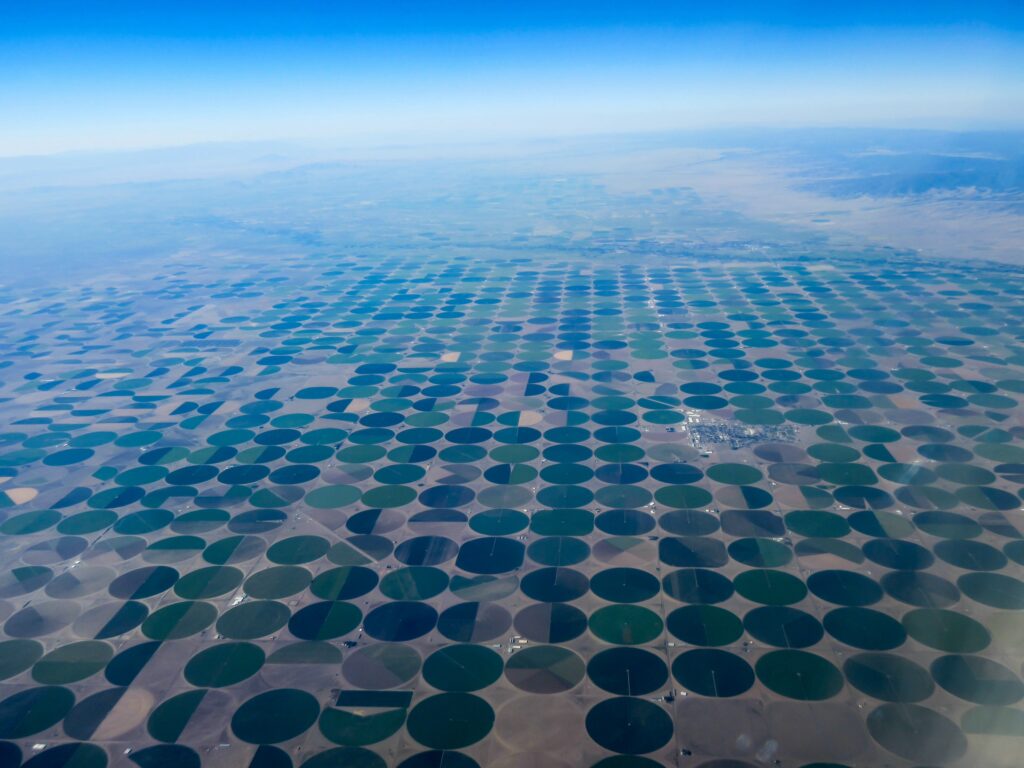
One way to do this is to increase crop productivity significantly compared to native ecosystems. Irrigation can do this. Although not considered a regenerative practice, irrigation can increase crop productivity, allowing some systems to surpass the productivity of the natural ecosystems they replaced. This is especially true in arid regions, where low native biomass productivity—due to low precipitation levels – creates an opportunity for irrigated cropping systems to boost soil organic matter. In the western U.S., irrigation can raise SOM levels even with high-disturbance crops like potatoes or onions (Cochran et al., 2007).
The “Steak, No Potato” Approach
The other way to get to the SOM levels of natural ecosystems is to reduce the amount of exported food. This is what many regenerative livestock grazing systems do. Livestock-focused systems often outperform crop-based systems in restoring soil carbon because grazing operations export far less energy than annual crop systems, leaving more carbon to cycle back into the soil. However, this approach limits agricultural output to primarily meat. It’s a “steak, no potato” option — no Texas toast, not even green beans. For most operations growing crops, regenerative agriculture’s soil restoration goals are unrealistic.
The Trade-off that Feeds Us
With these exceptions, restoring soil organic matter to pre-clearance levels is unlikely in most situations. It’s the fundamental trade-off of agriculture: more food for us, less for the land. Since lower soil organic matter levels are an inherent constraint in producing food, we should adjust our expectations. It’s not very encouraging to set an unachievable standard. How much lower depends on many factors, but to give us a ballpark idea, we can go back to our calculations.
Assuming equal biomass production X from both crops and nature, we have 0.9X coming from nature, and 0.1X – 0.5X remaining from cropping systems depending on how much is harvested from crops. Based on plant biomass inputs, nature then has the potential for 1.8-9 times more soil organic matter than cropland. In other words, cropland SOM levels will be 11-55% of pre-clearance levels. These estimates are lower than long-term measurements in the US, Canada, UK, Australia, and Germany (Powlson et al. 2022), probably because crops can produce more biomass than nature in intensive farming. However, the results show the general story; reality demands we set our expectations lower.
The only treatment in the Broadbalk Experiment to increase SOC in continuous arable soil to a level similar to that found in woodland was the annual application of farmyard manure, but the very high annual application rate means that this must be regarded as an extreme experimental treatment, not a practical recommendation.
Powlson et al., 2022
A Better Comparison
Natural systems do not feed large populations, cropped systems do. Therefore, nature should not be a benchmark for cropped soils nor a goal for regenerative cropping systems. Cropped fields are not “degraded nature” but rather, a system designed to function differently. Instead, realistic goals should focus on soil health improvements achievable while producing large amounts of food.
For on-farm comparisons, an increase over time would seem to be a practical standard, taking into account all the factors that my calculations ignored: differences in biomass produced by different crops, soil texture, crop rotation, etc. And improving is still regenerating even if it does not reach the level of natural systems, systems that do not feed us.
All Perspectives from Andrew McGuire
References
Cochran, R.L., H.P. Collins, A. Kennedy, and D.F. Bezdicek. 2007. Soil carbon pools and fluxes after land conversion in a semiarid shrub-steppe ecosystem. Biol Fertil Soils 43(4): 479–489. doi: 10.1007/s00374-006-0126-1.
Janzen, H.H., K.J. van Groenigen, D.S. Powlson, T. Schwinghamer, and J.W. van Groenigen. 2022. Photosynthetic limits on carbon sequestration in croplands. Geoderma 416: 115810. doi: 10.1016/j.geoderma.2022.115810.
Maharjan, B., S. Das, and B.S. Acharya. 2020. Soil Health Gap: A concept to establish a benchmark for soil health management. Global Ecology and Conservation 23: e01116. doi: 10.1016/j.gecco.2020.e01116.
Panagos, P., N. Broothaerts, C. Ballabio, A. Orgiazzi, D. De Rosa, et al. 2024. How the EU Soil Observatory is providing solid science for healthy soils. European Journal of Soil Science 75(3): e13507. doi: 10.1111/ejss.13507.
Powlson, D.S., P.R. Poulton, M.J. Glendining, A.J. Macdonald, and K.W.T. Goulding. 2022. Is it possible to attain the same soil organic matter content in arable agricultural soils as under natural vegetation? Outlook Agric 51(1): 91–104. doi: 10.1177/00307270221082113.
Comments
Great article Andrew, as always. Intensive agriculture efficiently produces and exports abundant food. Natural systems cycle to produce nature.
A concern is that excellent farming practices have plateaued in their SOM production, given their high yields. Soil Health grading systems punish high achievers.
This paper deeply analyses the concept of SOM and helps to understand and compare the natural ecosystems to Cropped Ecosystem. I have liked the simple but valid expression of Carbon sequestration in natural grasslands as compared to cropped fields. In this article I was able to clearly understand SOM accumulation in natural ecosystems as compared to cropped ecosystems. I was also able to know some of the ” high disturbance crops I.e Potatoes and Onions