Perspectives
Practical insights and opinions from agriculture and natural resources experts—brought to you by the Center for Sustaining Agriculture and Natural Resources.
The Flawed Thinking Behind “Mimic Nature” in Crop Production
By Andrew McGuire, CSANR Senior Extension Fellow
Organic farming, regenerative agriculture, and agroecology all aim to mimic nature under the assumption that natural systems offer the best solutions to challenges in crop production. A recent special issue of the journal Outlook on Agriculture reviewed several such efforts. Developing perennial grains, using biodiversity for pest control, and achieving regenerative agriculture’s goal of restoring soils, all produced mixed results.
We should expect this because the mimic-nature strategy is the result of flawed thinking. First, in failing to recognize the fundamental differences between natural ecosystems and human-managed crop production. And second, in the approach’s appeal to nature, which assumes natural is inherently good.
There is a better way: test all potential solutions, keep what is useful.
“Return to Nature” meets reality.
We must continue to improve crop production but how should we do this? Organic farming, agroecology, and regenerative agriculture all look to nature for solutions because natural ecosystems have qualities we’d like to see in crop production: stability, tight nutrient cycling, etc. The papers in Outlook on Agriculture (open access, see links below) explore several of these “return to nature” efforts and highlight the limitations of the strategy.

Perennial grains don’t yield.
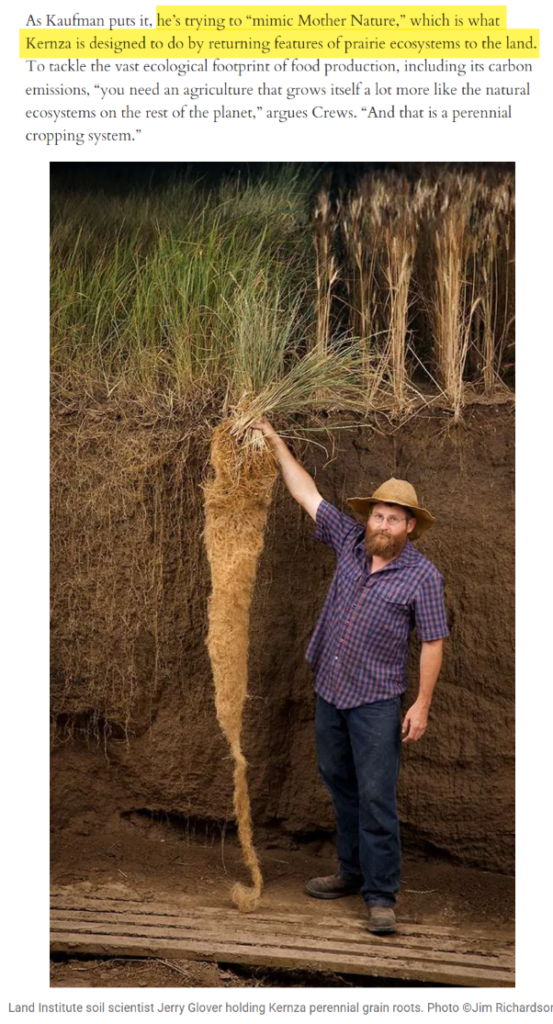
One approach has been to mimic the perennial polyculture of the prairie by developing perennial grain crops. The goal is to replace annual grain crops with perennial grain crops that both keep their perennial lifespan and produce grain yields similar to annual crops. Though efforts have been ongoing for 30+ years, this has only been recently achieved in rice. For a wheat replacement, the first commercial perennial grain, Kernza, has yields 1/3 that of wheat with declining growth after the first year (Cassman and Connor, 2022).
Loomis (2022) and others argue that this is because there is a basic trade-off between the carbon and nitrogen needs of the perennial plant and high grain yields; achieving one negates the other. So far, this is what grain breeders have found.
Based on reports published in refereed journals, we see little evidence that yield of Intermediate Wheatgrass or perennial wheats have improved to the point they are viable alternatives…Likewise, there is no evidence of a decrease in the severity of yield decline in the second and third years after crop establishment.
Cassman and Connor, 2022
Even if successful perennial grains are developed, there is another issue with this natural ecosystem mimicry. As Lenne and Wood (2022) point out, not all natural ecosystems are biodiverse. They present examples of natural monodominant stands of annual grasses, similar to our monoculture stands of grain crops. This undermines the assumption that because nature is biodiverse, higher diversity should always be a goal in crop production.
Pest control benefits of biodiversity are often too small, unreliable.
Nature’s biodiversity is also viewed as a superior way to manage crop pests. Van der Werf and Bianchi (2022) review the evidence for this and find that while there are many examples of reduced pest problems in intercrops, the level and reliability of this type of pest control is rarely equal to that of pesticides. The authors suggest that using biodiversity-based methods of pest control would only be feasible if society pays farmers for the higher risk of crop losses and pays more for food.
Furthermore, crop rotation (something which nature cannot do) can provide benefits similar to intercropping, but without the management complications of planting, weeding, harvesting, processing, and marketing involved with intercrops.
“The assumption that our agriculture must then mimic those processes would only be valid if natural ecosystems (including soil communities) had been selected for optimizing sustainable yield, for which there is no evidence.”
Pulleman et al. 2022
Restoring soil organic matter to nature’s levels is unrealistic.
The last example is not so much about mimicking nature as it is about using nature as a standard for fields producing crops. Regenerative agriculture aims to restore soils to their pre-agricultural state, specifically the level of soil organic matter (SOM) found in unmanaged soils. Powlson et al. (2022) examine this goal and find little to support it. Long-term studies in the US, Canada, UK, Germany, Ethiopia, Australia, and Chile show that soil organic matter levels under annual crop production are 38-67% pre-farming levels. While using regenerative agriculture practices may result in SOM levels at the high end of this range, basic energy flows prohibit reaching pre-agricultural levels unless yields are reduced.
…for the vast majority of situations globally, it is completely inappropriate to make this a goal for arable [annual cropping] soils as part of a climate change mitigation strategy based on soil carbon sequestration, or any other policy objective.
Powlson et al., 2022
Agriculture cannot be made into Nature.
These examples show the same flawed thinking in the mimic nature strategy: natural ecosystems cannot feed current populations, but crop production does. This is a logical “comparing apples to oranges” flaw called false equivalence. In comparing nature to agriculture, we are comparing different systems with different outcomes, so we should expect them to function differently. To produce food, crop production must work differently than natural ecosystems, which do not produce food. The three examples show how this plays out in different ways:
- Annual crops are not perennial because they put so much energy into their grain.
- To make food more edible for us, we have removed many anti-herbivore strategies from crops – thorns, toxins, etc. Then we fertilize them for high levels of nutritious food. Nature does not present this large, highly edible, high nutrient level source of food for pests.
- Attempting to restore natural soil conditions ignores the lower carbon/energy flows to the soil under crop production, and the nutrient exports, both required trade-offs in food production.
Further evidence for this flawed false-equivalence thinking is evident in the strategies of increasing biodiversity in general, cover crop mixtures, and the limited value of natural ecosystem research to agriculture.
The core problem is the idea that we can make crop production work like nature. This utopian desire is evident in the “epic narratives” (Cabral and Sumberg, 2022) of mimic-nature champions Masanobu Fukuoka, Wes Jackson, Robert Rodale, and Wendell Berry. Many, especially those outside of agriculture, have fallen for this enticing story, but it’s impossible. They are different systems with different benefits. Nature is valuable and we should protect it, but it provides little food. Crop production provides bountiful food, which sustains not just our population, but our art, sport, music, technology, etc. We focus on what was lost in the conversion to cropland, but look at what is gained.
Trying to make cropping systems work more like nature will nearly always reduce food production, or its reliability, or increase its cost. Because of this, even when we use methods gained from nature, we cannot expect anywhere near the same results because nature does not provide anywhere near the same amount of food, year after year. There are trade-offs, not win-wins. For these reasons, nature cannot be a consistent model for agriculture.
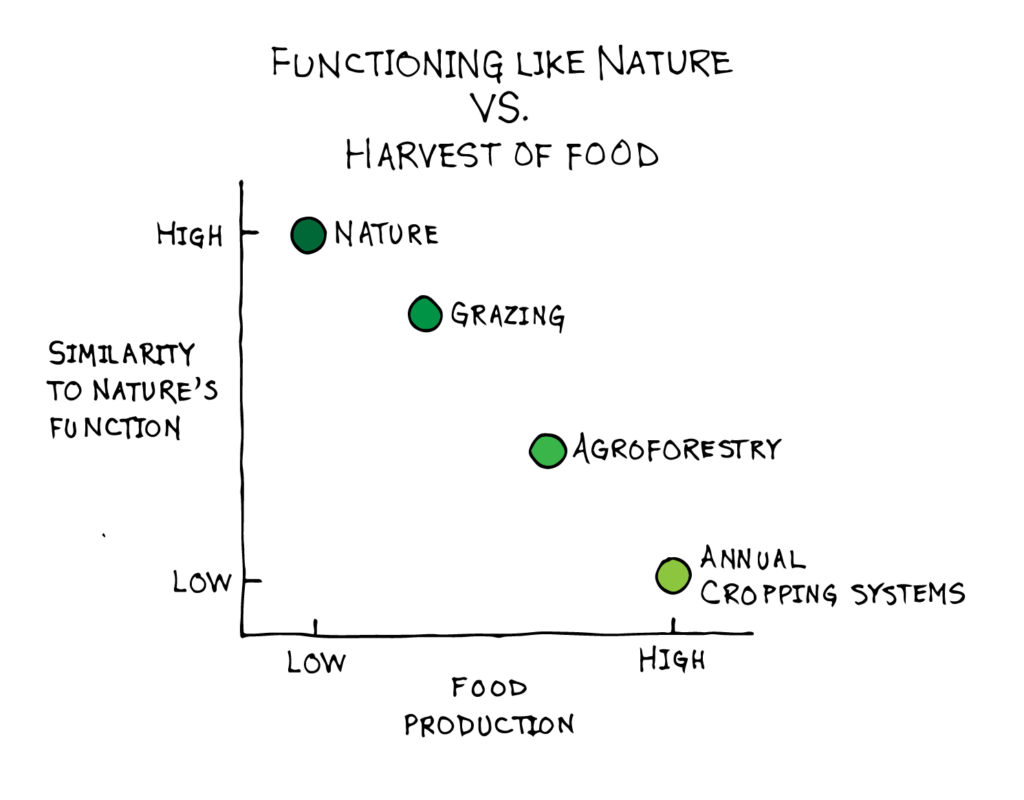
The thinking behind the mimic-nature approach reveals another flaw, its preference for natural solutions.
The flawed “appeal to nature” behind mimic-nature efforts
Beyond the desire to incorporate nature’s qualities into crop production, the mimic-nature strategy assumes we should prefer natural solutions. This is an “appeal to nature,” the flawed belief that since something is natural, it is also better or good. “Nature knows best” and “the balance of nature” are popular expressions of the idea. It can also be seen in bias against synthetic inputs, as found in organic farming’s ban on synthetic inputs, and in many versions of agroecology and regenerative agriculture.
There is nothing wrong with dividing natural and unnatural. It is a very useful distinction (Levinovitz, 2020). The problem comes when we attach a value to the distinction: natural is good or better than unnatural. Natural is not always better, nor unnatural/managed/synthetic/artificial worse, but this flawed thinking has influenced research and how we talk about solutions in agriculture.
Even if we can agree that some things are natural and some are not, what follows from this? The answer is: nothing. There is no factual reason to suppose that what is natural is good (or at least better) and what is unnatural is bad (or at least worse).
Baggini, 2004
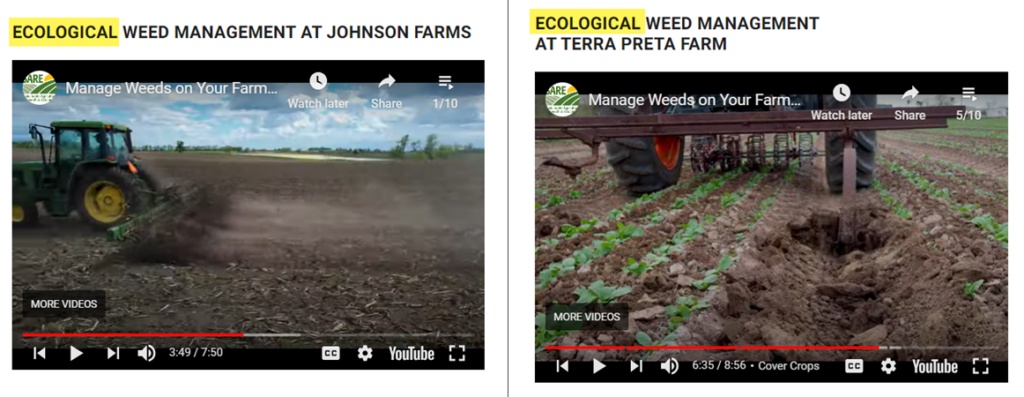
Ecology is the science that looks at the relationships between organisms and their environments. However, rather than this sphere of analysis, “ecological” and “agroecological” have become science-y ways of saying “natural.” This too is flawed appeal-to-nature thinking (Figure 4) and is not even consistent in its bias against synthetic inputs. Birthisel et al. (2021) includes plastic mulch, tarping, drip irrigation, tillage, fertilizer banding, and flaming under “ecological weed management,” everything except herbicides. Agroecology claims crop rotation, which is unnatural, as an ecological practice under the Diversity principle, yet herbicides are never included, even though allelopathy is natural. Driven by the appeal-to-nature fallacy, ecological and agroecological now imply values, assumptions, and prohibitions. Ecological can mean “green” or “natural” or “chemical-free” or a vague combination of these.
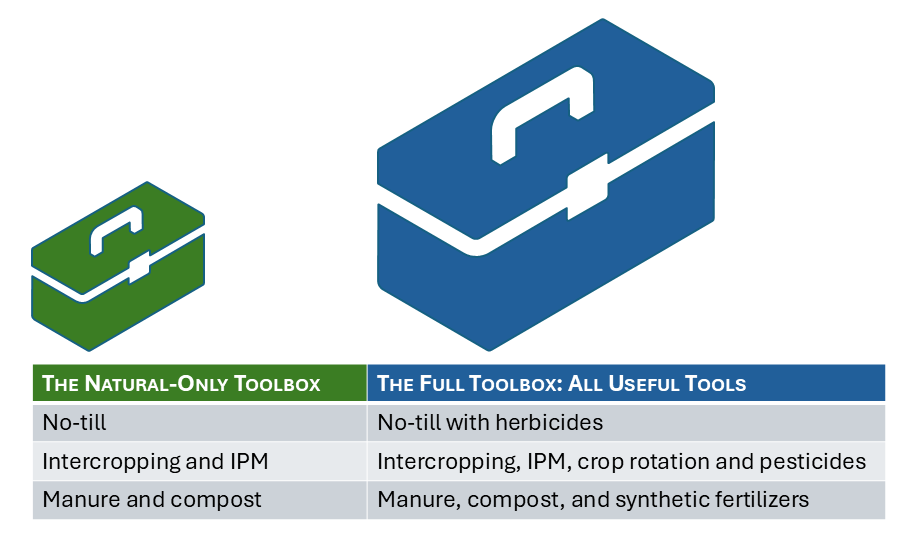
A better strategy: test everything, keep what is useful.
As Denison (2022) points out, selecting the useful aspects of nature and throwing out the rest is common, and proves the point that natural is not what we want; useful is what we want. “Copy what works.” When we find solutions in nature, we should use them without assuming that it works because we found it in nature or because it is natural. This whatever-works strategy is what we find, right now, in all modern “conventional” farming. It holds no bias for or against natural or unnatural; if it works and is cost-effective, it can be used. Conventional production is diversified by including both natural and unnatural methods and materials. Rather than conventional, I like the term full-toolbox farming; we shouldn’t let flawed thinking limit what we have in our toolbox.
All Perspectives from Andrew McGuire
References
Baggini, J. 2003. Making sense: philosophy behind the headlines. Oxford University Press, Oxford.
Birthisel, S.K., R.S. Clements, and E.R. Gallandt. 2021. Review: How will climate change impact the ‘many little hammers’ of ecological weed management? Weed Research 61(5): 327–341. doi: 10.1111/wre.12497.
Cabral, L., and J. Sumberg. 2022. The use of epic narratives in promoting ‘natural agriculture.’ Outlook Agric 51(1): 129–136. doi: 10.1177/00307270221077708.
Cassman, K.G., and D.J. Connor. 2022. Progress Towards Perennial Grains for Prairies and Plains. Outlook Agric 51(1): 32–38. doi: 10.1177/00307270211073153.
Denison, R.F. 2022. Copy competitively-tested adaptations of wild species, maybe, but not natural ecosystems tested only by persistence. Outlook Agric 51(1): 46–54. doi: 10.1177/00307270221076530.
Lenné, J., and D. Wood. 2022. Monodominant natural vegetation provides models for nature-based cereal production. Outlook Agric 51(1): 11–21. doi: 10.1177/00307270221078022.
Levinovitz, A. 2020. Natural: How Faith in Nature’s Goodness Leads to Harmful Fads, Unjust Laws, and Flawed Science. Beacon Press.
Loomis, R.S. 2022. Perils of production with perennial polycultures. Outlook Agric 51(1): 22–31. doi: 10.1177/00307270211063910.
Powlson, D.S., P.R. Poulton, M.J. Glendining, A.J. Macdonald, and K.W.T. Goulding. 2022. Is it possible to attain the same organic matter content in arable agricultural soil as under natural vegetation? Outlook Agric 51(1): 91–104. doi: 10.1177/00307270221082113.
Pulleman, M.M., W. de Boer, K.E. Giller, and T.W. Kuyper. 2022. Soil biodiversity and nature-mimicry in agriculture; the power of metaphor? Outlook Agric 51(1): 75–90. doi: 10.1177/00307270221080180.
van der Werf, W., and F. Bianchi. 2022. Options for diversifying agricultural systems to reduce pesticide use: Can we learn from nature? Outlook Agric 51(1): 105–113. doi: 10.1177/00307270221077442.
Comments
I love reading this blog posts and seeing how they build and connect to each other. Thank you.
When I was in highschool, I did switch side debate. I learned that the person who can write the best critique of a position can often also write the best defense of it.
I would love to see your version of “What mimicing nature gets right when it comes to crop production” blog post, just to see what lines of thinking you feel are stronger than others as they relate to the scientific evidence.
Jesse, thanks for the comments. I have switched sides in the sense that I used to believe the “mimic nature” line. I’ve seen Wes Jackson and Wendell Berry speak, and they both have enticing messages, but I’ve come to believe that enticing as they are, they are flawed. See if this paper I co-authored is what you are looking for, https://www.sciencedirect.com/science/article/abs/pii/S2211912414000601
Thanks for the article.
Didn’t realize Denison works at UMN st paul, he’s probably a 10 min walk from me. Small world.
I appreciate the articles concrete recommendations for what agricultural research should focus on at the end.
All this is fun to think about, at least while there’s time for it in the winter…
I love you Andrew McGuire! Love the work you do and making us all be better critical thinkers!
Even from the distance of the UK, this article (and the comments) is a welcome contribution. The next step is to build on the philosophy. Nature is not the solution but understanding it better might be a worthwhile component.
More philosophically, there may be less financial incentive for the industry supporting the farm to promote nature-based solutions and this is perhaps a system weakness. Less expertise is needed to sell a can with a more effective active ingredient than a solution demanding a change in management with a higher risk and fewer externalities. More effort. and thus more cost, has to be expended to sell the complex solution even if it is more cost-effective for the farmer.
Hi Simon. Thanks for the comments. I think I can agree with what you wrote. It’s a complicated issue full of the tradeoffs inherent to agriculture.
Thanks Andy. I’ve missed your clear thinking and explanations. I agree that the purpose of agriculture is to produce good food efficiently and profitably. We don’t sell or eat root mass or SOM. Producing these two reduces the photosynthate energy available for food production. May God increase your tribe.
Interesting read! Two pro-food articles in a week, maybe in 2025 we are going to appreciate the marvel of widely available, inexpensive food a little more! Go Cougs!
If you are curious:
https://www.nytimes.com/2024/12/13/opinion/food-agriculture-factory-farms-climate-change.html
Hi Jeannie. Regarding your statement about 2025, we can only hope.
The rhetoric of this article does little advance innovation, which is what I want agronomy to do. I understand that people want to jump off the merrygoround and return to conventional practices, which is our right. You are advising in so many words that the Land Institute and others working on perennial polyculture are wasting our time. The annual grains we have are the product of 10,000 years of selective breeding. It matters little that you consider 40 years of perennial grain breeding to be enough. All science fails forward over and over. So what if it takes 500 years? I expect better from acadamia.
Hi Jim, thanks for the comments. My goal was not to advance innovation but to clear up some misconceptions. Regarding the Land Institute’s efforts, I have seen Wes Jackson speak twice, to standing ovations, but he fails to address the basic trade-offs between annuals and perennials in those talks. Also, he never mentioned 500 years, but a decade or two, because an advance that is 500 years out is very risky.
I would encourage anyone interested in or skeptical about perennial grains to read this article, which addresses and discusses the points selected from the Cassman, and Loomis articles.
https://landinstitute.org/wp-content/uploads/2023/06/1-s2.0-S0048969723035982-main.pdf
A note for the author, the quote attributed to Pulleman et al. (2022) is from the abstract of the Cassman and Connor (2022) article.
The quote from Pulleman et al. is correct.