Perspectives
Practical insights and opinions from agriculture and natural resources experts—brought to you by the Center for Sustaining Agriculture and Natural Resources.
Dominant Factors: What Actually Builds Soil Organic Matter
By Andrew McGuire, CSANR Senior Extension Fellow
A new study suggests soil organic matter depends less on farming labels and more on the dominant drivers: plant biomass, nutrient availability, crop rotation, and tillage.
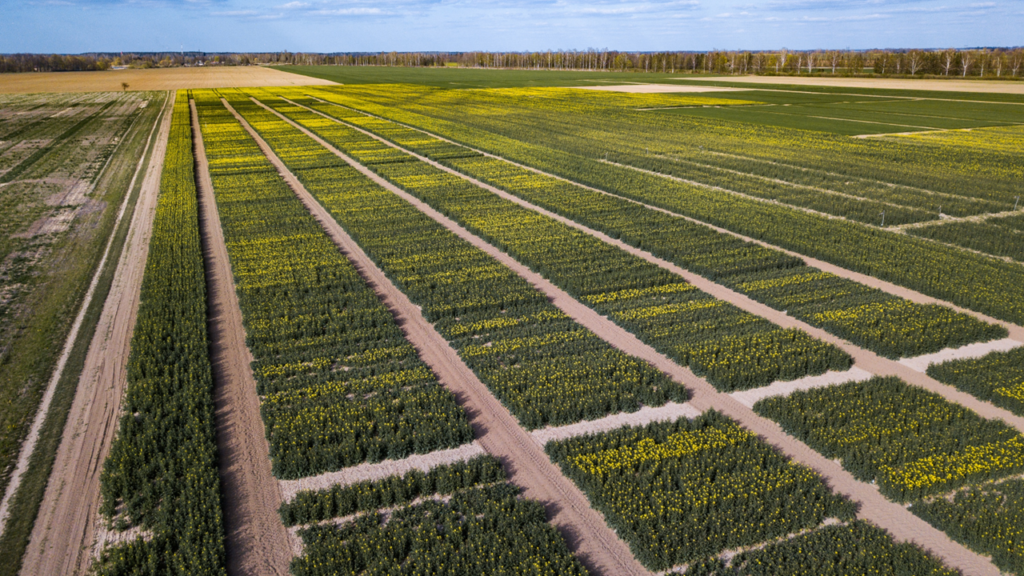
The common way to answer this question is to conduct a field plot experiment with organic and conventional treatments. It is often assumed that since organic farms cannot use synthetic fertilizers, they use more organic amendments or incorporate more livestock in their farming. So the treatments would usually be something like this:
- Organic production: no synthetic pesticides or fertilizers, but including organic amendments.
vs.
- Conventional: same crops, but with synthetic pesticides and fertilizers and no organic amendments.
The treatments are applied for a number of years, and then the soil is sampled to see what has changed. Because soil organic matter is strongly related to soil health, it is the key observation for determining whether organic or conventional practices are better for soil health.
Research results from such field experiments, both short- and long-term, have found that organic farming produces higher soil organic matter levels (Aguilera et al., 2013; Alvarez, 2022a; Bai et al., 2018; Gattinger et al., 2012; Smith et al. 2019). Decades of organic food marketing has repeated this message. The Don et al. study reminds us that seemingly answered questions are always worth revisiting.
Farms vs field experiments
Rather than using the field plot experiment approach to answer this question, Don et al. (2025) used two soil datasets, with 2159 (99 organic) and 811 (464 organic) sites, from actual farms in Germany. Contrary to past research, their analysis of these datasets found no difference in soil organic matter levels between organic and conventional farms.
Croplands under organic farming showed neither higher SOC content nor higher SOC stocks compared to those under conventional farming in both data sets.
Don et al. 2025
On the organic farms, the authors found the reverse of the soil health process we started with. Rather than optimized photosynthesis driving plant biomass inputs driving soil organic matter levels, they suspect that lower nutrient availability—probably nitrogen—led to lower crop yields and therefore, lower plant biomass inputs to the soil. And most importantly, organic and conventional farms had similar levels of organic amendments. These dominant factors determined the outcome.
Contrary results can be due to problems with the methods, or a fluke, or they can reveal something important. I am not qualified to review their analysis, models, or statistics. All I can say is that the methods seem robust, with one dataset used to verify the model based on the other dataset, and with the use of bias corrections and climate and soil corrections.
It could be that these results only apply to farms in Germany. However, organic standards are the same across the European Union and are more comprehensive than in most other countries. Also, the EU is very supportive of organic farming, aiming to have 25% of the land under the system by 2030. It is probably not a fluke, especially because there is a convincing explanation for the contrary results.
Dominant drivers of soil organic matter
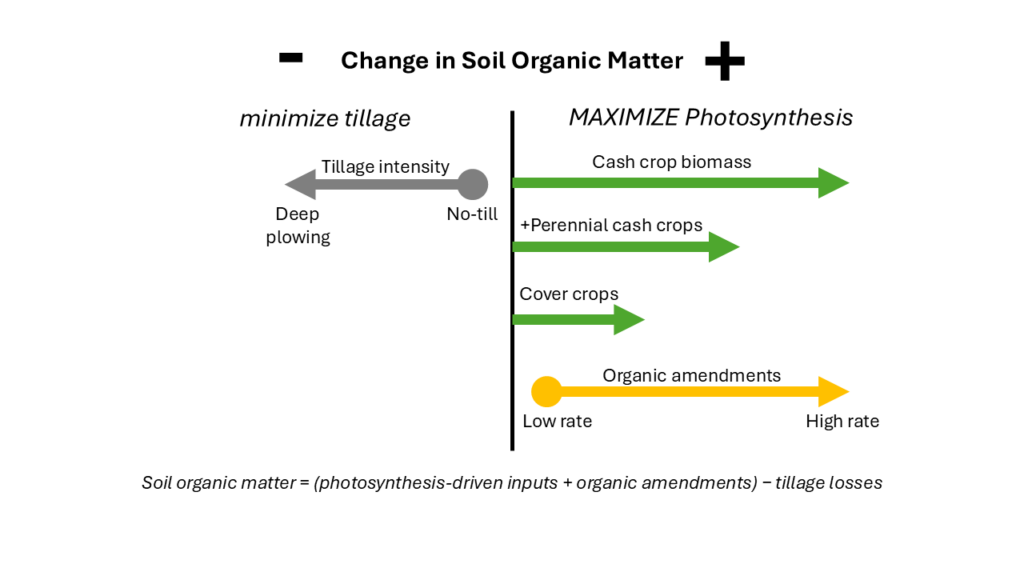
The main positive driver of soil health is plant biomass input, from whatever source, and the main negative driver is tillage (See Two Principles for Managing Soil Health). These strong causal drivers can mask weaker contributing factors.
Differences in plant biomass inputs can be due to several factors: organic amendments, crop rotation, and crop yields.
Similar levels of organic amendments
The assumption that organic farms use more organic amendments or incorporate more livestock than conventional farms did not hold for the actual organic farms in this study (Don et al. 2025):
- Use of organic fertilizers: “The amount of organic fertilizer applied was comparable between organic farming and conventional farming.” And “A comparable fraction of sites in both farming systems received no organic fertilizer at all: 33% of organic and 28% of conventional croplands.
- Livestock on farms: “The proportion of farms without livestock was also comparable, with 29% in organic farming and 32% in conventional farming.”
One of the most repeated results in agronomic science is that the use of manure, compost, or other organic amendments will increase soil organic matter better than synthetic fertilizers (Maillard & Angers, 2014). So, in traditional field plot experiments comparing organic and conventional farming, organic farming wins, at least for soil building, because the organic plots receive manure or compost, and the conventional plots do not. Yet despite the proclamations of organic farming as superior, it is the practice of applying organic amendments that gives the soil-building benefit and not organic farming itself.
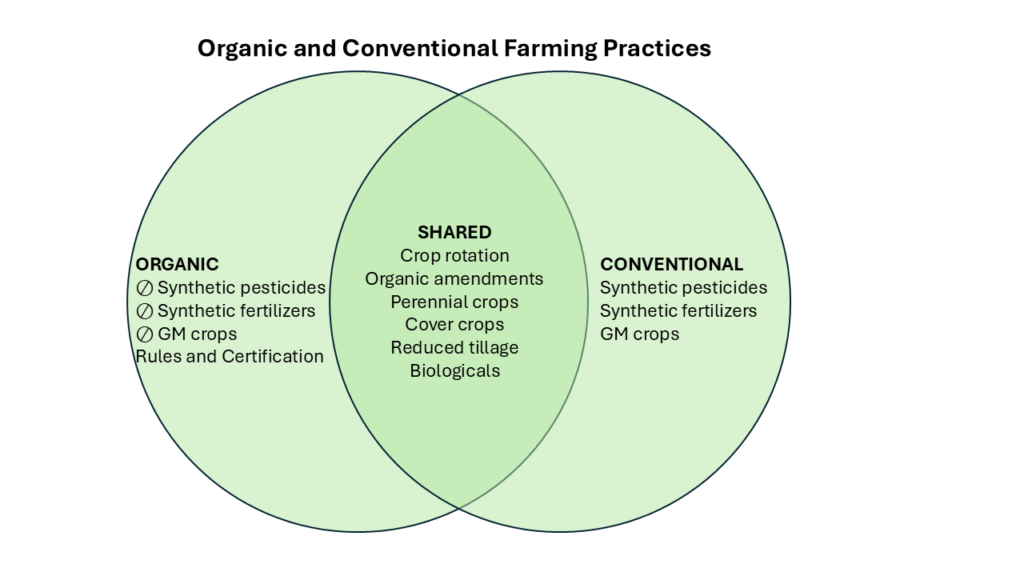
Don et al. (2025) did not use the idealized treatments found in most field plot experiments, but instead looked at actual farms. The results reveal that organic farming is unique in its ban of synthetic fertilizers and pesticides (McGuire, 2017), not in its use of organic amendments. Conventional farms can and do use organic amendments, and when they do, they can build soil just as well as organic farms.
Yields and nitrogen
Crops grown in the field are the primary source of biomass for building soil organic matter. They are also the source of the organic material in organic amendments like manure and compost (See Can Manure Sustain Soils?). For both crops and organic amendments, the application rate matters. With cash crops, the application rate is the biomass yield, which is directly related to the harvested yield through the harvest index. In the Don et al. study, the yield advantage goes to conventional farms:
This leads to a cascade of effects. A lower supply of available nitrogen leads to lower crop yields, which leads to less biomass input to the soil, which leads to lower soil organic matter levels, all other things being equal.
The authors of Don et al. (2025) mention an interesting study ongoing in Germany that compares a modified organic system using synthetic fertilizers to conventional production. In the first results from that study, the use of fertilizers reduced the yield gap, but not completely, indicating that it is more than just nutrient deficiencies reducing yield on organic farms (Class-Mahler et al. 2023).
Crop rotation, cover crops, and weeds
Differences in plant biomass inputs can also result from differences in crop rotation, cover crops, and weeds. Here, Don et al. (2025) find that organic farms have the advantage but are again hindered by crop yields:
Crop rotations: “Another key management factor is the crop rotation with the proportion of SOC-depleting (e.g. potatoes and sugar beet) and SOC-enhancing crops (e.g. clover grass and forage legumes). In organic farming, the proportion of SOC-enhancing crops was significantly higher in the crop rotations than in conventional farming.”
Cover crops: “In organic farming, cover crops were cultivated in 14% of the crop-years and in conventional farming in 11% of the crop-years.” Because they are often grown when temperature and light are not conducive to high biomass production, the biomass produced by cover crops is not often a driving force for soil organic matter. The slight difference here is probably even less than it appears.
So, the study found that organic farms had better rotations for building soils; more grass/clover and perennial forage legumes, and used slightly more cover crops. However, due to the overall finding on soil organic matter, the authors suspect this advantage was negated by lower crop yields.
Weeds: Plant biomass input is important, regardless of the source. The authors noted that the higher weed production on organic farms (Mwangi et al., 2024) could be an overlooked and plentiful source of biomass carbon, which can increase soil carbon.
“Weed biomass is a largely unaccounted C input to the soil. A yield reduction due to heavy weed pressure is therefore not always necessarily a disadvantage from a SOC perspective.” Don et al. (2025)
But as with the crop rotation advantage, it did not push soil organic matter levels on organic farms higher than those on conventional farms.
Tillage?
Surprisingly, the study did not mention tillage. Perhaps the dataset did not include tillage. However, since organic farming cannot use synthetic herbicides, it relies on more tillage for weed control in crops than conventional farming. In field experiments, the use of organic amendments more than makes up for this tillage in organic systems.
System results reflect practices
All of this makes sense. With similar levels of plant biomass inputs, including organic amendments, soil organic matter levels are similar in conventional and organic systems. The use or non-use of synthetic pesticides did not negate the dominant factors here; whichever system has the most positive balance of plant biomass inputs minus tillage losses is going to have the most soil organic matter. Dominant factors are dominant, whether the farm uses organic or conventional practices.
Broader application
Do the results of Don et al. apply more broadly? Yes, since the results are driven by universal factors in crop production—nitrogen, plant productivity, crop rotation—they should apply to most locations. In other research, when organic and conventional farms with similar rates of organic amendments were compared, the results were similar (Alvarez, 2021).
The results of field experiments often hinge on the use of high rates of organic amendments. However, the supply of organic amendments is limited, especially for high application rates. Because organic amendments are generally a concentration of plant biomass from a larger to a smaller area, there is not enough manure, compost, or other organic amendments to go around. The rates of organic amendments that increase soil organic matter are not scalable to all croplands. Those with access benefit; those without will have to manage with lower soil health.
Agrophysics and an expanded Liebig’s Law
What’s all this mean for your management? Back to agrophysics. The determining factors here are not new. However, today it is so easy to be distracted and diverted into optimizing factors that are not limiting. What can help you avoid enticing but unproductive pursuits? I suggest an expanded Liebig’s Law, one which addresses the agrophysics of crop production.
Liebig’s law of the minimum is well known for nutrients: crop growth is limited by the essential nutrient that is in the shortest supply relative to the plant’s needs, even if all other nutrients are abundant. This focuses management on the limiting nutrient, then the next limiting and so on. An expanded Liebig’s Law applies the idea to the controlling factors of soil health. Why focus on soil biology, cover crop mixtures, or soil inoculant products when biomass input is your limiting factor?
If your crop biomass inputs are low because your yields are low because your nitrogen is insufficient, that is your minimum. Fix that first. Or is crop rotation or tillage intensity your limiting factor? Focus on what matters: the big universal drivers, to get the most from your management of both crops and soil.
Here is Liebig’s law of the minimum for management: identify the limiting factor first, because optimizing anything else while that constraint remains is wasted effort. That is agrophysics in practice.
Want to read the Don et al. paper? It’s open access.
1 Yes, agronomists can have physics envy. In college, I toyed with studying physics, although not astrophysics, the inspiration for this term.
References
Aguilera, E., Lassaletta, L., Gattinger, A., & Gimeno, B. S. (2013). Managing soil carbon for climate change mitigation and adaptation in Mediterranean cropping systems: A meta-analysis. Agriculture, Ecosystems & Environment, 168, 25–36.
Alvarez, R. (2021). Organic farming does not increase soil organic carbon compared to conventional farming if there is no carbon transfer from other agroecosystems. A meta-analysis. Soil Research, 60(3), 211–223.
Alvarez, R. (2022). Comparing Productivity of Organic and Conventional Farming Systems: A Quantitative Review. Archives of Agronomy and Soil Science, 68(14), 1947–1958.
Bai, Z., Caspari, T., Gonzalez, M. R., Batjes, N. H., Mäder, P., Bünemann, E. K., de Goede, R., Brussaard, L., Xu, M., Ferreira, C. S. S., Reintam, E., Fan, H., Mihelič, R., Glavan, M., & Tóth, Z. (2018). Effects of agricultural management practices on soil quality: A review of long-term experiments for Europe and China. Agriculture, Ecosystems & Environment, 265, 1–7.
Class-Mahler, I., Zimmermann, B., Hermann, W., Schwarz, J., Piepho, H.-P., Lewandowski, I., Kehlenbeck, H., & Bahrs, E. (2023). Yield Potential of Cropping Systems without Chemical Synthetic Plant Protection Products in NOcsPS field trials in Germany. Landbauforschung, 72(1).
Don, A., Brügge, K., Emde, D., Aiteew, K., & Poeplau, C. (2025). No detectable elevated soil carbon under organic farming in German croplands − results from two soil surveys. Geoderma, 464, 117634.
Gattinger, A., Muller, A., Haeni, M., Skinner, C., Fliessbach, A., Buchmann, N., Mäder, P., Stolze, M., Smith, P., Scialabba, N. E.-H., & Niggli, U. (2012). Enhanced top soil carbon stocks under organic farming. Proceedings of the National Academy of Sciences, 109(44), 18226–18231.
McGuire, A. M. (2017). Agricultural Science and Organic Farming: Time to Change Our Trajectory. Agricultural & Environmental Letters, 2(1).
Mwangi, O., Mucheru-Muna, M., Kinyua, M., Bolo, P., & Kihara, J. (2024). Organic farming practices increase weed density and diversity over conventional practices: A meta-analysis. Heliyon, 10(12).
Smith, O. M., Cohen, A. L., Rieser, C. J., Davis, A. G., Taylor, J. M., Adesanya, A. W., Jones, M. S., Meier, A. R., Reganold, J. P., Orpet, R. J., Northfield, T. D., & Crowder, D. W. (2019). Organic Farming Provides Reliable Environmental Benefits but Increases Variability in Crop Yields: A Global Meta-Analysis. Frontiers in Sustainable Food Systems, 3.
Van Rijssel, S. Q., Koorneef, G. J., Veen, G. F. (Ciska), Pulleman, M. M., De Goede, R. G. M., Comans, R. N. J., Van Der Putten, W. H., & Mason-Jones, K. (2025). Conventional and organic farms with more intensive management have lower soil functionality. Science, 388(6745), 410–415.
Comments